Two weeks after the Supreme Court declared the IEEPA tariffs illegal, and two days after the Federal Circuit issued its mandates returning the case to the trial court, U.S. Customs and Border Protection was still liquidating import entries with the unlawful duties baked in. No refunds had been issued. White House controlled CBP Automated Commercial Environment system kept churning through previously filed entries as if Learning Resources, Inc. v. Trump, 607 U.S. ___ (2026), had never happened.
In Atmus Filtration, Inc. v. United States (Ct. Int’l Trade Mar. 4, 2026), Judge Richard Eaton issued an order that goes well beyond the individual case before him. Eaton declared that “all importers of record whose entries were subject to IEEPA duties are entitled to the benefit of the Learning Resources decision” and directed CBP to liquidate all unliquidated entries “without regard to the IEEPA duties.” For entries already liquidated but not yet final, CBP must reliquidate on the same terms. The order applies regardless of whether an importer has filed its own complaint. To hold otherwise, Judge Eaton wrote, “would be to thwart the efficient administration of justice and to deny those importers who have filed suit the efficient resolution of their claims, and to deny entirely importers who have not filed suit the benefit of the Learning Resources decision.” The CIT’s Chief Judge has designated Eaton as the sole judge for all IEEPA refund cases, and Eaton has scheduled a closed conference for March 6 at which the government must present a plan for administering refunds without requiring each of the thousands of affected importers to file individual complaints.
The U.S. Court of International Trade (CIT) is an Article III federal court with exclusive jurisdiction over civil actions arising from federal laws governing import transactions, tariffs, and international trade. 28 U.S.C. § 1581. Located in New York City, the CIT has nine judges appointed by the President and confirmed by the Senate. There is a difference with other Federal Courts that by statute, no more than five of the nine judges may belong to the same political party. The court functions as a specialized trial court, and its decisions are appealed to the U.S. Court of Appeals for the Federal Circuit. The CIT's jurisdiction includes challenges to customs duties, trade adjustment assistance, and certain agency determinations by the International Trade Commission and the Department of Commerce.
The order is striking for several reasons. The Supreme Court’s February 20 opinion held that IEEPA does not authorize the President to impose tariffs, but it said nothing about refunds, timelines, or administrative mechanics. See Dennis Crouch, Forthwith: Federal Circuit Issues Mandates in V.O.S. Selections, Clearing the Way for $175 Billion Refund Reckoning, Patently-O (Mar. 2, 2026). The Federal Circuit’s per curiam mandate order on March 2 declined the government’s request for a 90-day stay and sent the case back to the CIT, but it likewise prescribed no specific remedy. That left the CIT as the institution responsible for translating a constitutional ruling into an operational refund process covering an estimated $175 billion in collections. Judge Eaton has now taken the first concrete step, and it is a broad one.
The extension of relief to non-litigants is the most legally aggressive feature of the order. More than 2,000 importer lawsuits are pending at the CIT, but thousands more importers paid IEEPA duties without filing suit. Eaton’s reasoning rests on the CIT’s nationwide jurisdiction and the nature of the Supreme Court’s ruling: because the tariffs were held to exceed presidential authority as a matter of statutory interpretation, every importer who paid them was harmed by the same legal error. Requiring each to file a separate complaint would multiply litigation costs, burden the court’s docket, and produce identical outcomes in case after case.
Judge Eaton’s order also confronts a threshold objection head-on. Last year, in Trump v. CASA, Inc., 606 U.S. 831 (2025), the Supreme Court held that “universal injunctions are impermissible.” Eaton reasoned that CASA does not control here. The Supreme Court’s analysis in CASA addressed whether federal courts possess equitable authority under the Judiciary Act of 1789 to issue orders binding non-parties. But the CIT was established nearly 200 years later under the Customs Courts Act of 1980, Pub. L. No. 96-417, and Congress gave it both national geographic jurisdiction and exclusive subject matter jurisdiction over import-related claims. 28 U.S.C. § 1581. The Supreme Court itself acknowledged that exclusivity in Learning Resources, agreeing that these claims fall within the CIT’s exclusive jurisdiction. Eaton’s logic follows from that structure: if no other court can hear these claims, then an order directing CBP to liquidate all affected entries without IEEPA duties does not bind parties in some other forum. It is not an impermissable universal injunction; it is the only court with jurisdiction doing its job. Eaton reinforced the point with the Uniformity Clause, U.S. Const. art. I, § 8, cl. 1, which requires that “all Duties, Imposts and Excises shall be uniform throughout the United States.”
Based upon prior statements from President Trump and the Treasury Secretary, they will likely appeal as a mechanism to delay repayment for as long as possible. Secretary Bessent stated publicly that refunds would not issue until the CIT ordered them, and President Trump suggested the refund question would “get litigated for the next two years.” The government has 60 days to appeal to the Federal Circuit, and a motion to stay the order pending appeal seems almost certain given the scale of the refund obligation and the contested question of whether a single CIT judge can direct CBP to provide relief to importers who are not parties before the court.
]]>Last week, the ITC issued a limited exclusion order in a dispute between GoPro, Inc. and Arashi Vision, Inc. (d/b/a Insta360). The order covered “certain cameras and camera systems” which, in the Commission’s view, infringed U.S. Patent No. D789,435. In reaching this conclusion, the ITC appears to be requiring a much lower standard of visual similarity than the Federal Circuit does.
In deciding that the D’435 patent was infringed, the Commission affirmed—without further discussion—the finding of infringement in the Initial Determination that was issued by ALJ Doris Johnson Hines on July 10, 2025. In that decision, Judge Hines seems to have been persuaded to not only require a lower overall level of similarity than the Federal Circuit currently requires, but to also effectively ignore several claimed design elements, disregarding them as visually “minor,” “trivial,” or otherwise unimportant.
It is true that there is a longstanding line of Federal Circuit cases saying that “minor differences between a patented design and an accused article’s design cannot, and shall not, prevent a finding of infringement.” See Litton Sys., Inc. v. Whirlpool Corp., 728 F.2d 1423, 1444 (Fed. Cir. 1984). But that doesn’t—and shouldn’t—mean that a judge (or a jury) can completely read claimed visual elements out of a design patent claim. (For more on how I’m using the word “element” here, see Intelligent Design & Egyptian Goddess, 68 Duke L.J. Online 94, 109 (2019)).
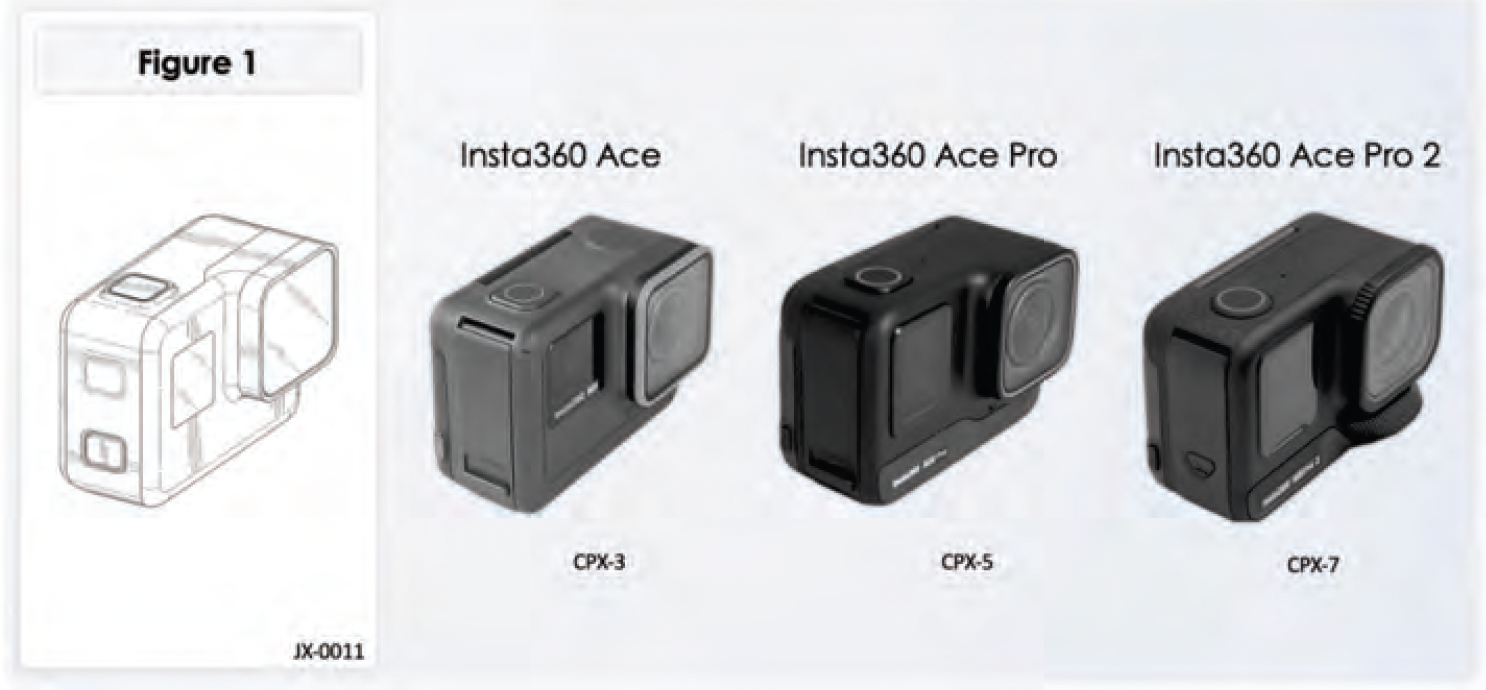
For example, consider this image (from GoPro’s expert report) that Judge Hines included in her decision:

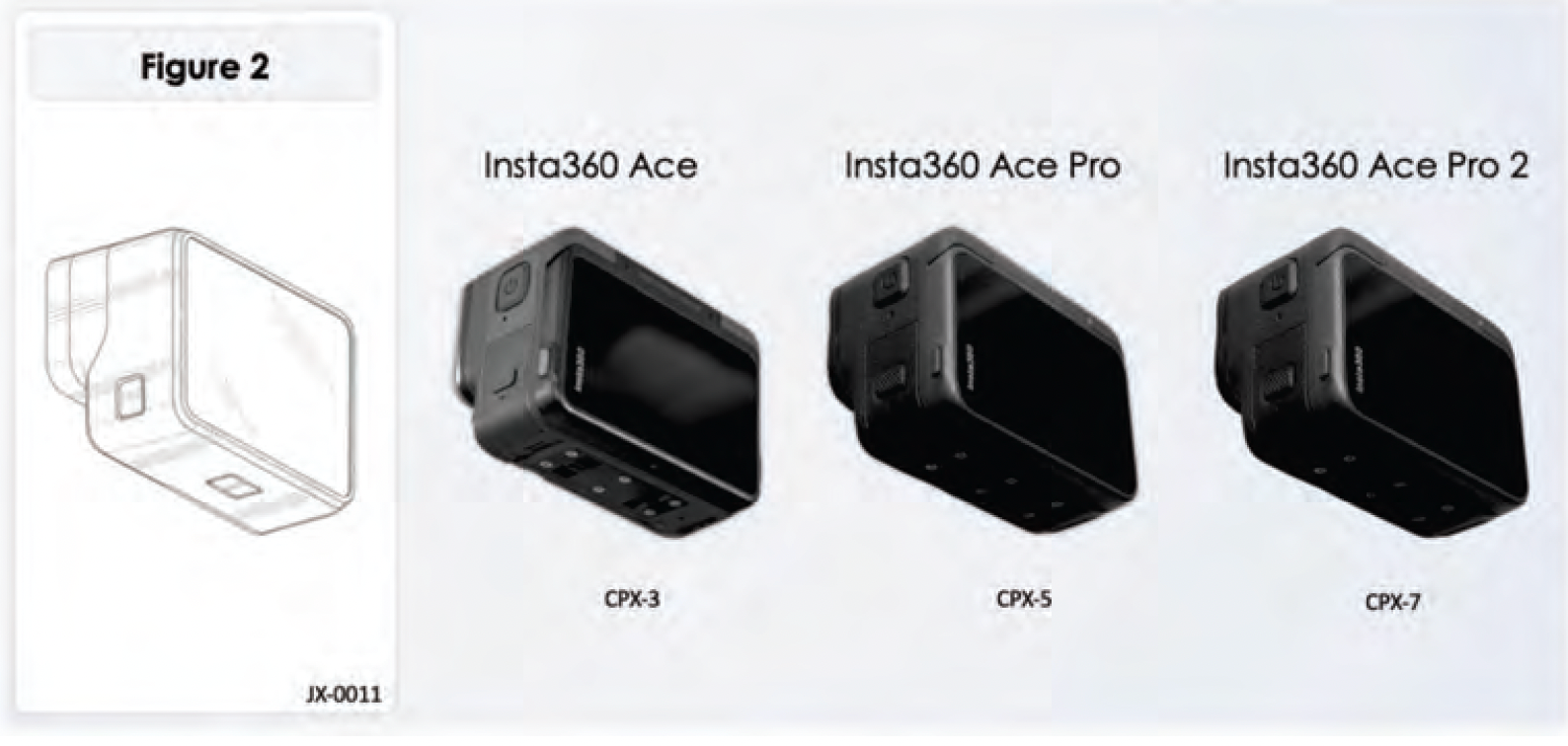
The image quality in the decision isn’t great but if you look at the patent, that lower square side button is shown in solid lines, which means it’s part of the claimed design. That button doesn’t appear at all in any of the accused products. On the other side, the accused products include buttons where the patent claims a smooth surface:

GoPro’s expert suggested—and the ITC seems to have agreed—that these were unimportant visual features.
But if they were so unimportant, why were they claimed?
It’s one thing to say that a corresponding button differed from a claimed button in a minor way. But it’s an entirely different thing to say that the patentee can essentially erase claimed elements when it comes to infringement.
That’s especially true in our post-Zahn world. See How Design Patent Law Lost Its Shape, 41 Cardozo L. Rev. 555, 556 (2019). In a world where a design patent applicant can pretty much claim—or disclaim—whatever they want, they should be held to what they choose to claim. If GoPro wanted to claim just the major contours of the camera as it’s “design,” it could have. But it did not. And presumably, it did not for good reason.
GoPro claimed narrowly and it should be held to that narrow scope. If the buttons don’t matter, GoPro didn’t have to claim them. But they did. Accordingly, those visual elements need to be considered when analyzing infringement. That’s what it means to look to the “whole design” when analyzing design patent infringement.
This isn’t copyright, with its fragmented literal similarity and “total concept and feel” tests. A design patent owners shouldn’t be able to treat their claim as a nose of wax, showing a narrow claim to the examiner and then stretching the scope when they argue infringement. Cf. White v. Dunbar, 119 U.S. 47, 51 (1886).
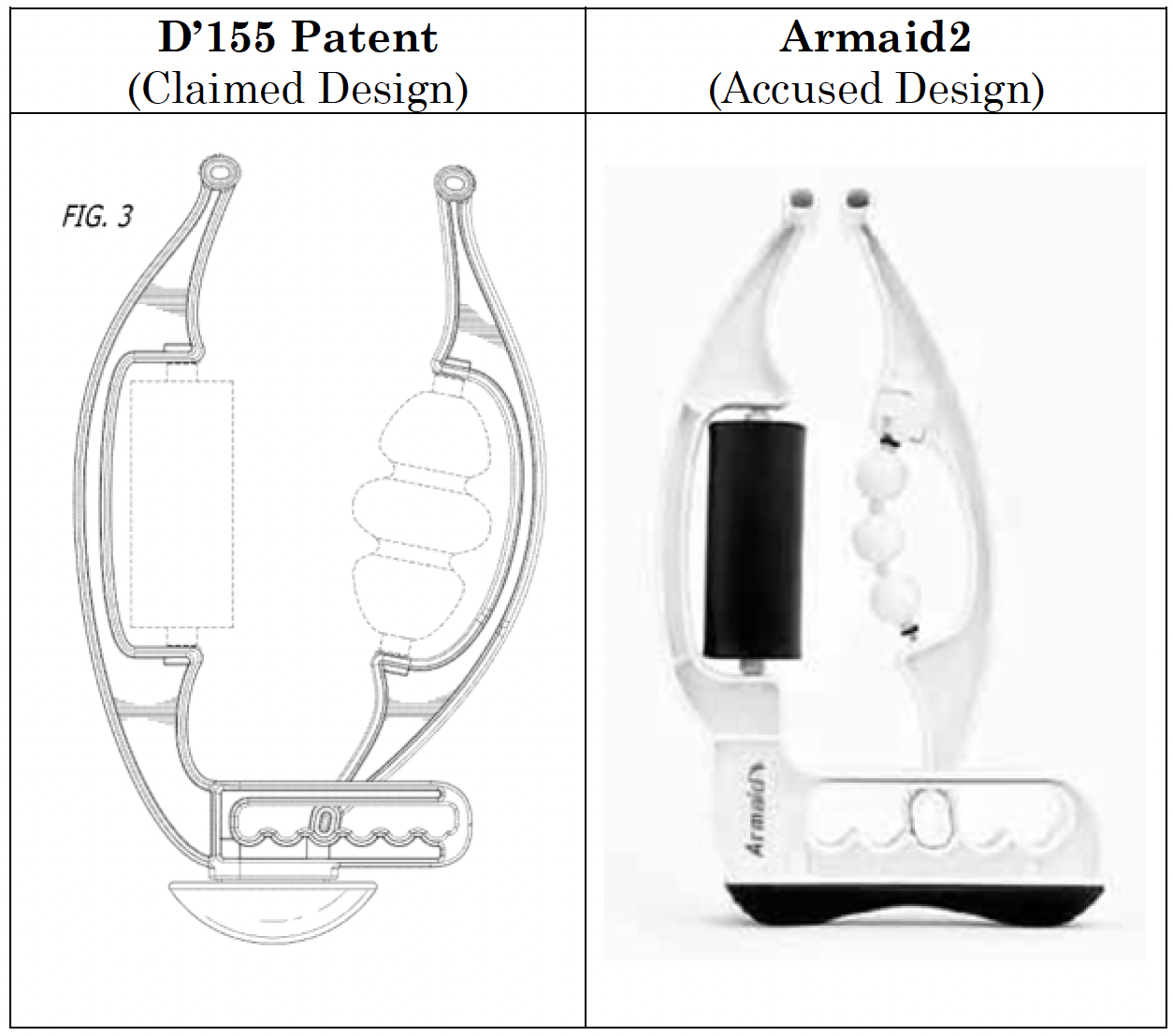
In a way, this is similar to the situation in the recent Armaid decision:

These designs only look substantially similar, overall, if one ignores the claimed shape of the base. Perhaps the other visual differences (for example, in the arm shapes) may count at “minor.” But factfinders shouldn’t be allowed to engage in something akin to design patent claim vitiation.
Requiring that all of the claimed design elements look similar is not a “spot the differences” game. Cf. Range of Motion Prods., LLC v. Armaid Co. Inc., 166 F.4th 981, 995 (Fed. Cir. 2026) (Moore, C.J., dissenting). It is the only way to be sure that the design patent infringement test takes into account the entire claimed design, including all of its relevant parts. We know which parts are relevant because the patentee claimed them.
The Zahn approach to design patent claiming gives patent applicants an incredible amount of flexibility in what to claim. They should be held to the choices that they make.
]]>The Federal Circuit’s role as the appellate court for international trade disputes has thrust it into the center of the most consequential separation-of-powers case in a generation. On February 20, 2026, the Supreme Court affirmed the Federal Circuit’s en banc ruling that the International Emergency Economic Powers Act (IEEPA) does not authorize the President to impose tariffs. Learning Resources, Inc. v. Trump, 607 U.S. ___ (2026); Trump v. V.O.S. Selections, Inc., 607 U.S. ___ (2026). And today, the Federal Circuit dissolved the stay that had held its mandate in abeyance since August 2025, ordering its mandates to “issue forthwith.” V.O.S. Selections, Inc. v. Trump, Nos. 2025-1812, -1813 (Fed. Cir. Mar. 2, 2026) (en banc per curiam). The case now returns to the Court of International Trade (CIT), which faces the formidable task of overseeing what could be the largest government refund obligation in American history: an estimated $175 billion in IEEPA tariff collections that the nation’s highest court has declared unlawful.
The briefing on the mandate motion offers a window into the pace of potential refunds. Former US Solicitor Neal Katyal (now with Milbank), representing the V.O.S. plaintiffs, filed the motion on February 24, arguing that the Supreme Court’s judgment satisfied the express condition this Court had set for releasing the mandate and that every day of delay inflicted real harm on the small businesses awaiting refunds. The motion quoted Treasury Secretary Bessent’s public statement that refunds would not issue until the CIT ordered them, and President Trump’s suggestion that the question would “get litigated for the next two years.” The government’s opposition, filed by the DOJ Appellate Staff, urged the court to wait at least until the Supreme Court formally sends down its certified judgment (32 days after entry under Supreme Court Rule 45.3), and cross-moved for a 90-day stay to “allow the political branches an opportunity to consider options.” The government invoked Northern Pipeline Construction Co. v. Marathon Pipe Line Co., 458 U.S. 50 (1982), where the Supreme Court stayed its own judgment to give Congress time to respond. DOJ also characterized the plaintiffs’ monetary harm as compensable rather than irreparable, and warned that the refund process would be protracted regardless. Katyal’s reply, filed over this past weekend was pointed: the government “cites nothing” for the proposition that this Court must wait for the Supreme Court’s certified judgment and the government notably did not deny the force of its own stipulations guaranteeing refunds to all similarly situated plaintiffs.
I have been covering this case from the beginning because the Federal Circuit sits at the apex of both patent law and international trade. Although tariff law is not patent law, the institutional dynamics are the same ones Patently-O readers watch every day: questions of statutory interpretation, the scope of delegated authority, and the Federal Circuit’s willingness to check executive overreach. The Supreme Court’s 6-3 ruling came down squarely on the side of the importers and the twelve state attorneys general who challenged the tariffs, holding that IEEPA’s authorization to “regulate … importation” does not encompass the power to levy tariffs of unlimited scope, rate, and duration. See, Dennis Crouch, Federal Circuit Takes Center Stage in Trump’s Tariff Campaign, Patently-O (May 30, 2025); Dennis Crouch, Marbury in the Trade Context: CAFed Declares Trump’s Tariffs Illegal, but Limits Relief, Patently-O (Aug. 29, 2025); Dennis Crouch, Supreme Court Grants Cert in Parallel Cases from Federal Circuit and DC Circuit, Patently-O (Sept. 10, 2025).
The International Emergency Economic Powers Act (IEEPA), 50 U.S.C. § 1701 et seq., was enacted in 1977 to replace the broad wartime authority under the Trading with the Enemy Act (TWEA). IEEPA authorizes the President to declare a national emergency in response to an "unusual and extraordinary threat" originating outside the United States, and then to "investigate, regulate, direct and compel, nullify, void, prevent or prohibit" certain economic transactions. No President had ever invoked IEEPA to impose tariffs before 2025. The statute contains no reference to "tariffs," "duties," or "taxes."
Chief Justice Roberts authored the majority opinion, joined in full by Justices Gorsuch and Barrett, and joined in part (on all but the major questions doctrine analysis) by Justices Sotomayor, Kagan, and Jackson. The reasoning proceeded along two tracks. First, all six justices in the majority agreed that IEEPA’s text does not authorize tariffs. Roberts observed that the word “regulate” ordinarily means to control or govern, not to raise revenue, and that the government could not identify any federal statute in which “regulate” has been understood to confer taxing authority. The statute lists nine verbs and eleven types of transactions, but never mentions tariffs or duties. Congress has delegated tariff authority to the President through other statutes, such as Section 232 of the Trade Expansion Act of 1962 and Section 122 of the Trade Act of 1974, but each of those delegations is explicit, comes with rate caps, time limits, and procedural preconditions. IEEPA has none of those features.
Second, in a portion of the opinion joined only by Gorsuch and Barrett, Roberts invoked the major questions doctrine, reasoning that Congress does not delegate “highly consequential power” through ambiguous statutory language. Justice Kagan wrote separately to emphasize that the textual case was strong enough on its own. Justice Thomas dissented, and Justice Kavanaugh authored the principal dissent (joined by Thomas and Alito), arguing that “regulate … importation” plainly encompasses tariff-setting and warning that the refund process would be a “mess.” But, that mess is President Trump’s own making.
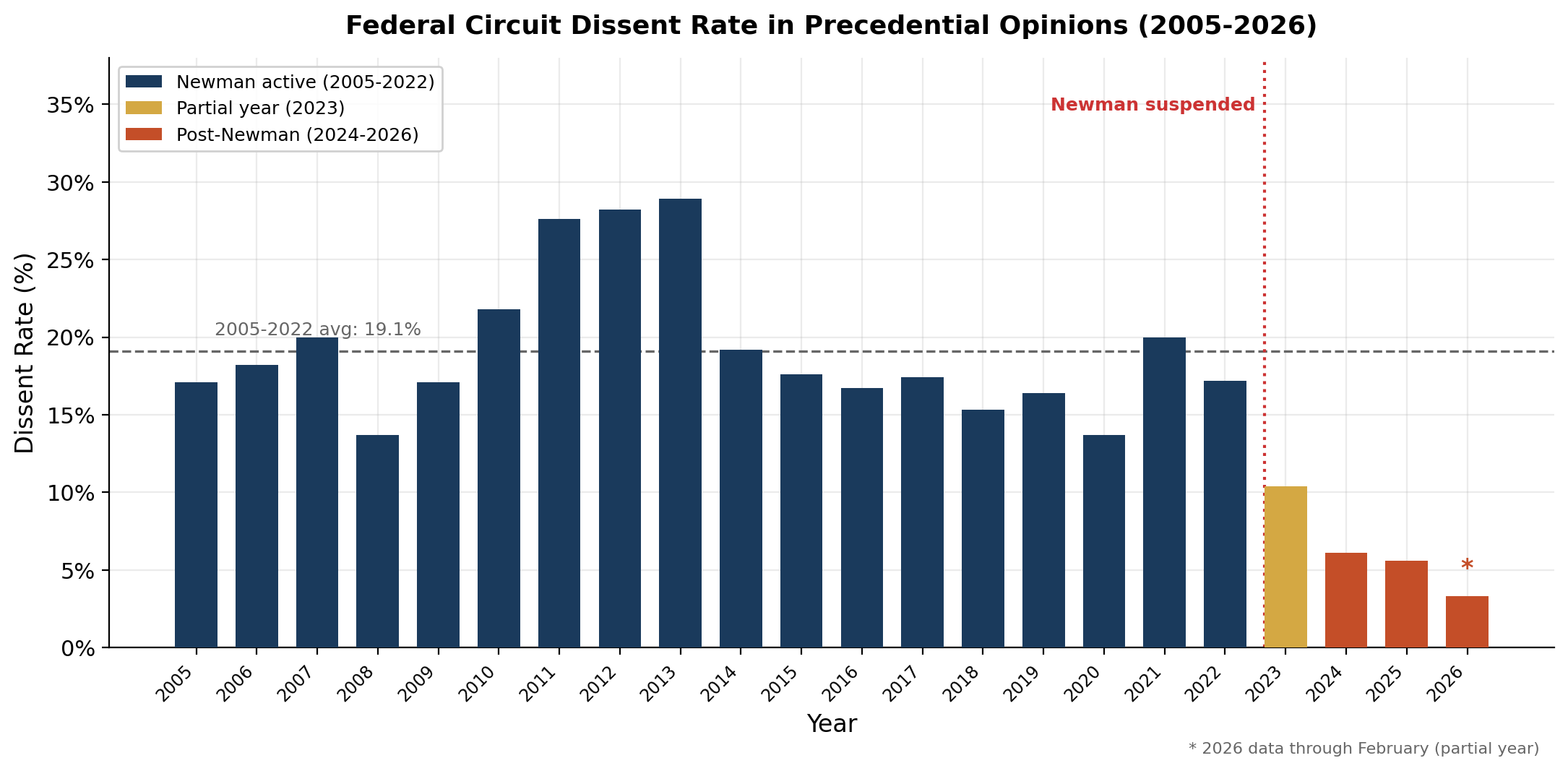
Today’s Federal Circuit Order. The per curiam order issued today by eleven of the twelve active Federal Circuit judges (Judge Newman was excluded from participation). With the mandates now in hand, the CIT is free to act, and the plaintiffs have already filed a motion for permanent injunction in the lower court.
The Refund Scramble. The Supreme Court’s opinion did not order refunds or prescribe any mechanism for obtaining them. Justice Kavanaugh’s dissent described the refund process accurately: it will be a mess.
Meanwhile, the administration has already pivoted to alternative tariff authorities. Within hours of the Supreme Court’s ruling, President Trump signed a proclamation under Section 122 of the Trade Act of 1974 imposing a 10% “temporary import surcharge” on products from all countries, effective February 24, 2026, for 150 days. Section 122 has never before been invoked, and it caps tariffs at 15% for a maximum of 150 days unless Congress votes to extend them. The administration has also signaled expanded use of Section 232 (national security tariffs on steel, aluminum, and potentially other sectors), Section 301 (retaliatory tariffs for unfair trade practices), and the rarely invoked Section 338 of the 1930 Tariff Act (anti-discrimination tariffs). Secretary of the Treasury Bessent stated that combining these authorities “will result in virtually unchanged tariff revenue in 2026.”
]]>