By Sarah Fackrell, Professor of Law at Chicago-Kent College of Law
Last week, the ITC issued a limited exclusion order in a dispute between GoPro, Inc. and Arashi Vision, Inc. (d/b/a Insta360). The order covered “certain cameras and camera systems” which, in the Commission’s view, infringed U.S. Patent No. D789,435. In reaching this conclusion, the ITC appears to be requiring a much lower standard of visual similarity than the Federal Circuit does.
In deciding that the D’435 patent was infringed, the Commission affirmed—without further discussion—the finding of infringement in the Initial Determination that was issued by ALJ Doris Johnson Hines on July 10, 2025. In that decision, Judge Hines seems to have been persuaded to not only require a lower overall level of similarity than the Federal Circuit currently requires, but to also effectively ignore several claimed design elements, disregarding them as visually “minor,” “trivial,” or otherwise unimportant.
It is true that there is a longstanding line of Federal Circuit cases saying that “minor differences between a patented design and an accused article’s design cannot, and shall not, prevent a finding of infringement.” See Litton Sys., Inc. v. Whirlpool Corp., 728 F.2d 1423, 1444 (Fed. Cir. 1984). But that doesn’t—and shouldn’t—mean that a judge (or a jury) can completely read claimed visual elements out of a design patent claim. (For more on how I’m using the word “element” here, see Intelligent Design & Egyptian Goddess, 68 Duke L.J. Online 94, 109 (2019)).
For example, consider this image (from GoPro’s expert report) that Judge Hines included in her decision:
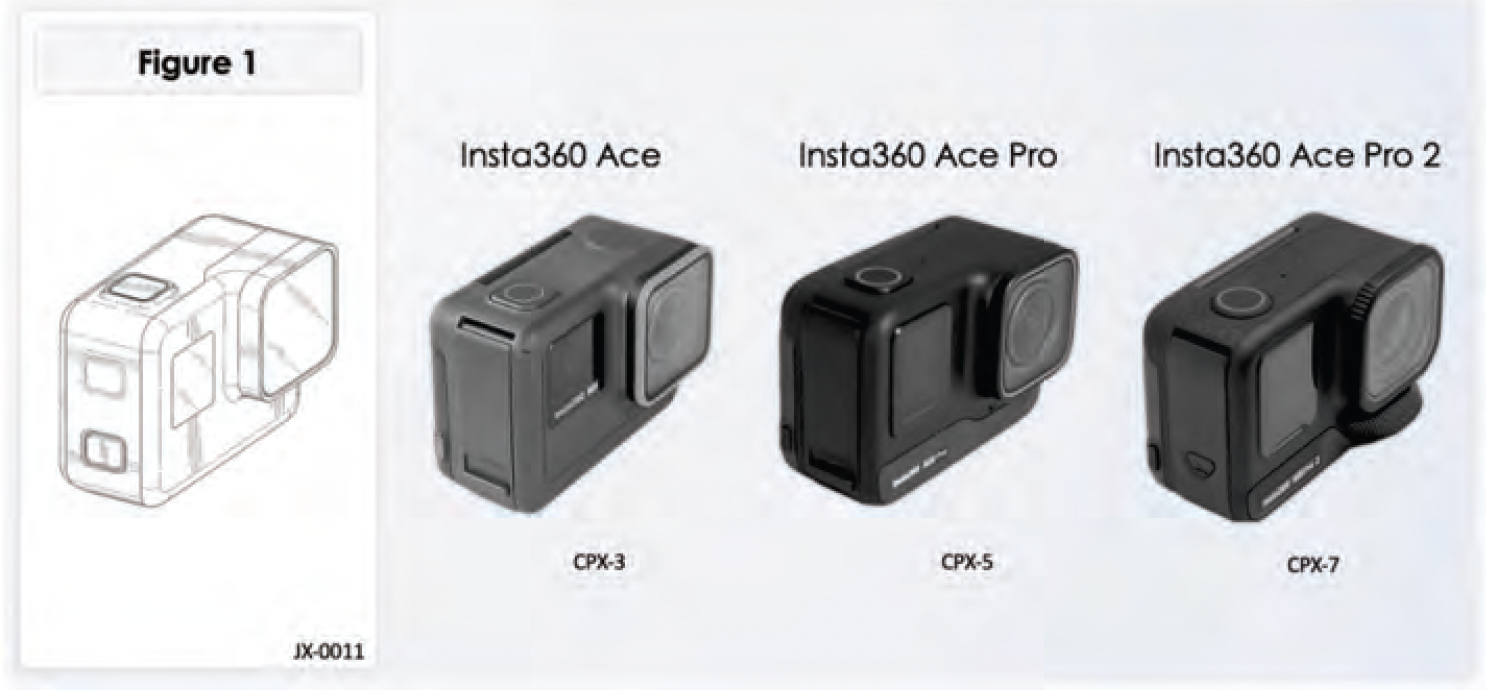
The image quality in the decision isn’t great but if you look at the patent, that lower square side button is shown in solid lines, which means it’s part of the claimed design. That button doesn’t appear at all in any of the accused products. On the other side, the accused products include buttons where the patent claims a smooth surface:
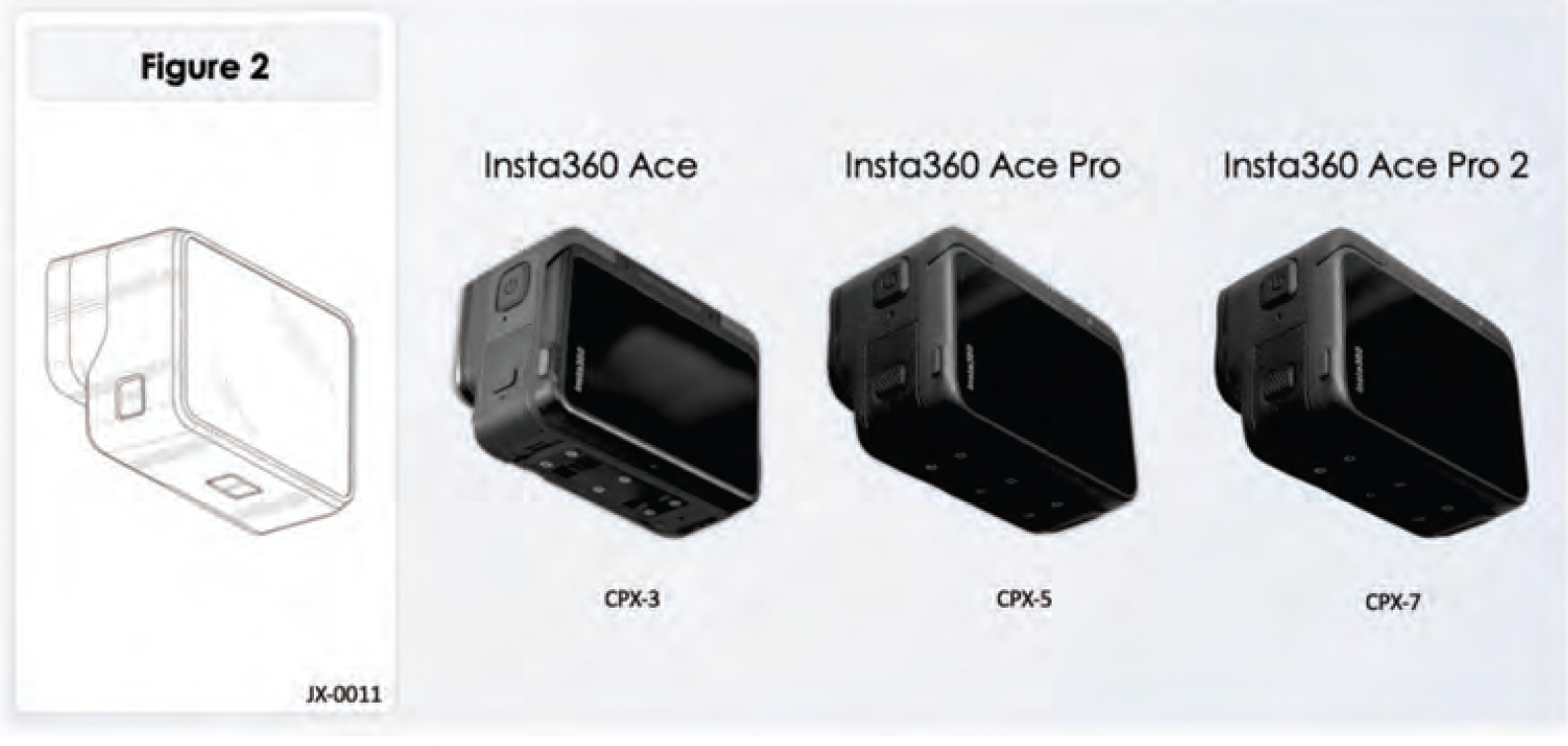
GoPro’s expert suggested—and the ITC seems to have agreed—that these were unimportant visual features.
But if they were so unimportant, why were they claimed?
It’s one thing to say that a corresponding button differed from a claimed button in a minor way. But it’s an entirely different thing to say that the patentee can essentially erase claimed elements when it comes to infringement.
That’s especially true in our post-Zahn world. See How Design Patent Law Lost Its Shape, 41 Cardozo L. Rev. 555, 556 (2019). In a world where a design patent applicant can pretty much claim—or disclaim—whatever they want, they should be held to what they choose to claim. If GoPro wanted to claim just the major contours of the camera as it’s “design,” it could have. But it did not. And presumably, it did not for good reason.
GoPro claimed narrowly and it should be held to that narrow scope. If the buttons don’t matter, GoPro didn’t have to claim them. But they did. Accordingly, those visual elements need to be considered when analyzing infringement. That’s what it means to look to the “whole design” when analyzing design patent infringement.
This isn’t copyright, with its fragmented literal similarity and “total concept and feel” tests. A design patent owners shouldn’t be able to treat their claim as a nose of wax, showing a narrow claim to the examiner and then stretching the scope when they argue infringement. Cf. White v. Dunbar, 119 U.S. 47, 51 (1886).
In a way, this is similar to the situation in the recent Armaid decision:
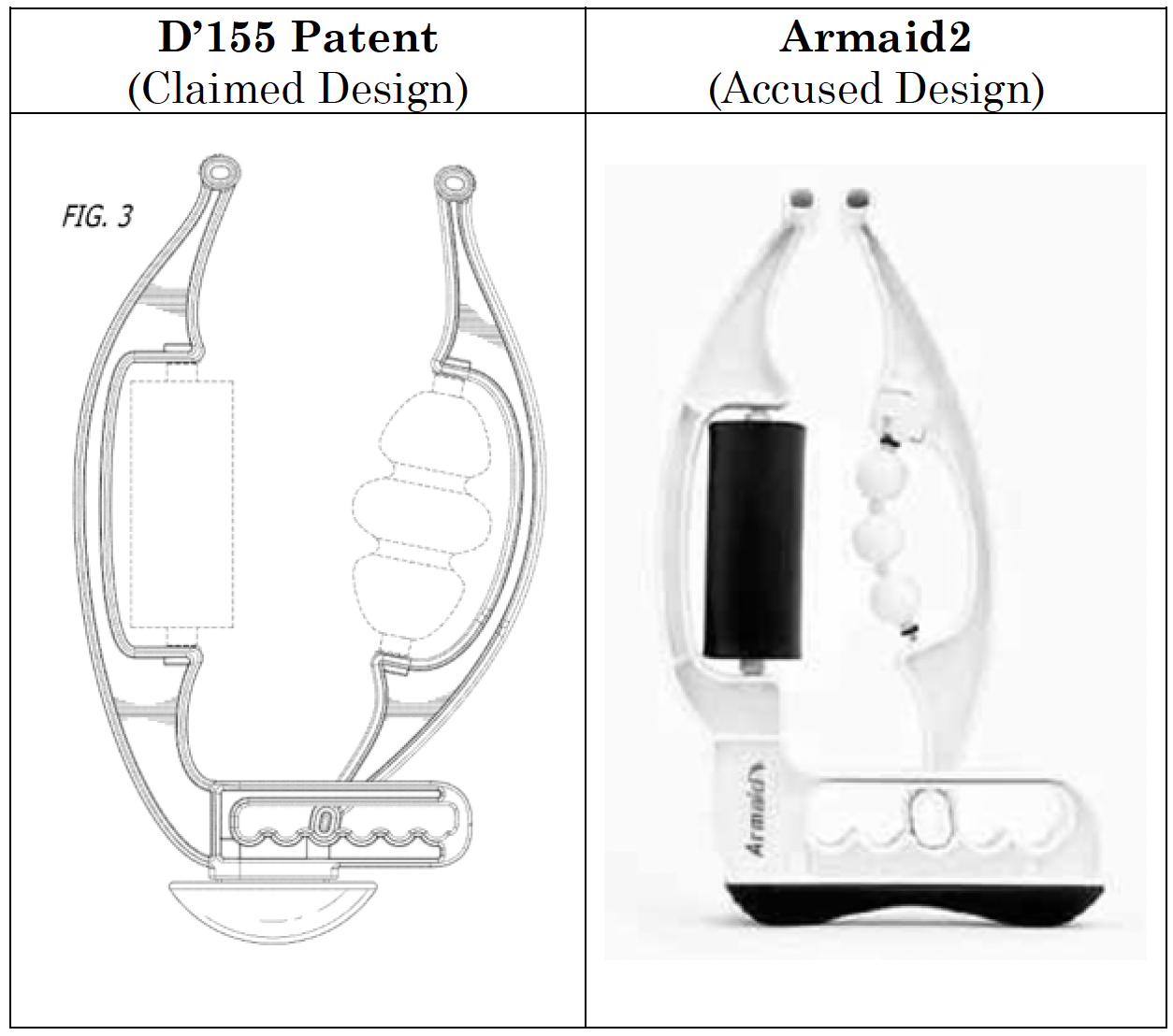
These designs only look substantially similar, overall, if one ignores the claimed shape of the base. Perhaps the other visual differences (for example, in the arm shapes) may count at “minor.” But factfinders shouldn’t be allowed to engage in something akin to design patent claim vitiation.
Requiring that all of the claimed design elements look similar is not a “spot the differences” game. Cf. Range of Motion Prods., LLC v. Armaid Co. Inc., 166 F.4th 981, 995 (Fed. Cir. 2026) (Moore, C.J., dissenting). It is the only way to be sure that the design patent infringement test takes into account the entire claimed design, including all of its relevant parts. We know which parts are relevant because the patentee claimed them.
The Zahn approach to design patent claiming gives patent applicants an incredible amount of flexibility in what to claim. They should be held to the choices that they make.
Perry: Your are correct, but there is more…much more. At the core of this problem is the difference between how lawyers, academics, and judges think about and form opinions on the substantial similarity of product shapes vs. how actual ordinary observers view products. There is now robust neuroscience on shape perception that provides deep insight into how a representative sample of ordinary observers (consumers) view products. Objectively, they do not assess shape based on perception of minor details except in very special situations. Solid research validates this view.
This new science shows that consumers’ product shape perception rarely aligns with how lawyers, academics, and judges assess the OOT. Judge Moore’s dissent using validated actual testing is the first instance of a research-based methodology for OOT.
Under your logic, an accused design would need to have all of the claimed elements, i.e., be virtually identical to the claimed design for infringement to be found. This goes against the seminal 1871 Supreme Court decision of Gorham v. White, where the Court found infringement even though the accused spoons and forks had many distinguishing detailed features (which the Court enumerated). In spite of these differences, the Court famously warned against a finding of non-infringement “[u]less … the patent is to receive such a construction that the act of Congress will afford no protection to a designer against imitations of his invention…”
In Campbell Soup Co. et al. v. Gamon Plus, Inc, 939 F.3d 1335 (Fed. Cir. 2019), the Federal Circuit ignored the absence of a major visual element (a can) in a claimed design by finding that a prior art reference – that lacked this element – was nevertheless a proper primary reference under 35 USC 103. At the time of this decision, the test for a proper primary reference was whether it was “basically the same” as the claimed design. This, of course, is virtually the same test as that for infringement: “substantially the same”. So here is precedent where the Federal Circuit held that ignoring a major (not minor) claimed element in its analysis was not a problem.