by Dennis Crouch
This is the third installment in a trilogy of posts examining USPTO allowance rates from different vantage points. The first post took the filing-cohort approach, tracking every published utility application filed in a given month and following it to resolution. The second post used an applicant-focused approach, measuring outcomes by the dates that patents issued and abandonments were recorded. That method captures when the applicant's decision becomes final, whether by paying the issue fee or letting a response deadline lapse. It makes sense to center the applicant because the applicant ultimately controls whether to continue prosecution, pay the issue fee, or walk away.
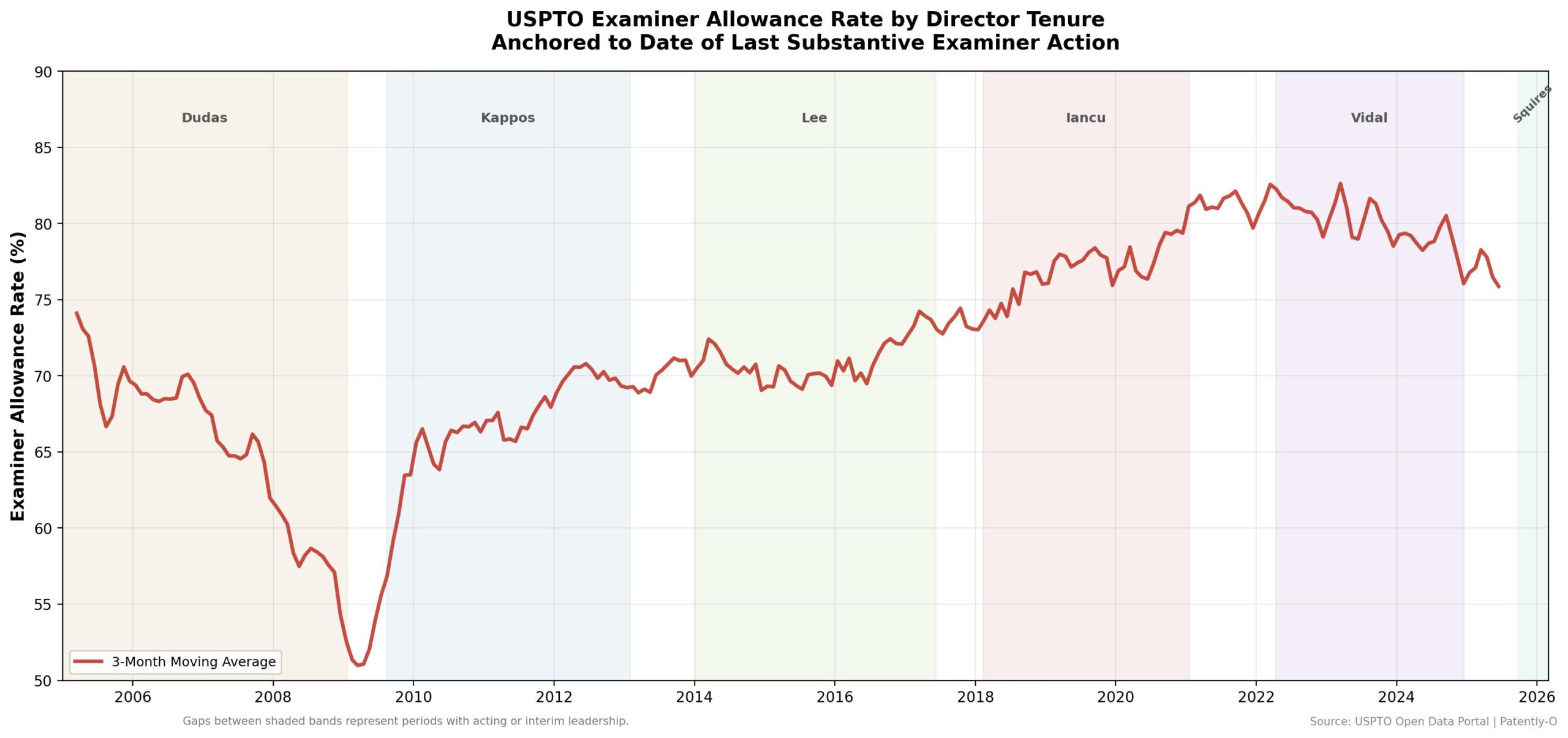
This third approach asks a different question: when did the examiner actually make the call? For each disposed application, I anchor the outcome to the date of the examiner's last substantive action: the mailing of the Notice of Allowance for applications that received one, and the mailing of the last office action rejection for applications that were abandoned after rejection. This strips away the administrative lag inherent in my prior two charts. The result is a more precise measure of examination policy as it operates in real time. Of the three approaches, this one offers the most direct window into USPTO policy. We are measuring the moment the agency acts, the last examiner decision that set the legal outcome in motion.
As with the prior posts, this analysis covers only published utility patent applications. A further caveat: most patent applications are part of a family of related U.S. patent applications, including continuations, divisionals, and continuations-in-part. The analysis here treats each application individually rather than tracking family-level outcomes, which means a single inventive effort may appear multiple times in the data.
Examiner Mail Dates: The USPTO's electronic records contain paired event codes for examiner actions: a "record" code when the examiner completes the action and a "mail" code when it is sent to the applicant. This study uses mail dates because that is when the examiner's decision takes legal effect. The mailing of a Notice of Allowance under 37 C.F.R. § 1.311 starts the three-month period for paying the issue fee. The mailing of a final rejection starts the six-month period under 37 C.F.R. § 1.136(a) for response or abandonment. This is also the most direct link to patent office policy: we are measuring the last USPTO action that led to the legal right or its abandonment.The chart above plots the three-month moving average of the examiner allowance rate from January 2005 through June 2025, with shaded bands marking the tenures of confirmed USPTO Directors. Because the examiner-action-date method captures the moment of decision rather than its downstream administrative consequences, these bands align more precisely with actual policy effects than they do in charts using grant or abandonment dates.