by Dennis Crouch
In Rideshare Displays, Inc. v. Lyft, Inc., No. 25-1132 (petition filed Mar. 23, 2026), the petitioner asks for clarification on when a court may disregard specific functional claim limitations in conducting the Alice patent eligibility analysis. The petition also raises a procedural question about the Federal Circuit’s authority to raise and decide new factual arguments sua sponte on appeal. Something unusual about the case – USPTO Dir. Vidal intervened at the Federal Circuit to defend the PTAB’s eligibility holding, and the court reversed anyway. I expect that Dir. Squires will be even more supportive. At the Supreme Court, the USPTO brief will be filed by the DOJ’s SG, bringing a wider set of interests – and likely a less pro-patentee tone – than the USPTO’s Federal Circuit presentation.
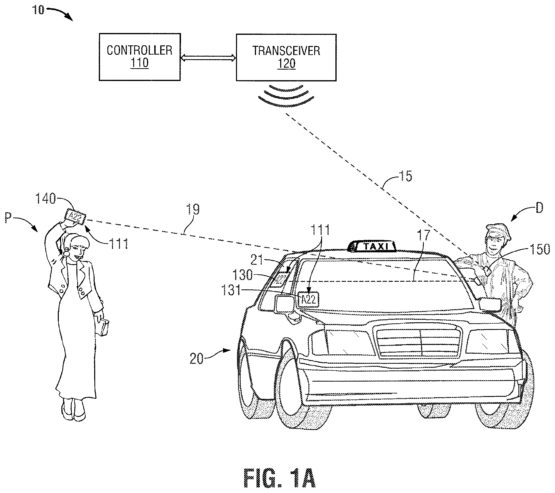
The patents at issue, U.S. Patent Nos. 9,892,637; 10,169,987; 10,395,525; 10,559,199; and 10,748,417, all share a common specification and claim a rideshare vehicle identification system. The basic concept involves a controller that transmits a notification signal to the driver’s mobile device when the driver’s vehicle reaches a predetermined distance from the rider. The driver’s device generates a unique indicator that is displayed on the vehicle’s exterior and on the rider’s phone, allowing the rider to visually match the indicator before getting in the car. The specification frames this as a safety innovation, reducing the window in which a bad actor could intercept or spoof the identification process.
Lyft filed five inter partes review petitions challenging the patents, and the PTAB found the original claims unpatentable for obviousness. But the Board granted Rideshare’s motion to amend, finding the substitute claims patent-eligible under Alice step one because they “provide a technological solution rooted in computer and network technologies.” The Board did not reach Alice step two because it found eligibility at step one. Lyft cross-appealed the Board’s grant of the motion to amend, and it is that cross-appeal that produced the § 101 ruling at the Federal Circuit.
A natural question is how a § 101 eligibility dispute ends up in an inter partes review at all. The statute limits IPR to challenges based on prior art patents and printed publications under §§ 102 and 103. 35 U.S.C. § 311(b). A petitioner cannot institute an IPR on § 101 grounds. But the door opens when the patent owner files a motion to amend under 37 C.F.R. § 42.121. In exchange for canceling challenged claims, the patent owner may propose substitute claims. The Board then evaluates whether those substitute claims satisfy all requirements for patentability, not just §§ 102 and 103 but also §§ 101 and 112. Lyft challenged Rideshare’s substitute claims under § 101. The Board sided with the patentee, but the Federal Circuit reversed.
What makes the case most interesting to me is that USPTO Director Vidal intervened in the appeal to defend the PTAB’s eligibility determination. The brief argued that Rideshare “has not claimed the abstract process of having rideshare drivers and riders identify each other, but rather, a technologically implemented means for facilitating and improving that recognition process through the generation and transmission of unique identifiers on mobile devices and vehicle displays.” The Director further argued that “when properly understood, § 101 will seldom imperil innovations within patent law’s traditional bailiwick of the scientific, technological, and industrial arts.” That last line reads along the same line as the pro-eligibility posture that Director Squires has pursued since taking office under President Trump.
The Federal Circuit panel reversed in a nonprecedential opinion. The Federal Circuit’s opinion characterized the Board’s holding as finding the substitute claims “directed to an abstract idea” at Alice step one but eligible at step two because the claims “provided a technological solution to a technological problem in computer and network technologies.” The petition contends this mischaracterizes the Board’s actual analysis. The Board found that while certain limitations recited a judicial exception, the claims as a whole were “not directed to an abstract idea” because they integrated the exception into a practical application. That is a step one holding. The Federal Circuit framed its own analysis as a step two disagreement, concluding that “the claims are directed to improving a user’s experience in using a ridesharing app and identifying a driver” and that “nothing in the claims themselves is directed to an improvement to the mobile device environment itself,” characterizing the claims as merely streamlining “the process of what is normally accomplished by creating hand-printed cards with names to help identify ride pickups at crowded locations, such as an airport.” The petition argues this abstracts away the specific technical limitations involving proximity-triggered notification signals, automatic indicator generation, and coordinated display across multiple devices.
The Federal Circuit oral argument were an interesting listen — I have posted them here: https://scotusgate.com/oral_argument.php?case=23-2033_04112025.
When the USPTO’s Associate Solicitor Kakoli Caprihan opened by arguing that the claims are eligible under step one of Alice, Judge Chen interrupted: “Under step one? I thought the board found that they weren’t eligible under step one and had to get to step two.” When Caprihan tried to explain that the Board’s analysis, Judge Chen dismissed the effort: “Oh, is this your nonsensical Step 0, Step 2A stuff?” I agree – the USPTO should at least rewrite its guidance to match the court language on eligibility numbering. Of course, the USPTO has spent years developing its own eligibility guidance to create internal consistency, but the Federal Circuit treats that guidance as irrelevant to its analysis.
The panel’s questioning on the merits was pointed. Judge Chen posed an elaborate hypothetical: a passenger named Jenny calls a dispatcher from the airport; the dispatcher sees on a map that a cab is within a mile; the cab driver drives over, writes Jenny’s phone number (867-5309) on a whiteboard attached to his window, and calls Jenny to say her number is displayed. Judge Chen then asked: “What I just described, is that patent eligible? It’s got phones. It’s got a whiteboard. Or is that just a method of organizing human activity just using available technology for their normal, conventional purposes?” Rideshare’s counsel struggled somewhat to distinguish the hypothetical.
Judge Hughes was more direct (as usual). After suggesting to Lyft’s counsel that the claims simply automate what a car service does when a driver holds up a sign at the airport, he agreed, invoking a Seinfeld episode in which George Costanza steals someone’s airport car by claiming to be the person on the driver’s sign. Judge Hughes then put the point to Rideshare’s counsel and the USPTO: “I’ve never found automating something that can be done with basically pen and paper to be eligible.” When Judge Chen asked the USPTO attorney what the technological improvement was, the response was “providing a more secure rideshare technology service.” Judge Chen responded: “That’s the result. What’s the means? What is the technological improved means of accomplishing the result? . . . I’ve been waiting and waiting and waiting for somebody to tell it to me. So now’s your chance.”
The new Supreme Court petition links itself to the pending petition in USAA (25-853) — arguing that the Federal Circuit improperly requires an improvement to the computer itself for eligibility, rather than an improvement in any technology or technical field. In USAA, the Court has requested a response from PNC, due April 8, 2026.
The petition’s second question focuses on what appears to be a written description holding buried in Footnote 3 where the court wrote:
We also conclude that the substitute claims are unsupported by the original disclosure, because we do not find support for the scenario described in the substitute claims, where a new indicator is generated in response to a notification signal when the vehicle is within a predetermined distance of a particular location.
The original disclosure merely identifies two alternative scenarios: one where the system generates another indicatory signal when the driver approaches a location, and a second scenario when the driver manually generates another indicator. For that reason, too, the Board’s grant of Rideshare’s motion to amend was improper.
This appears to be a new theory about written description introduced by the court during oral arguments. This has a number of procedural problems, including the court’s factual determination on an issue not even presented by the parties.
Footnote 3 would not have stayed in the case if it had been a precedential opinion. First because the court would have done a better job writing its opinion; and second the other judges on the court would have objected. Precedential opinions are circulated and reviewed by all members of the CAFC before their release; Non-precedential opinions are not.
The broader picture here is the ongoing (increasing) institutional tension between the USPTO and the Federal Circuit on eligibility. The agency has been allowing expanded eligibility for years; and that has further increased under Dir. Squires.