Bipartisan Skepticism Greets Director Squires at First House Oversight Hearing

by Dennis Crouch

On March 25, 2026, the House Judiciary Subcommittee on Courts, Intellectual Property, Artificial Intelligence, and the Internet held its first oversight hearing of the USPTO under Director John Squires. The hearing, which ran for several hours with Squires as the sole witness, covered an extraordinary range of topics: IPR institution policy (including the proposed NPRM), retroactive de-institution of trials, AI in patent examination, the application backlog, national security concerns about foreign petitioners, Section 101 reform, fee-setting authority, injunctive relief, employee morale, and a sustained exchange over Dir. Squires decision to file trademark applications for the Trump administration's "Board of Peace."  Overall, there was substantial and bipartisan skepticism.

Several themes recurred throughout the hearing. Squires repeatedly invoked his "born strong" framework for patent quality and characterized the IPR changes as restoring "balance and fairness" to the AIA system. Members on both sides pushed back, questioning whether the Director's centralized control of institution decisions, combined with summary denial orders that provide no reasoning, is consistent with the AIA's design. The hearing also showcased Squires' rhetorical style: the "Central Bank of Innovation" metaphor appeared in both his written and oral testimony, and he introduced a new characterization of the proposed estoppel rule as "one, join, and done" rather than the critics' shorthand of "one and done."


To continue reading, become a Patently-O member. Already a member? Simply log in to access the full post.
The 14-Month Fiction: Only 10% of First Actions Arrive on Time

by Dennis Crouch

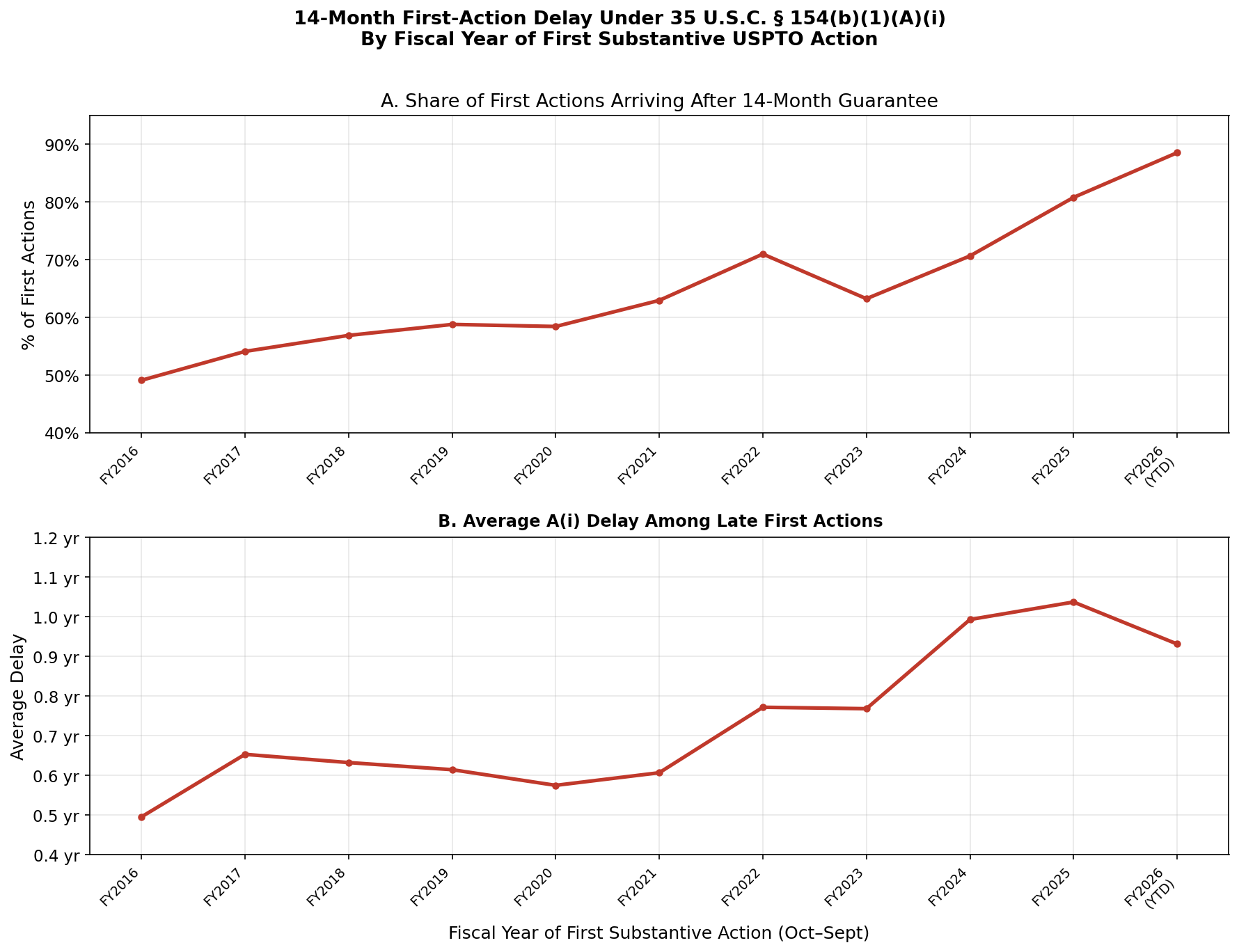
The Patent Term Adjustment statute guarantees that USPTO delays will not unduly shorten patent term. 35 U.S.C. § 154(b). The first guarantee an applicant encounters is the 14-month clock: the USPTO must issue a First Office Action on the Merits (FAOM) or a Notice of Allowance (NOA) within 14 months of filing. When the agency misses that mark, the applicant earns day-for-day patent term adjustment under what we call "A delay" or "(A)(i) delay."  § 154(b)(1)(A)(i).  The chart above shows how well the USPTO has been hitting that target, broken down by the fiscal year of the first substantive examiner action.

The short answer: not well.


To continue reading, become a Patently-O member. Already a member? Simply log in to access the full post.

The Patent Term Distribution, and What it Reveals

by Dennis Crouch

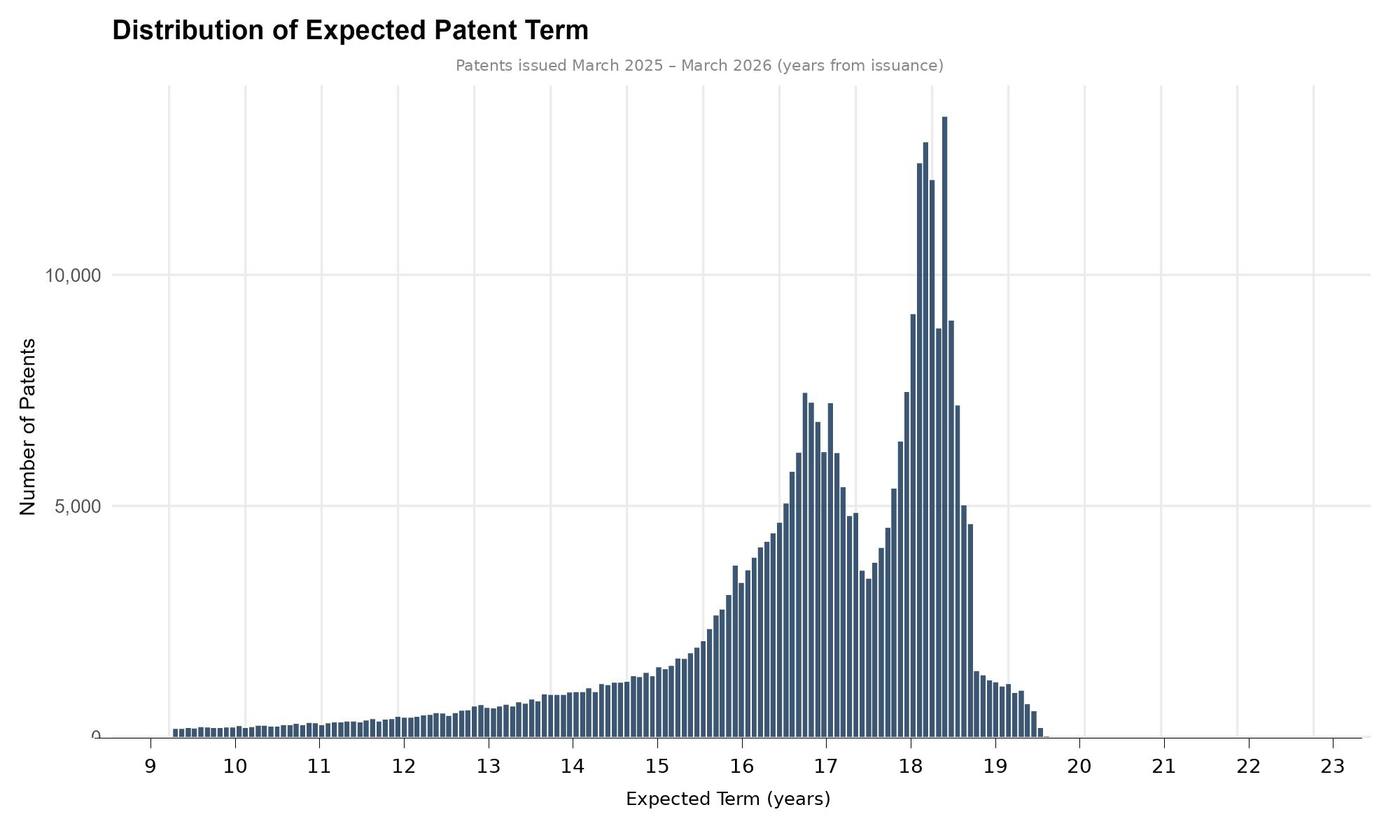
Congress set the patent term at twenty years from the earliest effective filing date. 35 U.S.C. § 154(a)(2) (not counting provisional or foreign national filing). But that statutory baseline is just the starting point. But, the actual term is shaped by a series of prosecution decisions, USPTO delays, terminal disclaimers, and patent family structure.  The chart below shows the distribution of expected remaining patent term (measured from issuance) for utility patents issued between March 2025 and March 2026. The calculation accounts for patent term adjustment (PTA) and terminal disclaimers, though the latter relies on a heuristics and so is not perfectly precise. Still, the overall shape tells a vivid story about what the patent system actually delivers.Distribution of Expected Patent Term for patents issued March 2025 to March 2026The most striking feature is


To continue reading, become a Patently-O member. Already a member? Simply log in to access the full post.

Are Rising Maintenance Fees Shortening the Effective Patent Term?

by Dennis Crouch

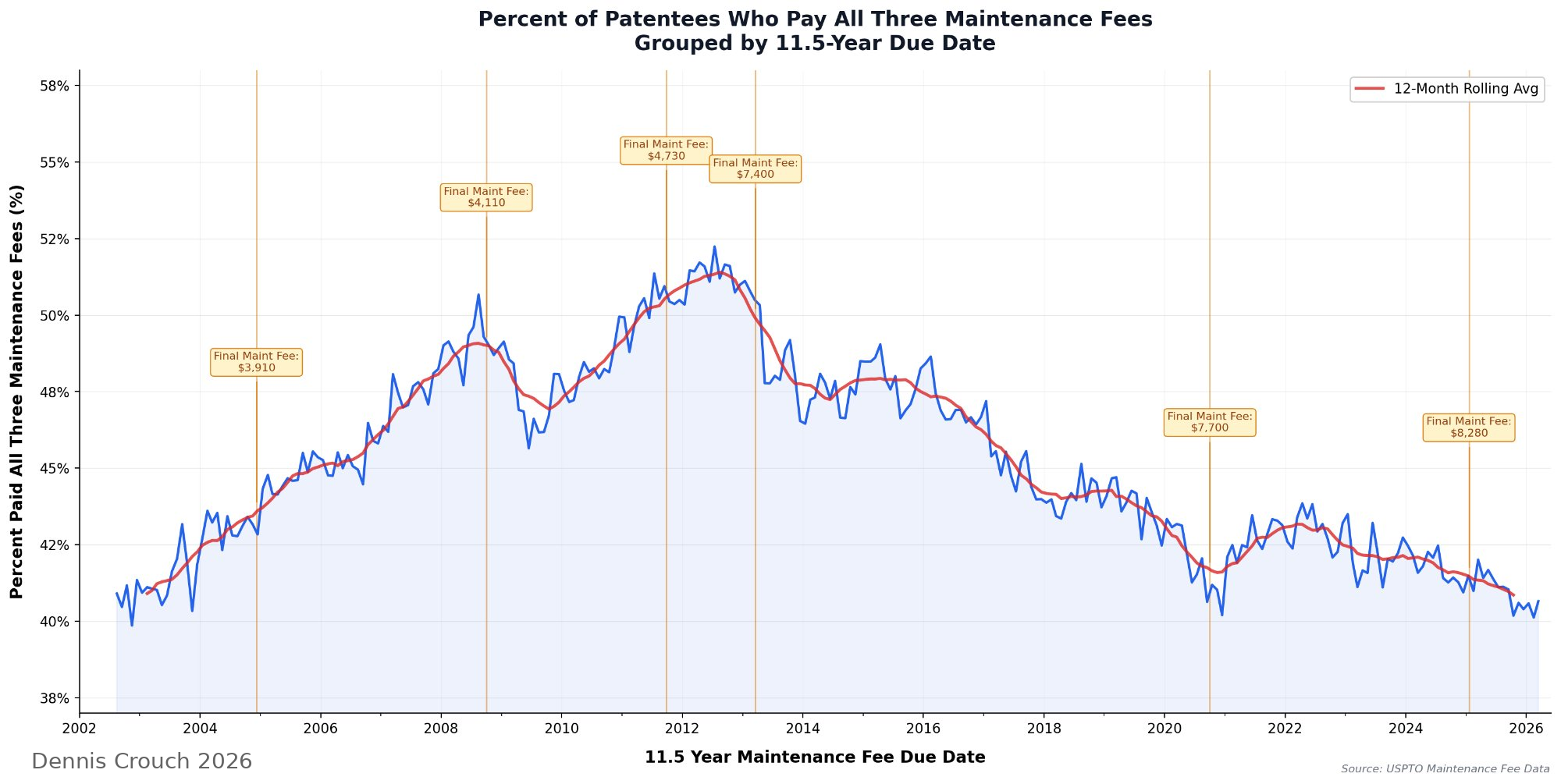
Congress set the patent term at 20 years from filing. But the effective term for most U.S. patents is considerably shorter - but these are self-selected patents. USPTO's maintenance fee records shows that roughly 60% of all patentees now abandon their patents before the full term expires, choosing not to pay the escalating series of post-issuance maintenance fees required to keep a patent in force. The rate of full-term patent maintenance has fallen to approximately 40%, approaching the lowest levels recorded in the past two decades, and the trajectory suggests further decline.

Chart showing percent of patentees who pay all three maintenance fees, grouped by 11.5-year due date, from 2002 to 2026

Under 35 U.S.C. § 41(b), patent holders must pay maintenance fees at three intervals after issuance: 3.5 years, 7.5 years, and 11.5 years. Failure to pay (including during a six-month grace period with surcharge) results in expiration of the patent. The chart below tracks the percentage of patentees who paid all three maintenance fees, grouped by the month their final (11.5-year) fee came due. The data reveals a striking arc: a steady rise from about 41% in 2002 to a peak of roughly 52% around 2012-2013, followed by a sustained decline back to approximately 40% today. The 11.5-year maintenance fee for large entities has nearly tripled during this period, from $3,100 in 2001 to $8,280 as of January 2025, well above the rate of inflation for this period. The question is whether this fee escalation is the primary driver of the decline, or whether other forces are at work.


To continue reading, become a Patently-O member. Already a member? Simply log in to access the full post.