October 2018

Thin Food and Thin People: CORN THINS are merely descriptive and perhaps generic

by Dennis Crouch

I previously wrote about the Real Foods v. Frito Lay case in a post titled Federal Circuit and Sealed Opinions. Now, the court has unsealed its decision focusing on trademark rights in CORN THINS and RICE THINS.  Frito-Lay opposed the registrations and the Trademark Trial & Appeal Board (TTAB) agreed — finding the marks “merely descriptive” and without “acquired distinctiveness.”

Generic terms — common names of a descriptive class — cannot be registered as trademarks.  Other descriptive marks can be registered — but only once they acquire distinctiveness. 15 U.S.C. § 1052(f).  Proof of distinctiveness is not required for terms that are suggestive (rather than descriptive) of a class, nor is it required of arbitrary or fanciful marks.

Real Foods sells food products that look a lot like rice cakes, but calls them CORN THINS and RICE THINS. As the name suggests/describes, these are thinner than traditional rice cakes.

Image result for corn thins

I have personally purchased these before.  Interesting story – I remember being confused since the name of the product seemed descriptive and so did the name of the company (Real Foods).  I thought – maybe this is one of the store-branded generic product.  But, they tasted good and the products now have acquired secondary meaning in the eye of this consumer. 

The level of descriptiveness is an issue of fact when decided by the TTAB and thus reviewed for substantial evidence – a low standard of review.  On appeal, the Federal Circuit found that the TTAB had sufficient evidence to find the marks highly descriptive.  The products are made of corn and rice respectively and are comparatively thin (when compared with traditional cakes).   There are also lots of other thins on the market – “Herb Rice Thins,” “Baked Potato Thins,” “FalaFel Thins,”
“Pita Thins,” and “Wheat Thins.” (Some images below).

One argument here is that the “thin” bit is only a little bit about the cracker itself — the double entendre is to suggest that these will also help keep your body thin.  Besides being mis-descriptive, the court cited to evidence that “thins” has been on lots of high calorie food “even chocolate-coated pretzels”

Based upon the evidence, a court could reasonably conclude that the sly-health suggestion “would not attach in the eyes of a consumer.”  Under the substantial evidence standard, this reasonableness is enough to pass muster on appeal.

Substantial evidence also supported the conclusion that the marks had not acquired distinctiveness. In a pool of respondents limited to “only purchasers and prospective
purchasers of crispbreads/crispbread slices,” less than 6% associated the mark primarily with Real Foods.

Not only did Real Foods lose its appeal — on remand, the Federal Circuit ordered the TTAB to consider whether these marks are actually generic.


Does Patent Eligibility Vary over Time? HP v. Berkheimer at the Supreme Court

by Dennis Crouch

Berkheimer v. HP Inc., 881 F.3d 1360 (Fed. Cir. 2018) is in my list of top-ten patent cases for 2018.  In the decision, Judge Moore vacated a lower court summary judgment ruling on eligibility — holding that a “genuine issue of material fact” as to whether the claims are directed toward a transformative inventive concept rather than merely a “well-understood, routine, and conventional” application of an abstract idea.  Thus, the decision gave some amount of respect to the traditional procedures associated with providing facts.  Practically, this means that is should be more difficult to challenge patent eligibility on the pleadings or on summary judgment. Likewise, it means that examiners must do a bit more work to ‘prove’ the lack of eligibility.

Now, HP has petitioned the United States Supreme Court on the fundamental law-fact divide:

Whether patent eligibility is a question of law for the court based on the scope of the claims or a question of fact for the jury based on the state of the art at the time of the patent.

HP Inc., v. Steven E. Berkheimer, Supreme Court Docket No. 18-415 (2018).

A key claim of HP’s brief is that “patent eligibility does not change over time with the state of the art.”  The focus, according to HP is “analysis of the type of discovery sought to be patented.”  I totally agree that HP’s suggestion here should be the law — eligibility need not enter into the question of novelty and non-obviousness.  The difficulty is how to deal with the the Supreme Court’s focus on “whether the claims disclose an inventive concept” as step two of the eligibility analysis framework.

[Read the Petition]

An important aspect of this case is to consider whether HP is something of a wolf in sheep’s clothing. Although HP clearly does not want to be liable to Mr. Berkheimer, HP also may be examining its portfolio that includes tens-of-thousands of patents — many of which have questionable eligibility.

= = = =
In its decision, the Federal Circuit confirmed that claim 1-3 and 9 are ineligible, but that underlying facts are required to determine whether 4-7 are ineligible. U.S. Patent No. 7,447,713.

1. A method of archiving an item in a computer processing system comprising:

presenting the item to a parser;

parsing the item into a plurality of multi-part object structures wherein portions of the structures have searchable information tags associated therewith;

evaluating the object structures in accordance with object structures previously stored in an archive;

presenting an evaluated object structure for manual reconciliation at least where there is a predetermined variance between the object and at least one of a predetermined standard and a user defined rule.

2. The method as in claim 1 wherein the respective structure can be manually edited after being presented for reconciliation.

3. The method as in claim 1 which includes, before the parsing step, converting an input item to a standardized format for input to the parser.

4. The method as in claim 1 which includes storing a reconciled object structure in the archive without substantial redundancy. (more…)

Patenting Exception to Non-Disclosure Agreement

by Dennis Crouch

Soarus L.L.C. v. Bolson Materials Int’l Corp., 2018 U.S. App. LEXIS 27802 (7th Cir. Oct 1, 2018).

This 7th Circuit decision stems a nondisclosure agreement – titled a “secrecy declaration — between Soarus and Bolson Materials.  Soarus was a G-Polymer distributer (for Nippon Synthetic) and Bolson was looking to begin acquiring and using G-Polymer in connection with developing a new 3D printing process.  Problems arose, though when Bolson filed for patent protection on a 3D printing process it developed using G-Polymer. The court explains:

Shortly after executing the NDA, Bolson filed a provisional patent for the 3D printing process it developed using G-Polymer. The filing resulted in Bolson receiving U.S. Patent No. 8,404,171 . . . Soarus later claimed that Bolson’s application for the ‘171 Patent revealed confidential information about G-Polymer, in violation of the NDA. Litigation ultimately ensued in the Northern District of Illinois.

The district court sided with the defendant on summary judgment — holding that the NDA authorized use of the confidential information for patent filings. On appeal, the Seventh Circuit has affirmed.

[Read the SecrecyAgreementAmended]

The two-page NDA includes broad restrictions against disclosure of confidential information.  However, there are two particular provisions relating to the filing of patent applications:

6. Bolson shall not file any application for a patent or other intellectual property using any piece of Confidential Information or the results of the Evaluation without prior written consent of Nippon.

10. Notwithstanding Article 6 hereof, Bolson is free to patent and protect any new applications using G-Polymer® in the specific area of Fused Deposition Method Rapid Prototyping Equipment and Methods.

In reading the provision here, the district court construed the language of paragraph 10 as an exception that gave Bolston the right to “freely patent and protect new applications of GPolymer in the specified 3D printing process” without being confined to the confidentiality restrictions of the NDA.

On appeal, the Seventh Circuit reviewed the contract interpretation de novo under Illinois law but arrived at the same result.

Soarus argued that paragraph 10 is simply making it possible for Bolson to patent its 3D printing inventions — but was not intended as also a blanket release of all confidentiality requirements associated with the filing.

Soarus contends that no reasonable company would seek to protect the confidentiality around a new product by entering into an agreement that permitted a counterparty to disclose those confidences in a public filing with the U.S. Patent Office.

The courts, disagreed with Soarus — finding that the language was clear.

[I]f Soarus was right about the meaning of paragraph 10, there was no reason to create an exception with respect to paragraph 6: the parties instead could (and should) have stated in clear and precise terms, as Soarus would now have it, that Bolson was free to patent and protect the new 3D printing method so long as doing so did not disclose confidential information without the consent of Soarus.

Since the language is clear, the standard contract interpretation process precludes the court from giving substantial or controlling weight to the commercial purposes of the agreement.

Affirmed.


Crouch’s Supreme Court Patent Law Update

by Dennis Crouch

The Supreme Court is now open for business for its 2018-2019 Calendar.  The only pending patent case before the court is Helsinn v. Teva, which focuses on the meaning of “on sale ” in the Section 102 of the Patent Act as revised by the 2011 America Invents Act.  When do pre-filing sales count as prior art — what level of public disclosure is necessary?

CVSG: On October 1, the Supreme Court asked for the views of the U.S. Government in the case of RPX v. ChanBond — Whether a party that asks for review of a patent has standing to appeal the U.S. Patent and Trademark Office’s final ruling on that review to the U.S. Court of Appeals for the Federal Circuit.

Early in the term, the court regularly denies a host of petitions that had accumulated over the summer as part of its “long conference.”  The court has now done that with about 16 patent case denials out of the gate, including a few cases that I found interesting, including:

  • Smartflash LLC v. Samsung Electronics America, Inc. et al., No. 18-189 (PTAB judges as principal officers; retroactive CBM reviews)
  • Regeneron Pharmaceuticals, Inc. v. Merus N.V., No. 17-1616 (litigation misconduct and inequitable conduct).
  • Bombardier Recreational Products Inc., et al. v. Arctic Cat Inc., No. 17-1645 (does the “should have known” standard for willful infringement under Seagatemeet the “intentional or knowing” requirement set forth in Halo v. Pulse).
  • Integrated Technological Systems, Inc. v. First Internet Bank of Indiana, No. 17-1590 (“Does 35 U.S.C. § 282 allow for challenges to a patent’s validity based on patent eligibility under 35 U.S.C. § 101?”).
  • Leon Stambler v. Mastercard International Inc., No. 17-1140 (Whether the Federal Circuit’s issuance of Rule 36 judgments without opinions for the disposition of appeals from the Patent and Trademark Office violates 35 U.S.C. § 144’s requirement that the Federal Circuit “shall issue” its “mandate and opinion” for such appeals.).

Supreme Court 2018 — Pending Cases for September Conference

RPX (CVSG mentioned above) is the only case from the initial September conference that was not denied on the first round.

The next upcoming conference is October 5, 2018 and the court is scheduled to consider two cert petitions in patent cases:

  • Advanced Audio Devices, LLC v. HTC Corporation, et al., No. 18-183 (Whether an IPR against patents filed before enactment of the AIA violates the Takings Clause of the 5th Amendment to the U.S. Constitution.?)
  • Alexsam, Inc. v. Wildcard Systems, Inc., et al., No. 17-1483 (when does a breach of patent license case get to Federal Court?)

Both of these cases would interesting to see before the court.


Re-Calibrating Willfulness and Enhanced Damages

By Dennis Crouch

Corning Optical Communications v. PPC Broadband (Supreme Court 2018) (on petition for writ of certiorari).

This new petition for writ of certiorari is focused on the same willfulness issues as another recent petition, Bombardier Recreational Products Inc., et al. v. Arctic Cat Inc., No. 17-1645 (cert denied, October 2, 2018).

Does a finding of willful infringement based on a “should have known” standard violate the requirement that willfulness be “intentional or knowing”?

The Patent Act is remarkably unhelpful in terms of spelling out the doctrine of willfulness and enhanced damages.  The statute simply states that “the court may increase the damages up to three times the amount found or assessed” without providing further guidance or limitation. 35 U.S.C. 284.  The Federal Circuit has taken this simple statutory text and layered over a multi-step analysis and multi-prong doctrine that must be met prior to increasing the damage award.  In Halo Electronics, Inc. v. Pulse Electronics, Inc., 136 S. Ct. 1923 (2016), the Supreme Court cut through a portion of the complexity — holding that an infringer’s “objective reasonableness” in its infringement decision does not bar an enhanced damages award.   Still, the doctrine continues to have muti-layers, including a first decision as to whether the infringer’s behavior was “willful, wanton, malicious, bad-faith, deliberate, consciously wrongful, flagrant, or—indeed—characteristic of a pirate.” Halo. That factual inquiry (willfulness finding) is then followed by a judicial decision as to whether to actually enhance damages.

The question above focuses on the jury’s willfulness finding — are jury instructions sufficient if they include a “should have known that it likely infringed” standard?

The petition also asks a second question about the court’s process in determining whether to enhance damages (following a willfulness verdict).  Corning asks:

In determining whether to enhance damages for “egregious” infringement under §284, must courts consider all relevant circumstances, including evidence that the defendant’s position was objectively reasonable?

In Halo, the Supreme Court held that subjectively egregious behavior could be sanction by enhanced damages even if “objectively reasonable.”  That situation typically involves a defendant who recognized that they were likely infringing a patent but continued to infringe. Then, later in litigation, the attorneys came up with a credible non-infringement argument.  After being adjudged an infringer, the defendant finally argues that its after-developed attorney arguments should be considered as relevant to the willful infringement.

In the petition, Corning explains:

The District Court … joined a growing number of courts in concluding that a finding of willful infringement suffices to support enhanced damages, regardless of the reasonableness of the defendant’s conduct.

Rather, according to Corning, the court should have considered the objective evidence of non-infringement.

Here, I’ll note that the Corning’s objective evidence is pretty good — the US Court of International Trade (CIT) ruled that an ITC General Exclusion Order didn’t apply to the same products at issue here — since they weren’t covered by the patent at issue. U.S. Patent No. 6,558,194.  (Note that in that case the patent owner was not permitted to participate, even as an amicus).

Patenting Therapeutic Use of a Natural Compound

by Dennis Crouch

I wrote earlier about a Natural Alternatives decision regarding priority.  A separate Natural Alternatives was also the subject of the annual patent law moot court competition in my 2017 Patent Law course at the University of Missouri.

In that case, Natural Alternatives v. Creative Compounds, the district court dismissed the lawsuit on the pleadings (12(b)(6)) — finding that the claims were improperly directed toward the natural phenomenon – beta alanine.  The amino acid is apparently useful in muscle building.

The case is now pending appeal before the Federal Circuit. As an example, Claim 1 of U.S. Pat. No. 7,825,084 is directed toward:

A human dietary supplement, comprising a beta-alanine in a unit dosage of between about 0.4 grams to 16 grams, wherein the supplement provides a unit dosage of beta-alanine.

In my judges’ brief, I suggest that this is likely the weakest of the patentee’s claims and provide the argument that: Beta-alanine is a product of nature and thus unpatentable; The specific dosage is associated with a law of nature because the amount is designed to be the effective amount to work on the human body; and Formulating it as a supplement at a proper treatment dosage does not add an inventive concept.  The other side might argue here that the claim is a supplement for treatment — not an underlying product of nature (Myriad), and the effective amount is far in excess of any supplementation relied upon in nature. I’ll note here that a high-meat diet might get up to 0.4 grams per day, but remember that this case was decided on the pleadings — so any plausible factual disputes must be sided in the patentee’s favor.

Claim 34 of the ‘947 Patent is one of the best claim for the patentees:

A human dietary supplement for increasing human muscle tissue strength comprising

a mixture of creatine, a carbohydrate and free amino acid beta-alanine that is not part of a dipeptide, polypeptide or an oligopeptide,

wherein the human dietary supplement does not contain a free amino acid L-histidine,

wherein the free amino acid beta-alanine is in an amount that is from 0.4 g to 16.0 g per daily dose,

wherein the amount increases the muscle tissue strength in the human, and

wherein the human dietary supplement is formulated for one or more doses per day for at least 14 days.

My judges brief explained the issue of importance on the patentee’s side is that the district court’s conclusions appear to be based upon a number of factual conclusions that were decided on the pleadings without any evidence in support. (Berkheimer). The pro-infringer argument: that creatine, carbs,, and beta-alanin are all naturally occurring, and their mixture is not patentable (Funk Bros); although the claims use beta-alanine that is separated from other peptides, that breakage of chemical bonds does not make it patent eligible (Myriad); and the claimed increase muscle mass is simply a law of nature (result of taking the supplement).

In my mind, this is not the type of case that should be dismissed on the pleadings.  But, Judge Huff disagree.

The now pending appeal is interesting and Natural Alternatives has garnered Amici support from both BIO and a group of leading patent law scholars  that include Chris Holman (Drake and UMKC), David Lund (GMU), Adam Mossoff (GMU), Kristen Osenga (Richmond), and David Taylor (SMU).   The law scholar brief was filed by Kevin Noonan of MBHB.  In addition to the legal arguments made by the parties, the Scholars provide their view:

Amici contend that Natural Alternatives’ claims represent precisely how the patent system should reward discovery of a therapeutic use of a natural compound, and thus their invention should be eligible for patent protection. The Supreme Court has repeatedly emphasized that patents claiming new uses of known drugs or new applications of laws of nature are patent eligible, and these teachings properly applied provide patent eligibility for the kinds of claims at issue in this case. Assoc. for Molec. Pathology v. Myriad Genetics, Inc., 569 U.S. 576, 594 (2013); Mayo Collaborative Servs v. Prometheus Labs., Inc., 566 U.S. 66, 87 (2012). The district court’s decision to the contrary conflicts with the Patent Act as an integrated statutory framework for promoting and securing innovation in the life sciences, as construed by this court as well as by the Supreme Court.

The case is pending before the Federal Circuit, although I don’t believe oral arguments have been scheduled (because of an attorney schedule conflicts).

Briefs in the pending case:

Strict Priority Claims: Unforced Errors in Priority Claiming — Results in Invalid Patents

by Dennis Crouch

This is an important case for anyone playing tricks with multiple patents and lots of priority claims.  In the decision, the court held that an ex post cancellation of priority claims in a parent application interrupted the previously claimed chain of priority in the child application — rendering that child invalid based upon the inventor’s own prior issued patents.  

Natural Alternatives v. Iancu (Fed. Cir. 2018), is one of those increasingly rare inter partes reexamination decisions. The timeline of this case serves as a helpful reminder of why this avenue of patent challenged was cancelled by the AIA.  In particular, this case is following a quite typical inter partes reexamination pathway — receiving an appellate court decision six years after the reexam’s initial filing.

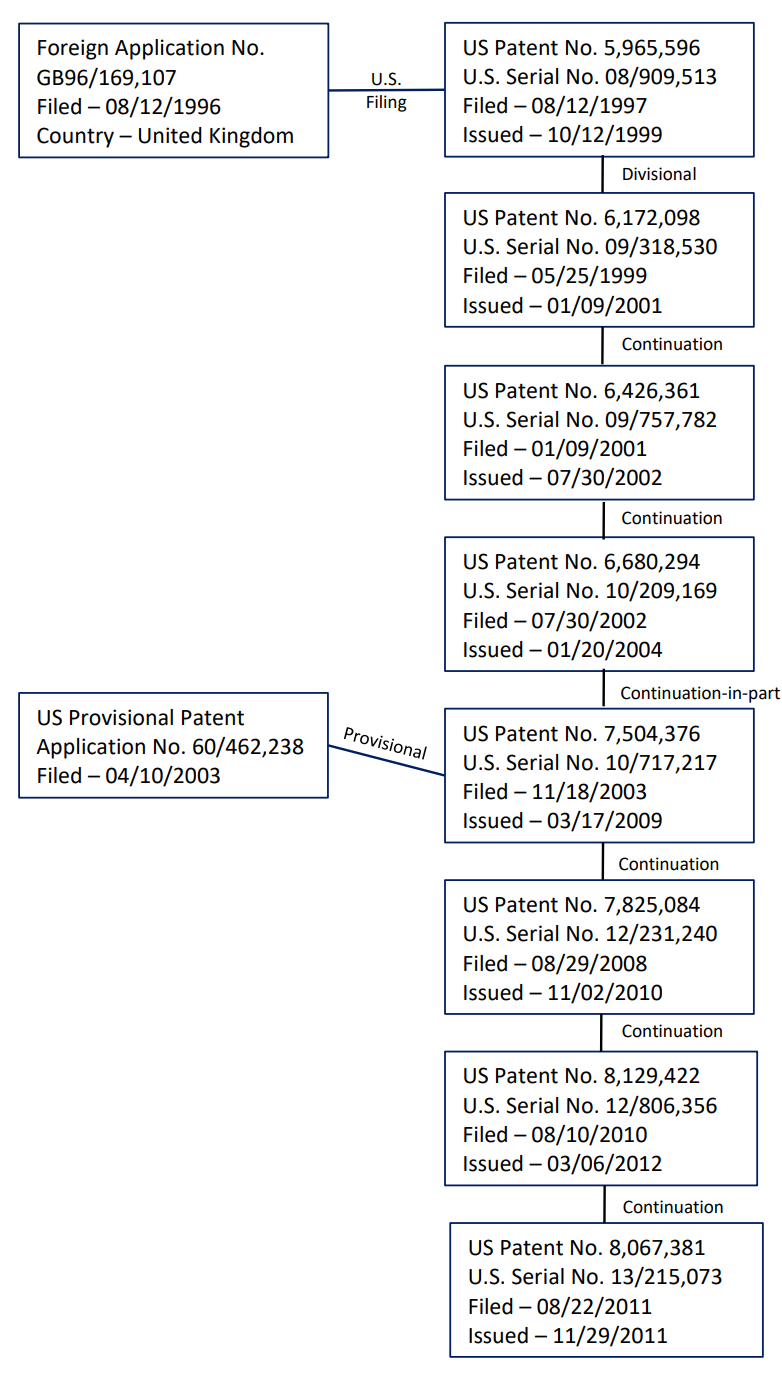
The patent at issue here is U.S. Patent No. 8,067,381 is directed to a dietary supplement containing free beta-alanine:

1. A human dietary supplement comprising at least one of:

… beta-alanine … an ester of beta-alanine …. or an amide of beta-alanine

that is not part of a dipeptide, polypeptide or oligopeptide.

The problem for the patentee here an unforced error in its chain of priority. 

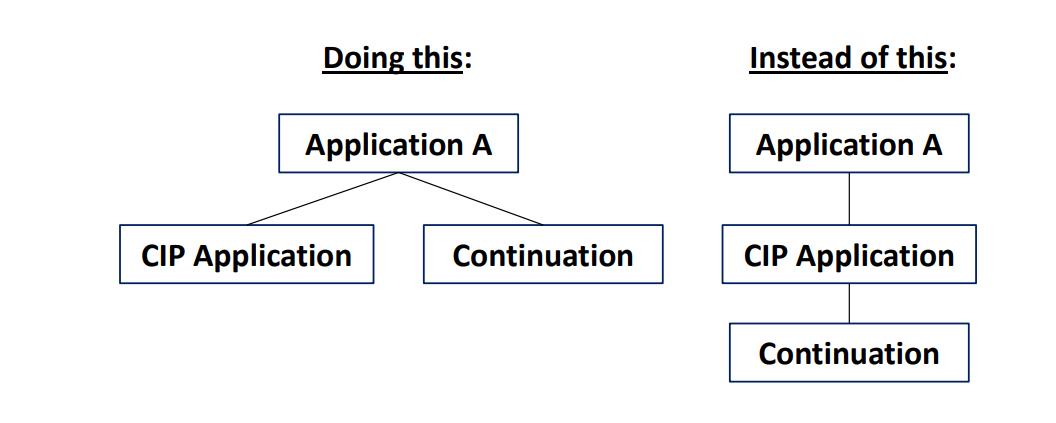
The patent at issue (applied for in 2011) is the last in a chain of eight U.S. patent applications plus one provisional and an original UK application originally filed in 1996. The new applications were filed in series just before the prior application’s issuance — such that the whole chain of priority needed to remain intact in order for the 1996 date to be effective.

The fifth and sixth in the series followed this approach and were filed with proper claims of priority reaching back all the way to the 1996 UK filing.  However, just before the fifth-application issued, “Natural amended the fifth application to delete its claim of benefit from the fourth through first applications in the series back to the 1996 British application’s filing date and, instead, claimed benefit solely of a provisional application filed in 2003.”  The idea here was that the fifth would have a later effective filing date and thus a later expiration date.  The problem, though, is that the changed priority claim in the fifth application broke the chain of priority for the sixth, seventh, and eighth.

On reexamination, the USPTO recognized the break in priority and rejected the eighth patent based upon the first patent in the series. And, on appeal, the Federal Circuit has affirmed:

Natural can only win on appeal if this Court accepts its erroneous thesis that a benefit claim vests on the day an application is filed and, thereafter, cannot be divested by events in another application. Natural’s thesis has no support in section 120 or this Court’s precedent.

Section 120 is is not clear on this point — it focuses on whether the prior application “contains or is amended to contain a specific reference to the earlier filed application.”  Although the statute does not delineate the result of eliminating a priority claim in a prior-filed application, the statute does suggest that amendments will be respected.  And, part of the difficulty here is that the chain of priority in the fifth application was not fully examined.  The court writes: “The mutable and unexamined nature of a benefit claim weighs against Natural’s argument that entitlement to a section 120 benefit claim permanently vests on an application’s filing date.”

Natural chose to delete the benefit claim in its fifth U.S. application and thereby obtained a longer term for the patent issuing therefrom. The foreseeable – and easily avoidable – consequence of this voluntary action is that Natural’s sixth through eighth U.S. applications would no longer be entitled to benefit of the filing date of its fourth through first U.S. applications.

The court notes that this problem was “easily avoidable.” Natural could have, for example, filed a separate continuation application from the fifth application to get those claims without soiling the trunk of priority claims.

Without the priority claim, Natural’s own prior patents become on-point prior art — as such, the invalidity is affirmed.


Patently-O Bits and Bytes by Juvan Bonni

Recent Headlines in the IP World:

Commentary and Journal Articles:

New Job Postings on Patently-O:

Should Your Engagement Letters Require Indemnification for 285-Fee Shifting?

As I’ve written, district courts are beginning to hold that if a case is exceptional under 285, fees can be imposed on, not just the losing patentee or infringer, but its lawyers (and principals).  I’ve written before that I have grave doubts this is permitted by the statutory text, and some courts so hold, but others are interpreting 285 to allow for it. (If an opposing party seeks to shift fees onto you under 285 consider the conflicts that it creates, as discussed in my prior posts.)

The Utah Bar Association issued an opinion, Utah Ethics Advisory Opinion Committee No. 18-04 (Sept. 11, 2018) (here), that you should consider. It addresses an issue that only a few opinions have, which is whether a lawyer can include in an engagement letter a provision that requires the prospective client to indemnify the lawyer for claims that arise from the client’s behavior or negligence — not the lawyer’s behavior or negligence (without jumping through the hoops of Rule 1.8(h).  (It also states that a lawyer may require a prospective client, in the engagement letter, to state that if the client sues the lawyer for legal malpractice and loses, the client must then reimburse the lawyer for the deductible in the malpractice insurance, if the client is advised to obtain independent counsel.)

The opinion provides an interesting possible way to, perhaps, deal with the chilling effect that Octane Fitness creates on lawyer advocacy while reasonably allocating liability.  These clauses will be scrutinized closely, and I’m not certain they would be accepted in every jurisdiction.

(August 15 post, below, has links to earlier article.)