March 25-26 the USPTO is hosting its Patent Quality Summit to discuss its pillars of patent quality and associated proposals.
Links:
March 25-26 the USPTO is hosting its Patent Quality Summit to discuss its pillars of patent quality and associated proposals.
Links:
by Dennis Crouch
In B&B Hardware v. Hargis Indus. (2015), the U.S. Supreme Court involved a trademark opposition running in parallel with a trademark infringement lawsuit over the mark SEALTITE/SEALTIGHT. The general holding is that a final decision by the US Patent & Trademark Office’s Trademark Trial and Appeal Board (TTAB) can serve as issue preclusion to collaterally estop a court from re-judging already-decided issues. The particular issue being precluded here is the likelihood-of-confusion between the two marks, and the Supreme Court held that the TTAB’s final decision on likelihood-of-confusion could preclude that issue from being later litigated in the collateral action between the parties.
A court should give preclusive effect to TTAB decisions if the ordinary elements of issue preclusion are met.
Here, the “ordinary elements” of issue preclusion are that “[w]hen an issue of fact or law is actually litigated and determined by a valid and final judgment, and the determination is essential to the judgment, the determination is conclusive in a subsequent action between the parties, whether on the same or a different claim.” Restatement (Second) of Judgments §27.
In its decision, the Supreme Court recognized (1) that the TTAB is an administrative agency and not an Article III court; (2) that a right to a jury trial would exist in the infringement action absent preclusion; (3) that the details and procedures associated with the TTAB judging likelihood-of-confusion were somewhat different (but not fundamentally different) than that applied in the 8th Circuit; and (4) that – had the TTAB decision been challenged – it was not appealed.
And it is undisputed that a civil action in district court would entail de novo review of the TTAB’s decision. Ante, at 5.
Going forward, the court is clear that many TTAB decisions will not have preclusive effective — but that is because they fail the ordinary elements of preclusion and not simply because the TTAB is an administrative agency or because the TTAB usually decides cases in a certain way.
The 7-2 decision was penned by Justice Alito with a concurring opinion by Justice Ginsburg. Justice Thomas wrote in dissent and was joined by Justice Scalia. The dissent argued that the court should not simply presume that Congress intended agency decision to have preclusive effect.
= = = = =
For patent attorneys, the case will have an obvious impact on the interplay between the Patent Trial and Appeal Board (PTAB) and parallel district court litigation. The same reasoning that led the Supreme Court to its decision in B&B will apply equally with determinations made during inter partes and post grant review proceedings. Importantly, issue preclusion applies to individual decisions of fact or law and thus may be important for sub-issues such as claim construction, scope and content of the prior art, level of skill in the art, etc.
Although B&B focused on traditional mutual issue preclusion, there is should also apply to defensive non-mutual issue preclusion that might arise when the defendant in an infringement action was not one of the parties in the IPR/PGR.
An important caveat: The Supreme Court recognized that issue preclusion won’t apply to agency decision when Congress so indicates. Here, there is an argument that the estoppel provisions in the IPR/PGR statutes suggest that Congress has opted out of the issue preclusion arena for these decisions.
= = = = =
One of the most interesting lines from the opinion: “federal law does not create trademarks.” For that line, the court cited Trade-Mark Cases, 100 U. S. 82, 92 (1879) (“This exclusive right was not created by the act of Congress, and does not now depend upon it for its enforcement. The whole system of trade-mark property and the civil remedies for its protection existed long anterior to that act, and have remained in full force since its passage.”).
By Jason Rantanen
Halo Electronics, Inc. v. Pulse Electronics, Inc. (Fed. Cir. 2015) (denial of rehearing en banc) Halo Order
The Federal Circuit denied Halo’s petition for rehearing en banc today over the dissent of Judges O’Malley and Hughes. (For background, Dennis and I previously wrote about the opinion and the petition for rehearing). The concurrence and dissent focused solely on the issue of willfulness, which Halo had framed as:
Willfulness: Whether an infringer who subjectively knew pre-suit that it was infringing a valid patent (after being given notice of the patent, and failing to design around, seek a license, or stop infringing) can use an unsuccessful defense developed post-suit as a per se bar to liability for pre-suit willful infringement, despite the flexible text of 35 U.S.C. § 284.
This is not the right case: Concurring in the denial of the rehearing en banc, Judge Taranto, joined by Judge Reyna, wrote separately to explain that the denial was appropriate because “Halo raises only one question about the enhanced-damages provision of the Patent Act, 35 U.S.C. § 274, and I do not think that further review of that question is warranted.” Concurrence at 4. In the concurrence’s view, “[t]he only enhancement-related question that Halo presents for en banc review is whether the objective reasonableness of Pulse’s invalidity position must be judged only on the basis of Pulse’s beliefs before the infringement took place.” Id. at 5. In Judge Taranto’s view, “Halo has not demonstrated the general importance of that question or that the panel’s assessment of objective reasonableness is inconsistent with any applicable precedents or produces confusion calling for en banc review.” Id. Nor is the requirement of objective recklessness affected by Octane Fitness.
Nevertheless, the concurrence observed, there are many aspects of the court’s § 284 jurisprudence that could bear revisiting en banc, including “whether willfulness should remain a necessary condition for enhancement under § 284’s “may” language,”” the proper standards for finding willfulness,” “who makes which decisions and what standards of proof and review should govern those decisions,” whether “a judge or jury decide willfulness, in full or in part,” whether “willfulness (or, rather, its factual predicates) have to be proved by clear and convincing evidence,” and “what standards govern appellate review”? In Judge Taranto’s words, “Whether such questions warrant en banc review will have to be determined in other cases.” Id. at 1.
The Willfulness Jurisprudence Should be Reevaluated: Judge O’Malley, joined by Judge Hughes, disagreed for the same reasons provided in her dissent to the original opinion (discussed here). The court’s “jurisprudence governing the award of enhanced damages under § 284 has closely mirrored our jurisprudence governing the award of attorneys’ fees under § 285.” Dissent at 2. But “[w]e now know that the artificial and awkward construct we had established for § 285 claims is not appropriate. We should assess whether the same is true with respect to the structure we continue to employ under § 284.” Id. at 4. Both the court’s framework for assessing willfulness and the framework for attorneys’ fees were predicted on its interpretation of Professional Real Estate Investors, Inc. v. Columbia Pictures Industries, Inc., 508 U.S. 49 (1993). But in Octane Fitness, the Supreme Court held that the Federal Circuit had misunderstood PRE for its attorneys’ fees inquiry. Consequently “[w]e should now assess whether a flexible test similar to what we have been told to apply in the § 285 context is also appropriate for an award of enhanced damages.” Id. at 5.
Beyond the effect of Octane Fitness, Judge O’Malley identifies additional issues with the current willfulness framework: its requirement of clear and convincing evidence, the court’s imposition of de novo review, which was rejected for fee awards by the Court in Highmark, and who should be making the decision to enhance damages: the judge or the jury?
The Unsettled Standard of Review: Shortly after releasing its denial of rehearing en banc in Halo, the court issued a revised opinion in Stryker v. Zimmer, in which it added a new footnote:
6 This court has not yet addressed whether Octane Fitness, LLC v. ICON Health & Fitness, Inc., 134 S. Ct. 1749 (2014), or Highmark Inc. v. Allcare Health Mgmt. Sys., Inc., 134 S. Ct. 1744, 1746 (2014), altered the standard of review under which this court analyzes the objective prong of willfulness. However, as the district court failed to undertake any objective assessment of Zimmer’s specific defenses, the district court erred under any standard of review and thus this court need not now address what standard of review is proper regarding the objective prong of willfulness.
Combined with the additional language in Stryker v. Zimmer, the court may be gearing up to take on a compromise issue in willfulness: namely, whether a modified standard of review is appropriate. That said, it is entirely possible that the Supreme Court will take on the bigger question that Judge O’Malley raises in dissent. Halo remains an appeal to watch.
by Dennis Crouch
Senju v. Lupin (Fed. Cir. 2015)
In a split decision, the Federal Circuit has affirmed a district court judgment that Senju’sU.S. Patent No. 6,333,045 is invalid as obvious. The patent covers an eye-drop formulation that is mixture gatifloxacin and EDTA (sold as Zymar) and has an interesting litigation history. In particular, this case represents the fourth time that the patent has been asserted in a lawsuit before Judge Sue Robinson (D.Del.). That history includes a prior finding by Judge Robinson that the claims were invalid as obvious. Following that original obviousness decision, Senju successfully shepherded the claims through an ex parte reexamination. In that process, the PTO confirmed the patentability of the claims once amended to include a specified concentrations of the aforementioned ingredients (e.g., “about 0.3 to about 0.8 w/v%” of gatifloxacin and “about 0.01 w/v%” of EDTA). Following reexamination, the court blocked Senju from asserting the reexamined claims against the same party (Apotex) who won the first obviousness decision — finding that claim to be precluded. However, the court did allow assertion of the new claims against new parties – here Lupin and Hi-Tech Pharma. However, after considering the same prior art as the USPTO, Judge Robinson found the revised claims still obvious based upon -again – the same prior art.
On appeal, the Federal Circuit affirms – holding that the district court’s conclusion of obviousness was correct. In the process the Federal Circuit appeared to give no deference to the USPTO reexamination determinations other than to require clear and convincing proof of the factual underpinnings of the obviousness determination. See Sciele Pharma Inc. v. Lupin Ltd., 684 F.3d 1253, 1260 (Fed. Cir. 2012) (“Whether a reference was previously considered by the PTO, the burden is the same: clear and convincing evidence of invalidity.”). The appellate court did agree that the amendments during reexamination did refresh the patent claims so as to reestablish the presumption of validity in the face of the prior invalidity ruling.
Regarding the added concentration limitation of “0.01 w/v% EDTA,” the two sides fought over whether that concentration level was suggested by the prior art studies. The court writes:
At bottom, the district court’s analysis rests largely on a determination that Lupin’s experts were more credible than Senju’s experts. Based on this determination, the district court found that [the Prior Art] Grass 1988-I, along with the other cited references, taught that 0.01 w/v% EDTA would be effective to increase corneal permeability. On the evidence before us, that determination by the district court falls well within the wide discretion the court has to weigh expert credibility. Ordinarily, and absent compelling reason otherwise, an appellate court defers to such credibility determinations.
With that (and some further analysis), the court affirmed the obviousness finding.
= = = = =
Judge Plager drafted the majority opinion that was joined by Judge Moore. Writing in dissent, Judge Newman argued that the courts should “give deference” to the PTO’s review of the narrowed claim scope and its conclusions regarding the unexpected results associated with the newly narrowed claims. Judge Newman further writes:
The prior art is crowded. . . . However, no combination of prior art references shows or suggests the use of very low concentrations of EDTA to enhance the corneal permeability of antibiotic formulations of gatifloxacin, or of any other quinolone. . . . The panel majority relies on the unsupported opinion of Lupin’s expert witness, and gives that unsupported opinion greater weight than the experimental data.
= = = = =
Although PTO reexamination decisions are not given deference in this type of third-party challenge, there are some reasons to think that IPR/PGR decisions should be given deference under the APA. However, it is unlikely that the Federal Circuit would come to that conclusion without first being led by either Congress or the Supreme Court.
by Dennis Crouch
The Federal Circuit decision in Two-Way Media focuses on a narrow issue of appellate deadlines – with a 2-1 majority concluding that AT&T cannot recover from missing its deadline for filing a notice to appeal following resolution of the defendant’s post-verdict motions.
AT&T had apparently relied upon the court’s PACER/ECF docket and email notification that had incorrectly labeled the Court’s final order (JMOL denial) as a decision on a motion to seal even though the underlying PDF documents clearly denied the JMOL motions. According to the appellate panel – that reliance was insufficient to excuse the delay.
The case is a cautionary tale warning against over reliance upon PACER/PAIR in docketing due-dates and particularly against automated docketing systems or docketing departments that rely primarily upon document headers to populate their information. Rather, the court writes here that “it is the responsibility of every attorney to read the substance of each order received from the court and that it is not sufficient to rely on the email notifications received from the electronic filing system.”
In the lawsuit, a jury found that AT&T infringed Two-Way Media’s U.S. Patent Nos. 5,778,187 and 5,983,005 under the doctrine of equivalents and that the asserted patent claims were neither anticipated or obvious. The result then was a $27.5 million reasonable royalty verdict raised to about $40 million with interest.
= = = = =
The rules of appellate procedure provide that a notice of appeal must be filed within 30 days of the final judgment. Fed R. App. Proc. 4(a)(1). Here, that timeline was triggered with the Judge’s November 22, 2013 docketing of its orders denying JMOL. However, AT&T claims that it did not have actual notice of the decisions until January 15, 2014 — well past the 30-day period. AT&T quickly filed a motion with the district court to extend/reopen the appeal period pursuant to Federal Rules of Appellate Procedure 4(a)(5) and (6). Those provisions provide for “extending” the appeal period if “the party shows excusable neglect or good cause,” F.R.A.P. R. 4(a)(5)(A)(i), or “reopening” the appeal period when “the moving party did not receive notice … of the entry of the judgment.” The district court denied that motion and the Federal Circuit has now affirmed – holding that the lower court’s decision was within its proper discretion.
The following is the Federal Circuit’s write-up on the district court findings:
In considering AT&T’s motion under Rule 4(a)(5), the court found that the AT&T had failed to show good cause or excusable neglect. Although the [Notices of Electronic Filing] communicated an arguably incomplete description of the orders, the district court noted that even a total lack of notice would not be enough, standing alone, to justify extending the time for filing an appeal. The court concluded that it is the responsibility of every attorney to read the substance of each order received from the court and that it is not sufficient to rely on the email notifications received from the electronic filing system. The court explained that the NEFs were sent to 18 attorneys at the two firms representing AT&T. The court further noted that assistants at those firms actually downloaded copies of all of the orders onto the firms’ internal systems. Finally, the court pointed to the fact that, on that same day, the court also issued orders denying the unsealed JMOL motion and entering a bill of costs—both of which produced accurately labeled NEFs. The district court therefore refused to extend the appeal period under Rule 4(a)(5). . . .
After concluding that AT&T’s neglect was not excusable, the court turned to AT&T’s request for relief under Rule 4(a)(6). . . . Here, the district court found that AT&T did receive notice of the entry of judgment when it received and downloaded those judgments from the electronic docket and that TWM would be prejudiced by the reopening of the appeal period, rendering Rule 4(a)(6) inapplicable.
On appeal, the Federal Circuit affirmed this reasoning. Thus, no appeal and AT&T must pay the $40 million.
= = = = =
The majority here was written by Judge O’Malley who has the tendency to give deference to district court judgments and be a stickler for following the rules of procedure. Judge Dyk wrote in dissent – arguing that AT&T had proven its case of not receiving notice because the docket listing was incorrect.
Now that USPTO Director Michelle Lee has fully taken office as Director, the next position-filling step will be to hire a Deputy Director. The Patent Act provides that the USPTO Director (Lee) will nominate a Deputy Director but that the Secretary of Commerce (Pritzker) has the power to make the actual appointment. 35 U.S.C. 3. According to the statute, the Deputy Director must “be a citizen of the United States who has a professional background and experience in patent or trademark law.” In a speech yesterday, Director Lee added her goal of “identifying the perfect individual for this position, someone who from day one can join with me and the rest of the agency’s leadership in promoting intellectual property and advancing innovation.”
Hal Wegner has mentioned two possible nominees: Russ Slifer (Director of the USPTO Denver Office) and Christal Sheppard (new Director of the USPTO Detroit Office). Slifer and Sheppard are current USPTO executives who have spent most of their careers outside the agency. Mike Walker (DuPont) has also been suggested as an excellent candidate, but it may be difficult to draw him away from his chief-IP-counsel role. It would be fun to have Kevin Noonan.
Terry Rea was the Deputy under Dave Kappos after Sharon Barner resigned from the post.
Guest post by Michael Risch, Professor of Law, Villanova University School of Law. Professor Risch also recently joined the Written Description blog as a regular author. The full article, forthcoming in the Iowa Law Review, is available here.
This follows my last guest post about my article A Generation of Patent Litigation and is the third in my Patent Troll Myths series of studies of the ten most litigious NPEs from 2000-2010. To recap, I gathered data on 1313 randomly selected patent cases distributed over a 25 year period in roughly the same proportion as the 917 cases filed by the most litigious NPEs over the same time period. The number of cases grew substantially starting in 2004. This led to 792 nonNPE patents versus 352 NPE patents, which indicates that the NPEs asserted the more patents per case. This article expands on the last one by looking at the technology categories for each patent as well as the initial source of the patent that wound up in litigation.
The results of my analysis confirmed much of what we already knew, but the data allowed me to demonstrate it. In short, patent litigation is a complex system made up of at least three layers: inventors and their assignees, patent plaintiffs, and technology. There are surely more layers, like defendants and licensees, but these three layers have some of the most relevance to patent quality. The problem is that most of our discourse examines one—or maybe a second—layer at a time, but rarely all three. Thus, we have NPEs versus producers, software versus pharma, individuals versus corporations. We rarely have data that includes all three of these layers in one place. When they are included, they are usually considered control variables rather than additional explanatory measures.
This study seeks the interconnection between the layers. I’ll give a few examples in this post, but there is a lot more detail in the paper.
Consider, for example, initial assignees. Both the random plaintiffs and the most litigious NPEs obtained a majority of their patents from product companies. And a substantial percentage of those companies were public for both groups (though about twice as many for the random plaintiffs). But not all product companies are created equal. Among the random companies, the initial assignees were bigger, better funded by venture and stock market investors, had more employees, and earned greater sales.
What does this mean? Any quality differences we might see between the NPEs and random plaintiffs might relate to the size and types of companies obtaining those patents. It also means that the technologies we see the NPEs enforcing might be the types of technologies that require less investment.
In fact, we do see different types of technologies. The following table shows the top five patent classes for each group with a comparison to the percentage held by the other group. The differences are stark. The paper shows the top 13 categories, and shows that 66% of the NPE patents are in the top 13 classes, while only 30% of the random group’s patents are in the top 13 classes.
| Top NonNPE Classes | Top NPE Classes | ||||||
| Class | NonNPE | NPE | Class | NonNPE | NPE | ||
| 514 | Drug | 4.17% | 0.28% | 379 | Telephonic Comm. | 2.40% | 17.05% |
| 362 | Illumination | 4.17% | 0.28% | 360 | Mag. Info. Storage | 0.00% | 8.24% |
| 348 | Television | 3.66% | 6.53% | 705 | Fin. Bus. Meth. | 1.01% | 6.82% |
| 424 | Drug | 3.54% | 0.00% | 348 | Television | 3.66% | 6.53% |
| 349 | Liquid Crystal | 2.53% | 0.00% | 709 | Data Process. Trans. | 1.89% | 4.55% |
When we break down by technology and by plaintiff type (two different layers), we see differences that weren’t apparent before. The graphs below show two categories, e-commerce, which has higher invalidation rates, and electric circuits, which has lower.
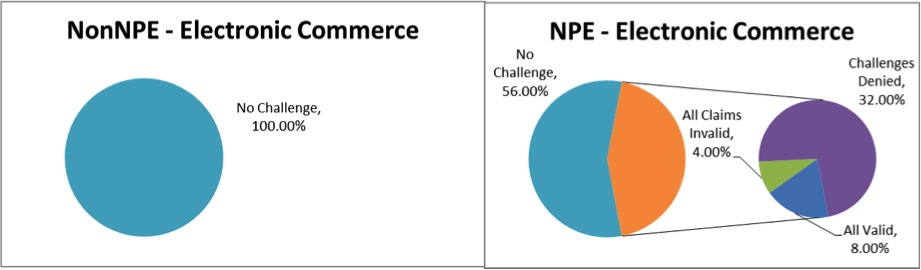
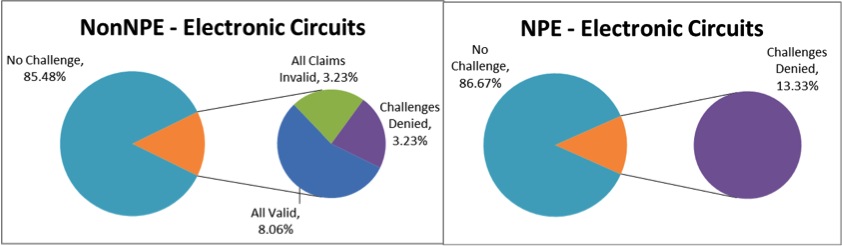
In electronic commerce, the nonNPE group saw no challenges – at all. Among the litigious NPEs, however, nearly half of the patents were challenged. When there was a decision on the merits, patents were completely invalidated about half as often as they were held valid. But much of the time, challenges were denied or pending at dismissal.
For electric circuits, however, patents were challenged at about the same rate. But this time it was the nonNPE group that was more likely to reach a decision on the merits – with validation more than twice as much as invalidation when there was a decision on the merits, but also a decision on the merits almost three-fourths of the time. Among the litigious NPE group, however, all of the challenges were denied or pending at settlement, and none went through to final judgment.
These are just two technology categories. The paper compares several others, including optics, chemistry, and medical instruments. It also considers results for different types of software (and for non-software).
As a final test, I ran a series of regressions to test the likelihood that a patent would be adjudicated to have any invalid claim. The full model is presented in the paper, but a few of findings stood out.
First, patents coming from failed startups had the highest correlation with invalidity, regardless of who enforced the patent.
Second, patents left unassigned at issuance were more likely to be invalidated whether asserted by either group (though individual obtained patents fared better when asserted by the random plaintiffs). However, the same was not true of patents assigned to inventor-owned companies. The data does not allow a causal inference, but there appears to be something about inventors starting their own companies that improves validity outcomes later.
Third, once source of the patent and type of plaintiff is controlled for, invalidity differences appear for only some types of technology. This is consistent with the graph I show above, but more rigorous. Thus, for example, cryptography patents are invalidated about one-third as often when we consider the source of the patent and type of plaintiff as compared to just looking at the average cryptography patent without patentee/plaintiff type. On the other hand, optics patents are invalidated at about the same rate, whether or not we consider the source or plaintiff type.
Fourth, these findings continue for software. Though software patents are, on average, invalidated more often than other patents (a finding consistent with other studies), when the type of patentee and plaintiff is considered, whether the patent covers software is no longer statistically significant.
This last point is ultimately the point of the article. When we consider all of the layers of the system rather than just the averages on any one layer, the picture gets far more complex. My data can’t answer every question, of course. After all, I only studied the most litigious NPEs. But even this sample shows the complexity. There’s much more I could write, but I’m out of space. The full article is here if you are interested in reading more.
by Dennis Crouch
I received a number of comments on one line from my post yesterday where I stated:
The law requires that a patented invention represent a significant advance beyond what was previously known in the art.
See Obviousness as a Question of Fact, Patently-O (March 17, 2015).
The basic retort from patent attorneys is that there is no “significant advance” requirement. Rather, the 1952 Patent Act involved an intentional rewriting of the law of invention to focus only on obviousness and remove the “invention” requirement.
When thinking about patent law doctrine, I ordinarily begin with the Constitutional provision that suggests creation of a system that offers exclusive rights to inventors for their discoveries in order to promote the progress of the useful arts. When I speak of an advance or invention, I do so within this Constitutional framework. The idea here is to promote the progress. Now, we might generally argue about whether we care what our long-dead policy predecessors goals for society, but most will still agree that progress in the useful arts of medicine, energy, transportation, communications, manufacturing, etc., continue to be proper goals.
It makes sense that an invention will usually represent an advance that is both new and better than the prior art in some way. However, there will be times when someone conceives of a new product that is worse than the prior art in every measurable way. (E.g., worse performance, higher costs to manufacture, higher failure rate, and worse customer appeal). In certain instances, a company may want to make and sell that more expensive but lower quality product if – for instance – the better product is locked-up by a competitor’s patent. That partial substitute may still be competitive in an otherwise over-concentrated market.
I argue that the invention of a lower-quality and higher-cost product can still represent the type of significant advance that I highlighted above and that the obviousness test is a good measure of that advance.
The worse-invention still represents a new application of technology that would not have been obvious to someone skilled in the art. And that new application fills-out the space of our technological knowledge in a way that can serve as a building block for future innovations. It has happened time-and-again that major successful innovations are built upon a series of innovative but failed endeavors — those “failures” are part of the progress and represent significant advances.
We have a real problem if the system does in-fact offer patents without any invention or any advance. Fortunately, the obviousness test is designed to prevent that from happening. Now, we just have to make sure that the test is applied in a way that lives up to our hopes.
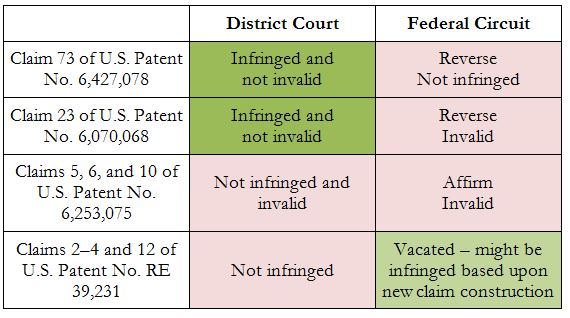
The Federal Circuit’s decision in MobileMedia Ideas v. Apple is almost comic – with the appellate panel rejecting the district court decisions siding with Apple as well as those siding with MobileMedia. The chart below highlights the transformation.
 MobileMedia is an MPEG LA company that was formed as a collaboration of Nokia and Sony.
Obviousness: An interesting aspect of the decision is obviousness analysis of Claim 73 of the ‘078 patent. The law requires that a patented invention represent a significant advance beyond what was previously known in the art. That obviousness doctrine is codified under 35 U.S.C. § 103 and serves to invalidate patents “if the differences between the subject matter sought to be patented and the prior art are such that the subject matter would have been obvious.”
Claim 73 is directed to a mobile phone with a built in camera optics and an “image sensor” along with the requisite control, capture, storage, user interface, and transmitting capabilities being directed through a microprocessor. (App filed in 1995).
All the Elements in Two References: The prior art here follows the typical obviousness scenario. Namely all of the elements of the claimed invention are found within a collection of prior art documents, but no single reference teaches each and every element. Here those references are, Kyocera (Japanese Pub. No. H6-133081 disclosing camera phone with the image sensor and optics but somehow does not disclose the microprocessor) and Lucent (U.S. Patent No. 5,550,646 disclosing a camera device with an interface, display, and controls operating through a microprocessor).
At this point, we have the parallel scenario that the Supreme Court addressed in the oft cited case of KSR v. Teleflex (2007). There, the Court noted “a combination of familiar elements according to known methods is likely to be obvious when it does no more than yield predictable results.” In its flexible approach, the Court noted that such a combination should consider both (1) whether a skilled artisan would recognize the combination as a potential improvement as well as (2) whether the actual combination would be within the skill of the artisan.
[I]f a technique has been used to improve one device, and a person of ordinary skill in the art would recognize that it would improve similar devices in the same way, using the technique is obvious unless its actual application is beyond that person’s skill. A court must ask whether the improvement is more than the predictable use of prior-art elements according to their established functions.
Here, MobileMedia’s expert testified that integrating the Lucent microprocessor would actually require more skill than held by an ordinary skilled artisan (EE with 4-years experience). And, on appeal, the Federal Circuit ruled that the testimony offered “a reasonable basis” for rejecting the obviousness defense.
Fact or Law: In its analysis here, the Federal Circuit gave deference to the jury verdict — re-holding that “the question of whether there was a reason to combine certain references” is a question of fact. (citing TransOcean 2010). However, that statement of the law appears to conflict with the approach actually taken by the Supreme Court in KSR. In addition, the particularly conclusion here – that the posed combination is beyond the level of skill in the art appears to merge together the various Graham factors in a way that leads directly to the ultimate conclusion legal of non-obviousness. To me, that looks like the combination here is a conclusion of obviousness, which is a question of law. The approach is consistent, however, with the approach of allowing a jury to decide all issues of obviousness.
= = = =
Although this case is in the midst of infringement litigation, the law of obviousness applies equally to prosecution. Here, applicants may be interested in reviewing the expert testimony to see what carried the day in proving that the proposed combination would be beyond the skill of an ordinary skilled artisan at the time of the invention. Here, the basic issue was not in connecting the elements together but instead in programming the microprocessor to work.
A new business article on “measuring innovation” notes that 50% of firms investing in R&D are not patenting the results of their research. The main thrust of the article is that, because so many firms are avoiding the patent system, that patents do not make sense as a broad measure of innovation. Their solution is to use the Research Quotient (Prof Knott’s measure of optimal research output based upon various financial outputs) as a better measure. See Cooper, Knott, and Yang, Measuring Innovation (March 2, 2015). Available at SSRN: http://ssrn.com/abstract=2572815 or http://dx.doi.org/10.2139/ssrn.2572815.
by Dennis Crouch
The list below considers all of the U.S. Supreme Court patent cases decided during the past decade (Since January 2005) and ranks them according to the number of citations. Citation offers some insight into the influence of decisions, but is obviously limited for a number of reasons. Cases may be cited because of their importance in changing the doctrine (KSR, eBay) or simply as the court’s most recent statement of the law on an important issue (Microsoft v. i4i and KSR) or for a narrow procedural issue that applies in many cases (Unitherm). EBay’s high citation rate is also boosted because its principles have been applied broadly to injunctive relief across many areas of law. Some cases with low citation counts may also have major impacts. They may, for instance impact a small number of very important cases (Caraco) or perhaps they cause folks to change behavior so that the issue stops arising.
With this list we also have the timeline problem where older cases are more likely to be highly cited since there has been more opportunity for those cites. I Alice Corp to rise in the ranks Nautilus and Teva, on the other hand, may well flounder (based upon the Federal Circuit’s treatment of those cases thus far).
KSR has actually rocketed to the position of most-cited Supreme Court patent case of all time followed by Markman (1996); U.S. Gypsom (1948) (antitrust-patent); Graham v. Deere (1966); and Warner-Jenkinson (1997).
Earlier this month I posted a letter to Congress from a group of 51 law professors and economists suggesting that the empirical evidence shows that patents are actually serving as a deterrent to innovation because potential innovators are afraid of getting sued for patent infringement and that the rewards of patent reform “could be great.” Now comes the response signed by 40 law professors and economists expressing “deep concern” that the aforementioned studies are “flawed, unreliable, [and] incomplete.” I have copied the letter below. Those of you following will note substantial similarity to the counter-post from Ted Sichelman who was instrumental in drafting and circulating this letter -Dennis
[Read the full letter with its citations]
*****
[To Members of the United States Congress:]
As economists and law professors who conduct research in patent law and policy, we write to express our deep concerns with the many flawed, unreliable, or incomplete studies about the American patent system that have been provided to members of Congress. Unfortunately, much of the information surrounding the patent policy discussion, and in particular the discussion of so-called “patent trolls,” is either inaccurate or does not support the conclusions for which it is cited.
As Congress considers legislation to address abusive patent litigation, we believe it is imperative that your decisions be informed by reliable data that accurately reflect the real-world performance of the U.S. patent system. The claim that patent trolls bring the majority of patent lawsuits is profoundly incorrect. Recent studies further indicate that new patent infringement filings were down in 2014, with a significant decline in non-practicing entity (NPE) case filings. Unfortunately, these facts have gone largely unnoticed. Instead, unreliable studies with highly exaggerated claims regarding patent trolls have stolen the spotlight after being heavily promoted by well-organized proponents of sweeping patent legislation.
Indeed, the bulk of the studies relied upon by advocates of broad patent legislation are infected by fundamental mistakes. For example, the claim that patent trolls cost U.S. businesses $29 billion a year in direct costs has been roundly criticized. Studies cited for the proposition that NPE litigation is harmful to startup firms, that it reduces R&D, and that it reduces venture capital investment are likewise deeply flawed. In the Appendix, we point to a body of research that calls into question many of these claims and provides some explanation as to the limitations of other studies.
Those bent on attacking “trolls” have engendered an alarmist reaction that threatens to gut the patent system as it existed in the Twentieth Century, a period of tremendous innovation and economic growth. Indeed, award-winning economists have linked the two trends tightly together, and others have noted that it is exactly during periods of massive innovation that litigation rates have risen. We are not opposed to sensible, targeted reforms that consider the costs created by both plaintiffs and defendants in patent litigation. Yet, tinkering with the engine of innovation—the U.S. patent system—on the basis of flawed and incomplete evidence threatens to impede this country’s economic growth. Many of the wide-ranging changes to the patent system currently under consideration by Congress raise serious concerns in this regard.
That these proposed changes to the patent system have not been supported by rigorous studies is an understatement. We are very concerned that reliance on flawed data will lead to legislation that goes well beyond what is needed to curb abusive litigation practices, causing unintended negative consequences for inventors, small businesses, and emerging entrepreneurs. It is important to remember that inventors and startups rely on the patent system to protect their most valuable assets. Legislation that substantially raises the costs of patent enforcement for small businesses risks emboldening large infringers and disrupting our startup-based innovation economy. If reducing patent litigation comes at the price of reducing inventors’ ability to protect their patents, the costs to American innovation may well outweigh the benefits.
As David Kappos, the Director of the Patent Office from 2009 to 2013, stated in 2013 testimony before the House Judiciary Committee, “we are not tinkering with just any system here; we are reworking the greatest innovation engine the world has ever known, almost instantly after it has just been significantly overhauled” by the America Invents Act in 2011. “If there were ever a case where caution is called for, this is it.” As Congress addresses this important issue, we hope you will demand empirically sound data on the state of the American patent system.
Sincerely,
Michael Abramowicz (GWU); Martin J. Adelman (GWU); Andrew Beckerman-Rodau (Suffolk); David C. Berry (Cooley); Ralph D. Clifford (UMass); Christopher A. Cotropia (Richmond); Gregory Dolin (Baltimore); John Duffy (UVA); Richard A. Epstein (NYU); Chris Frerking (UNH); Damien Geradin (George Mason); Richard S. Gruner (John Marshall); Stephen Haber (Stanford Poli-Sci); Timothy R. Holbrook (Emory); Chris Holman (UMKC); Ryan Holte (SIU); Gus Hurwitz (Nebraska); Jay P. Kesan (Illinois); Zorina Khan (Bowdoin Econ); Anne Layne-Farrar (Northwestern); Stephen M. Maurer (Berkeley Public Policy); Damon C. Matteo (Tsinghua); Michael Mazzeo (Northwestern Management); Adam Mossoff (George Mason); Sean O’Connor (UW); Kristen Osenga (Richmond); Jorge Padilla (Lexecon); Lee Petherbridge (Loyola); Michael Risch (Villanova); Mark Schultz (SIU); David L. Schwartz (Chicago Kent); Ted Sichelman (USD); Brenda M. Simon (Thomas Jefferson); Matthew Laurence Spitzer (Northwestern); Daniel F. Spulber (Northwestern Management); David J. Teece (Berkeley Business); Shine Tu (WVU); Polk Wagner (Penn); Brian Wright (Berkeley Ag-Econ); Christopher S. Yoo (Penn).
As part of its patent quality initiative, the USPTO has offered six proposals for comment and discussion. These will serve as focal-points for the March 25-26 Patent Quality Summit hosted at the USPTO’s Arlington HQ. I will be participating in the Summit that looks to offer a highly-interactive experience where all attendees will have the opportunity to be heard. Via its Federal Register notice, the USPTO is also seeking written comments on the proposals.
by Dennis Crouch
The U.S. Senate has now confirmed President Obama’s nomination of Michelle Lee as Undersecretary of Commerce and Director of the USPTO. Congratulations to Director Lee on this expected but long awaited final step to filling the post left by David Kappos more than two years ago. Lee has been with the PTO since 2012 and was previously Google’s chief patent counsel.
We will see Director Lee staying the course that she has already set with a focus on patent quality and efficient operations. The larger and ongoing battles will be fought over patent litigation reform and the role of our post grant review system. Lee is the first female director of the agency, whose top three leaders are now all women (with Peggy Focarino as Commissioner of Patents and Mary Boney Denison as Commissioner of Trademarks).
I very much look forward to working with Director Lee and her team at the USPTO. As part of this, we’re hosting a patent quality summit at the USPTO on March 25-26, 2015. [http://www.uspto.gov/patent/initiatives/patent-quality-summit]
Lee will likely be given latitude in naming her deputy director. Hal Wegner – very often correct in his insight – suggests two potential candidates: Russ Slifer (Director of the USPTO Denver Office) and Christal Sheppard (Director of the USPTO Detroit Office). Slifer and Sheppard are current USPTO executives who have spent most of their careers outside the agency.
 For those of you interested: Yes, I am one of those technologists who sends his kids to a low-tech elementary school where they learn to build, knit, paint, dye, crochet, and write — but basically only work with materials and tools that they can find in nature or make themselves. I’m pretty confident that they’ll still figure out how to use an iPad when the time comes. Here is the most recent article on the school: http://www.columbiamissourian.com/a/186109/fairy-huts-pop-up-around-town-for-truefalse-film-fest/
-Dennis
This is a guest post written by Tim Molino who is the Policy Director for BSA, which as shortened its name to The Software Alliance. Prior to joining BSA, Tim was Chief Counsel for Sen. Klobuchar (MN) and before that, he was a patent litigator for eight years. The BSA has just filed an amicus brief in the Activision Blizzard case whose Section 101 issue is pending before the Federal Circuit. This is one of the several cases where parties are testing for the boundaries of Alice Corp. – Dennis
= = = = =
by Tim Molino
The highly-anticipated Alice Corp. v CLS Bank case was widely expected to clarify the application of Section 101 to computer-implemented inventions and many expected the decision would answer the contentious question of whether software is eligible for patent protection. Instead, the Supreme Court issued a relatively narrow ruling that cast doubt on the eligibility of most business methods, but suggested that software-based inventions that “improve the functioning of the computer itself” or “effect an improvement in any other technology or technical field” would likely be eligible.
Now lower courts are beginning to apply the Alice and the Supreme Court’s distinction between abstract business practices and technological inventions. To date, the bulk of the district court decisions have dealt with so-called business method patents that recite a business practice or economic concept combined with a token recitation of implementation on a computer. District courts have correctly invalidated these patents under 101 in the wake of Alice and Bilski. But we have also seen some troubling decisions where Alice has been misapplied to invalidate patents directed to real technology, rather than abstract business concepts.
Docket Navigator data suggests that in 2015, we could see more than 150 patent cases in district courts, arguing the patents are invalid on 101 grounds – and if the current trends continue, the patent would be invalidated in as many as 111 of those cases. These trend lines are troubling. With more than $50 billion in software research and development incentives at stake, it is imperative that the Federal Circuit make a course correction and send a clear signal that software-based technology is eligible for patent protection.
McRO v. Activision Blizzard – An Opportunity
Fortunately, the Federal Circuit has an opportunity to provide much-needed guidance to the lower courts in the upcoming McRO v. Activision Blizzard appeal. The McRO patents describe a computerized process for “automated rules-based use of morph targets and delta sets for lip-synchronized three-dimensional animation” that was a significant improvement over computer-aided processes previously used in the industry.
In this case, the Federal Circuit will use the Mayo and Alice decisions to guide their ruling. The Mayo and Alice decisions set forth a two-step analysis for eligibility: First, the court must “determine whether the claims at issue are directed to” an ineligible “abstract idea, law of nature, or a natural phenomenon.” If so, the court must then consider the elements of each claim to determine whether they contain sufficient detail and additional limitations “to ensure that the patent in practice amounts to significantly more than a patent upon the [ineligible concept] itself.”
The lower court began its eligibility analysis in McRO v. Activision by noting that “[f]acially, these claims do not seem directed to an abstract idea. They are tangible, each covering an approach to automated three-dimensional computer animation, which is a specific technological process.” However, instead of stopping there and recognizing that the patents did not involve an “abstract idea,” the court proceeded to invalidate them based on its conclusion that the claims covered nothing significantly more than the abstract idea of “using a rules-based morph target approach” to accomplish “automatic lip synchronization for computer-generated 3D animation.”
As we argue in our brief, reaching this counterintuitive (and seemingly counterfactual) conclusion required fundamental errors in applying both steps of the Alice analysis.
Step One – Are the claims directed to an abstract idea?
The claims at issue are directed to a specific, practical and useful improvement to an existing technological process. Claim 1 of the ‘576 patent reads:
A method for automatically animating lip synchronization and facial expression of three-dimensional characters comprising:
obtaining a first set of rules that define output morph weight set stream as a function of phoneme sequence and time of said phoneme sequence;
An apparatus for automatically animating lip synchronization and facial expression of three-dimensional characters comprising:
obtaining a timed data file of phonemes having a plurality of sub-sequences; generating an intermediate stream of output morph weight sets and a plurality of transition parameters between two adjacent morph weight sets by evaluating said plurality of sub-sequences against said first set of rules;
generating a final stream of output morph weight sets at a desired frame rate from said intermediate stream of output morph weight sets and said plurality of transition parameters; and
applying said final stream of output morph weight sets to a sequence of animated characters to produce lip synchronization and facial expression control of said animated characters.
Clearly, this claim describes a concrete, real-world innovation that solves the difficult problem of accurately replicating the human face and speech in CGI and animation.
So how did the lower court conclude that it recites nothing more than an abstract idea? It did so by reversing the order of Alice’s two analytical steps and by collapsing them into a single inquiry.
Rather than first determining whether the claim as written was directed to an abstract idea and then assessing the claim’s “additional element” to determine whether they add significantly more to the idea, the court began by seeking to uncover the “abstract idea” lurking underneath the claim language by stripping away all elements that were known in the prior art in an attempt to discover the claims “point of novelty.”
Step Two – Does the claim contain additional elements that ensure the patent amounts to “significantly more” than the underlying abstract idea?
The lower court’s application of step-two is equally misguided and problematic. In step two of the Alice test, the court must assess whether the “additional elements” (i.e., any element beyond the abstract idea itself) places meaningful limitations on the scope of the claim.
In describing step two, the Supreme Court stated in Mayo that “well-understood, routine, conventional activity” previously used in the field “is normally not sufficient to transform an unpatentable [abstract idea] into a patent-eligible application . . . .” In other words, it is not generally “enough” simply to append routine, conventional steps – described at a high level of generality – to the abstract idea.
Unfortunately, the lower court fundamentally misinterprets this statement to mean that only novel elements (rather than all “additional elements”) should be considered for purposes of the “significantly more” analysis. The court then proceeds (yet again) to read all of the additional elements out of the claim because they lack sufficient novelty. Unsurprisingly, once all of the additional limitations recited in the claim are stripped away, all that is left is the abstract idea, leading the court to conclude that the claim fails the “significantly more” test.
This approach lacks any basis in the case law and ignores the fundamental difference between what is “known” in the prior art and what is “conventional” in industry practice. For something to be conventional it must not only be known, but widely-adopted. Put simply, the fact that space travel is “known” in human society by no means makes it a “conventional” practice.
Conflating these two concepts and disregarding any element that has a basis in the prior art makes it virtually impossible to satisfy step two. As the Supreme Court recognized in Mayo, “all inventions at some level embody, use, reflect, rest upon, or apply laws of nature, natural phenomena, or abstract ideas,” and as a result “too broad an interpretation” of these implicit exclusions from eligibility would “eviscerate patent law.”
The approach taken by the lower court would fulfill this dismal prophesy. As Judge Pfaelzer noted in a subsequent decision, “it is difficult to imagine any software patent that survives under McRO’s approach—most inventions today build on what is known in the art, and an improvement to software will almost inevitably be an algorithm or concept which, when viewed in isolation, will seem abstract. This analysis would likely render all software patents ineligible, contrary to Congress’s wishes.”
The Federal Circuit must be clear and decisive in nipping this in the bud. In deciding McRO, not only should they overrule the lower court’s erroneous conclusion, but they should take care to provide additional guidance regarding the correct application of the Alice test to avoid similar misapplication in other cases. This would provide much-needed clarity and certainty to patent holders and industries that rely on technology and software patents, shoring up our economic competitiveness and maintaining more than 2.5 million American jobs.
******
BSA’s members include: Adobe, Altium, Apple, ANSYS, Autodesk, Bentley Systems, CA Technologies, CNC/Mastercam, Dell, IBM, Intuit, Microsoft, Minitab, Oracle, PTC, salesforce.com, Siemens PLM Software, Symantec, Tekla, The MathWorks, and Trend Micro.
******
Briefs Filed Thus Far:
In February 2015, a Delaware Jury sided with Intellectual Ventures in its case against Symantec — finding that the security software company was infringing two IV patents and awarding $17 million in damages. U.S. Patent Nos. 6,073,142 and 5,987,610.
In an interesting post-verdict letter, Judge Stark has noted that the damages may have to be reduced because of the lack of evidence that the patented features “drove demand” for the accused products. [1-10-cv-01067-LPS-691-PRIMARY DOCUMENT]. I should note here that the letter is expressly not (yet) an order.
At trial, Intellectual Ventures damages expert (Michael Wagner) took the risky strategy of presenting only testimony relating to damages under the entire market value rule and did not offer a fallback reasonable royalty position. That approach kept choices simple for the jury, but now it seems that the entire-market-value calculation likely lacks sufficient supporting evidence. If that testimony is disregarded then the only fall-back position is the damage evidence presented by Symantec’s expert. Although that figure is currently under seal, it is most certainly significantly less than the $17 million award.
Judge Stark has also ordered post-trial briefing on whether the asserted claims lack patentable subject matter under Section 101 with the hope of resolving that issue before a second trial where IV is asserting the same patents against Trend Micro. Obviously, a Section 101 ruling could eliminate the damage award in full.
= = = = =
About half of the award was associated with Symantec’s infringement of Claim 7 of the ‘610 patent. Claim 7 is a dependent claim (from claim 1), but I have rewritten it below in its equivalent independent form:
7. A virus screening method comprising the steps of:routing a call between a calling party and a called party of a telephone network;receiving, within the telephone network, computer data from a first party selected from the group consisting of the calling party and the called party;detecting, within the telephone network, a virus in the computer data; andin response to detecting the virus, inhibiting communication of at least a portion of the computer data from the telephone network to a second party selected from the group consisting of the calling party and the called party; and further comprising the step of determining that virus screening is to be applied to the call based upon at least one of an identification code of the calling party and an identification code of the called party.
By Jason Rantanen
One of the main pieces of empirical data being drawn upon by folks arguing for and against various patent law reform proposals is the rate of new patent lawsuit filings. As the intellectual property scholars’ letter to Congress recently observed, while there were fewer patent lawsuits filed last year than in 2013, that year was itself a record-setting year for patent lawsuit filings. Professor Matthew Sag’s new study, IP Litigation in the United States District Courts: 1994 to 2014, illustrates the point of rising patent litigation dramatically: in the sixteen years from 1994 until 2010, the annual number of patent lawsuit filings doubled; it doubled again in the three years from 2010 to 2013.
While Professor Sag’s study provides a comprehensive empirical look at intellectual property litigation rates across all areas, over at Lex Machina legal data scientist Brian Howard has dug deeply into the patent lawsuit filing rate numbers to examine whether the America Invents Act led to a reduction in patent lawsuit filings once the anti-joinder provision of the AIA is accounted for. Even when controlling for the disaggregation of multi-defendant suits, he finds a rise in patent lawsuit filings during the two years after the enactment of the AIA. While the more recent period has seen filings turn downward, his findings about the short term effects of the AIA are surprising and worth thinking about further.
Finally, as I’ve noted in the past, I find it useful to think not just about new patent lawsuit filings, which can provide a barometer of future patent litigation activity, but also about currently pending patent litigation and lawsuit termination rates. In my view, these provide a better (although still imperfect) gauge of what kind of patent activity courts are presently seeing. Figures 1 and 2 below are updated versions of the pending patent lawsuit data that I’ve previously written about.
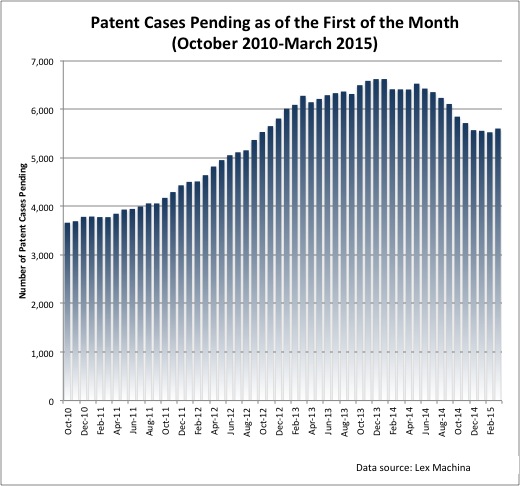
Figure 1
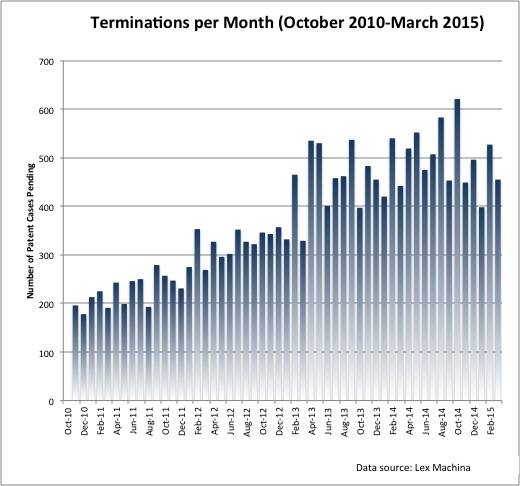
Figure 2
The bottom line for this data is that while pending patent litigation remains below the all-time highs of the late 2013’s and early 2014, this activity has plateaued over the last few months and even rose slightly in February. Digging a bit under the hood of the data, this rise appears due an increase in filings over that month as opposed to a drop in terminations, with February 2015 seeing about 500 new patent cases filed—a rise of 69 over January despite the shortness of the month. Given the close attention that is paid to patent lawsuit filing rates, I suspect that this is a point that will be jumped on by many. The below graph shows the number of patent actions filed, using LexMachina data, on a monthly basis from August 2014 – February 2015.
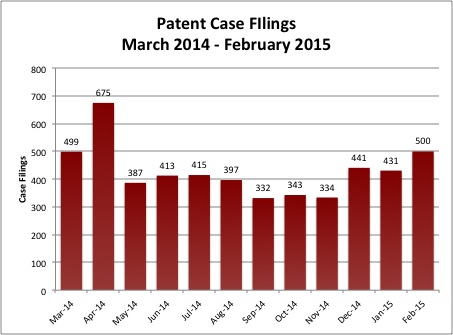
Figure 3
Guest Post by Professor Amelia Smith Rinehart (University of Utah)
Recently, the Federal Circuit held that the New York Times and others infringed patents claiming methods and systems for delivering content to smartphones.[1] In a related Patently-O essay, Professor Sam Ernst states that the Federal Circuit’s opinion in Helferich is “directly contrary to Supreme Court precedent and represents a fundamental misunderstanding of one of the core purposes of the exhaustion doctrine.”[2] To support his premise, Ernst claims that the Federal Circuit made “a broad and novel pronouncement that patent exhaustion only shields an authorized acquirer from liability, and does not follow the licensed device down the stream of commerce to protect all users of the device for its intended purpose.” [3]
I respectfully disagree. There is nothing broad or novel about the Federal Circuit’s “authorized acquirers” concept. In fact, as the Federal Circuit explains in Helferich, it comports with 150 years of judicial authority examining the patent exhaustion doctrine in a variety of contexts.[4] Likewise, Helferich squares directly with the Supreme Court’s recent exhaustion decisions in Quanta Computer v. LG Electronics[5] and Bowman v. Monsanto Co.[6] More surprising, perhaps, may be the fact that this is so—that Helferich could win infringement suits against New York Times and J.C. Penney based on their provision of content to smartphones that were already licensed by Helferich.[7] Accordingly, the difficulty with Helferich is not that the Federal Circuit stretches the exhaustion doctrine in a new way, but that the doctrine, in its old way, fails to provide an easy way to remove infringement liability in an increasingly complex world of patent assertion.
In his well-reasoned post, Professor Ernst contends that the exhaustion doctrine “has frequently applied to shield from liability persons who are not ‘authorized acquirers’ of the licensed devices,” and looks to both Quanta and the much older Motion Picture Patents v. Universal Manufacturing Co. for support. In my view, neither of these cases provides authority for applying the exhaustion doctrine directly to third parties who have not acquired the sold articles.
Quanta involved a license agreement that authorized the licensee to make, use, and sell the licensed products without restriction. In a separate agreement, the licensee agreed to notify its customers that they did not have a license to combine the licensed products with other non-licensed components. The Supreme Court held that the notice restriction was irrelevant because the licensee had a blanket authorization to make, use, and sell the licensed products. Once made then sold under this first authorization to make, sell, and use, the licensed products could be used by anyone downstream without liability for infringement on the grounds of exhaustion, including those purchasers who had notice of the separate notice restriction.[8] In Quanta, the purchasers of the licensed products—the customers of the licensee, Intel—were authorized acquirers (having acquired title to the products from one authorized to make and sell them unconditionally) shielded from liability when the patent owner sued them for infringement. The Quanta Court did not have to address the question of whether a third party who has not acquired title to a licensed product is shielded from direct liability for its own infringement by an authorized acquirer’s unlimited right to use and sell the patented good obtained via exhaustion.
Motion Picture Patents provides a more nuanced account of the exhaustion doctrine, but still involves authorized acquirers shielded from infringement liability.[9] The patented movie projectors in Motion Picture Patents carried a label notice that restricted the projector owner’s permission to use the projector to use solely with the patent owner’s films. After the patent owner sued a projector owner and a third party film manufacturer for infringement, the Court held that the projector patent rights were not infringed because of exhaustion. The label notice was not enforceable as a matter of patent law because the films were not within the patent rights in question—“to enforce [the label notice] would be to create a monopoly in the manufacture and use of moving picture films, wholly outside of the patent in suit and of the patent law as we have interpreted it.”[10] The projector owner clearly qualified as an authorized acquirer (with an invalid restriction on use) and avoided infringement liability because the authorized projector sale exhausted the patent rights covering those projectors.
Professor Ernst seems to extrapolate from the Motion Picture Patents opinion (which admittedly is unclear on this point) that the third party film manufacturer could not be liable for infringement of the projector patents because it made and sold films for use in the projectors obtained from the patent owner in an authorized sale. In other words, Professor Ernst reads Motion Picture Patents to hold that exhaustion shielded the film manufacturer from liability because otherwise the patent owner could interfere with a projector owner’s use of the machines themselves.[11]
But Motion Picture Patents doesn’t go that far. The questions addressed by the Supreme Court both focus on whether the patent owner can restrict by mere notice a machine’s use by its purchaser or his successors in interest.[12] Later in its opinion, the Supreme Court distinguishes the machine from the materials to be used with it, declaring that “the right of the owner [of the machine] . . . to control by restriction the materials to be used in operating [it] . . . must be a right derived through the general law from the ownership of the property in the machine.”[13] Plainly, the Court applies the exhaustion doctrine to the possessor of the projector, a patented good now in commerce and owned free and clear from the patentee’s right to control the use and sale of the good itself. Therefore, I believe the better view of Motion Picture Patents is that the film manufacturer would’ve been liable, if at all, on a theory of contributory infringement. When the label notices could not be enforced, the sales of the projectors exhausted the projector patent rights as to those machines, and the film manufacturer could produce unpatented film for use in any of the sold machines without contributing to or inducing any infringement by the machine users.
Like the projectors in Motion Picture Patents, goods can travel through many hands downstream from the first authorized acquirer of title to the good. Nothing in Helferich indicates that the Federal Circuit is construing its “authorized acquirer” concept so narrowly as to exclude a good’s future owner (no matter how that downstream party obtained the good) from claiming exhaustion as a defense, should that good’s owner be charged with infringement by use or sale. Rather, the Federal Circuit seems to be unremarkably suggesting that an alleged infringer cannot assert an exhaustion defense unless she has acquired a good from the patent owner (directly or indirectly through someone with authorization to make and sell) that exhausts the claims at issue. Difficult questions may arise as to whether the good was acquired without condition on sale, whether the good’s sale exhausts claims to methods or combinations, whether any post-sale restrictions on the good are enforceable, and so on, but those questions are not at issue in the Helferich appeal.
When Professor Ernst states that “patent exhaustion adheres in the patented device, not in ‘certain persons’ who are authorized to use the device,” he might be conflating the exclusive rights of a patent with the exclusive rights of a purchased good, a conundrum that itself supports the existence of the patent exhaustion doctrine in the first place. Patent exhaustion is a defense to patent infringement. As such, it belongs to juridical persons accused of infringement (people, corporations, etc.), not the good itself.[14] Although we might talk in shorthand about the patented good traveling in commerce unencumbered by patent rights, a patent grants to its owner the right to exclude others (people, corporations, etc.) from infringing the patent. The purchaser of a good holds the rights inherent to the good as a piece of personal property. When the good is patented, these rights overlap. The doctrine of patent exhaustion emerged to reconcile that overlap in favor of the purchaser (and downstream acquirers, too) when it comes to using and selling a patented good acquired from an authorized seller: “one who buys patented articles of manufacture from one authorized to sell them becomes possessed of an absolute property in such articles, unrestricted in time or place.”[15] If the patented good is bought from someone unauthorized, if the transfer of the good’s title is conditional, if the good carries a post-sale restriction, then the purchaser may not be able to avail itself of the exhaustion defense. Thus, it is true that “patent exhaustion removes those legal restrictions [imposed by the patent statute] on certain persons in certain circumstances”[16]
The Federal Circuit makes Helferich look easy (and much less groundbreaking than Professor Ernst suggests) by assuming that Helferich controls separate and distinct patents from an exhaustion standpoint. The court holds that Helferich’s content claims are distinct patentable inventions from its handset claims, and, importantly, the allegedly infringing content providers are distinct infringing entities from the handset owners. This enables the court to affirm that exhaustion does not apply to “multiple related and separately patentable inventions” in this manner, without addressing the possibility offered by Professor Ernst that the exhaustion doctrine’s protection of downstream uses of a purchased good might inure to third parties who practice a claimed invention simply referencing a downstream device.[17]
During the parties’ oral arguments, all three judges asked both sides to consider that more difficult question of whether exhaustion would apply to the third party content providers if the content and handset patents were not separate and distinct. The plaintiffs not surprisingly answered no, that third parties not in possession of the patented good could not benefit from the exhaustion defense. The defendants admitted that no case existed on this point, but that cases like Hewlett Packard and Keurig, Inc. v. Sturm Foods, Inc. held that claims contemplating that an alleged infringer interferes with the use of a patented good would suffice to trigger exhaustion as to that third party.[18] In its opinion, the court confirmed that third party exhaustion was a question of first impression— “[n]either the parties nor we have identified any case from the Supreme Court that has found exhaustion without this common feature [of an authorized acquirer infringing the asserted claims].” Then, distinguishing the Keurig case directly, the court held that an alleged infringer who does not acquire the relevant patented good in an authorized manner cannot claim an exhaustion defense for his own direct infringement.[19]
Professor Ernst concludes that “[a] primary reason why patent exhaustion liberates the patented device from infringement claims is to promote the policy against restraints on alienation.” This notion obviously relates to the restrictions that factored so heavily into the early cases about exhaustion: territorial restrictions, post-sale restrictions, and tying restrictions like the ones in Motion Picture Patents. The holding in Helferich does not, as Professor Ernst urges, “threaten to impose a servitude on devices as they pass down the stream of commerce” because a downstream acquirer of the device can fully avail himself of the defense due to his property rights in the device. Judge Bryson’s walkie-talkie owner can sell his walkie-talkie, use it as an expensive paperweight, or otherwise dispose of it as he sees fit without fear of suit from the patent owner. In contrast, Helferich may continue to bring its infringement claims because these alleged infringers cannot avail themselves of a patent exhaustion doctrine defense. In my view, the Federal Circuit gets it right on the law from Quanta and earlier cases. Indeed, the court recognizes that to hold otherwise would expand the judicial doctrine.[20]
Unfortunately, the exhaustion doctrine presently can’t regulate what is most troubling about Helferich: the patent owner’s licensing practices. Helferich is a patent assertion entity that generates revenue from handset device licensing, making all handset device owners authorized acquirers of its patented goods. Yet, Helferich also intends to generate revenue from content licensing that allows companies like the New York Times, J.C. Penney, CBS, and others to provide content to those same handsets. It cannot do so unless it can threaten these companies with infringement. In this manner, Helferich wields what Justice Clarke in Motion Picture Patents called “a potential power for evil over an industry which must be recognized as an important element in the amusement life of a nation. . .”[21] Like the patent owners in that case, Helferich sells its machines and attempts to prohibit their use with content providers not authorized by Helferich. Unlike the patent owners in that case, Helferich’s content provision claims are independently patentable (or so the Federal Circuit determined based on the limited evidence before it) and, even if they were not, the content providers themselves (who do not use or sell the purchased handset devices) are not subject to the exhaustion doctrine based upon those claims.[22] Confirming the Court’s recent decisions in Quanta and Bowman, the class of “certain persons in certain circumstances” who can avail themselves of the patent exhaustion defense remains bound up in questions of what is used and sold, who bought the things used and sold, and what conditions are placed on that use or sale. None of these relevant limitations are apparent in Helferich.
Nevertheless, Professor Ernst is right to balk at carte blanche enforcement of these patents. The patent exhaustion doctrine fails to eliminate infringement liability for the defendants in Helferich, but the case offers an opportunity for scholars, courts, and other policymakers to reexamine the underlying goals of patenting along with mechanisms within patent law and antitrust law, like the narrowly applied exhaustion doctrine, that may promote or impede those goals in the context of patent assertion entities.[23]
—– notes —–
[1] Helferich Patent Licensing Co. v. New York Times Co. (Fed. Cir. Feb. 10, 2015).
[2] Samuel F. Ernst, The Federal Circuit’s New Authorized Acquirer Restriction on Patent Exhaustion, Patently-O blog, available at https://patentlyo.com/patent/2015/02/authorized-restriction-exhaustion.html.
[3] Id.
[4] Helferich, slip op. at 18.
[5] Quanta Computer, Inc. v. LG Electronics, Inc., 553 U.S. 617 (2008).
[7] Helferich, slip op. at 7.
[8] Quanta, 553 U.S. at 638.
[9] Motion Picture Patents Co. v. Universal Film Mfg. Co., 243 U.S. 502 (1917).
[10] Id.
[11] See Hewlett-Packard Co. v. Repeat-O-Type Stencil Mfg. Corp., Inc., 123 F.3d 1445 (Fed. Cir. 1997). Counsel for the Helferich defendants argued that the concept of interference with use laid out in Hewlett-Packard, a case about printer cartridge refilling, laid the grounds for a third party’s assertion of an exhaustion defense despite not owning the article sold. See Oral Argument, available at http://oralarguments.cafc.uscourts.gov/default.aspx?fl=2014-1196.mp3.
[12] Id. at 508–509.
[13] Id. at 513.
[14] See 35 U.S.C. § 271(a) (2012) (“whoever without authority makes, uses, offers to sell, or sells any patented invention, within the United States or imports into the United States any patented invention during the term of the patent therefor, infringes the patent.”) (emphasis added).
[15] Keeler v. Standard Folding Bed Co., 157 U.S. 659, 666 (1895).
[16] Helferich, slip op. at 18.
[17] Helferich, slip op. at 17.
[18] Hewlett-Packard, 123 F.3d at 1455; Keurig, Inc. v. Sturm Foods, Inc., 732 F.3d 1370, 1374 (Fed. Cir. 2013).
[19] See Helferich, slip op. at 21 (“in contrast to Keurig, the present cases involve no assertion that the defendants are inducing or contributing to authorized acquirers’ infringement of the claims asserted against defendants.”)
[20] Id. at 29. Bowman further supports a goods-based view of exhaustion. There, the patented technology could self-replicate, meaning a use of the patented invention also made the patented invention. The Supreme Court held that an authorized sale only exhausted the right to use and sell the patented invention, not the right to make the invention, and so the second generation seed, despite being a product of a use of the first generation seed, infringed the patent when a farmer used it to grow (make) a third generation seed. Bowman, __ U.S. at __.
[21] Motion Picture Patents, 243 U.S. at 514–15.
[22] Notably, the films in Motion Picture Patents were also independently patentable, but the patent had expired before Universal began supplying film to the projector in suit. See Motion Picture Patents Co. v. Universal Film Mfg. Co., 235 F. 398, 399 (2d Cir. 1916) aff’d, 243 U.S. 502 (1917). (“Reissued letters patent No. 12,192 expired subsequent to the execution of the license by the complainant to the Precision Machine Company. Thereupon the Universal Film Manufacturing Company made a film embodying that invention, and sold it to the Universal Film Exchange, who furnished it for use to the [projector owner].”
[23] See also Mark A. Lemley & Douglas A. Melamed, Missing the Forest for the Trolls, 113 Colum. L. Rev. 2117 (suggesting changes to improve the patent system generally, including revising patentability standards, remedies and fee-shifting in patent litigation, and importantly, using antitrust to limit anticompetitive patent dispersion).