by Dennis Crouch
Congress set the patent term at 20 years from filing. But the effective term for most U.S. patents is considerably shorter - but these are self-selected patents. USPTO's maintenance fee records shows that roughly 60% of all patentees now abandon their patents before the full term expires, choosing not to pay the escalating series of post-issuance maintenance fees required to keep a patent in force. The rate of full-term patent maintenance has fallen to approximately 40%, approaching the lowest levels recorded in the past two decades, and the trajectory suggests further decline.
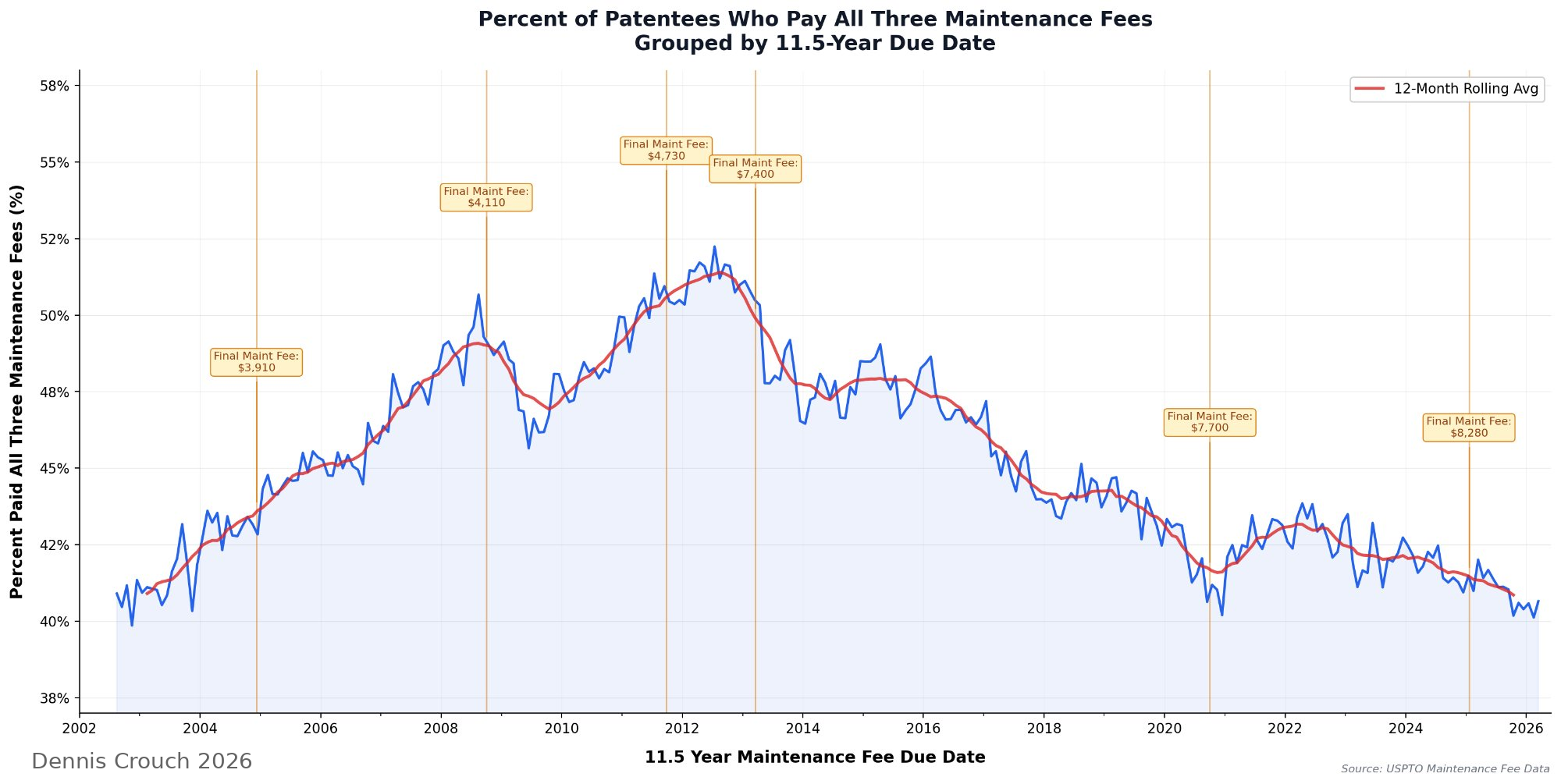
Under 35 U.S.C. § 41(b), patent holders must pay maintenance fees at three intervals after issuance: 3.5 years, 7.5 years, and 11.5 years. Failure to pay (including during a six-month grace period with surcharge) results in expiration of the patent. The chart below tracks the percentage of patentees who paid all three maintenance fees, grouped by the month their final (11.5-year) fee came due. The data reveals a striking arc: a steady rise from about 41% in 2002 to a peak of roughly 52% around 2012-2013, followed by a sustained decline back to approximately 40% today. The 11.5-year maintenance fee for large entities has nearly tripled during this period, from $3,100 in 2001 to $8,280 as of January 2025, well above the rate of inflation for this period. The question is whether this fee escalation is the primary driver of the decline, or whether other forces are at work.