Privies, Prior Art, and Procedure: Stewart’s Triple Rebuke of PTAB in favor of Patentees

by Dennis Crouch

Last week, Acting USPTO Director Coke Morgan Stewart vacated Final Written Decisions invalidating two semiconductor patents, remanding the cases back to the PTAB with instructions to permit discovery into potential privity relationships. Semiconductor Components Industries, LLC v. Greenthread, LLC, IPR2023-01242, IPR2023-01243, IPR2023-01244 (April 24, 2025). This represents a significant rebuke of the PTAB’s handling of time-bar issues and privity allegations under 35 U.S.C. § 315(b), and is yet another general victory for patentees seeking relief from IPR cancellations. IPR2023-01242 -1243 -1244 Semiconductor v Greenthread DR Decision

Although the privity issue is juicy because it suggests backroom dealing, two additional aspects of the decision may end up being more important: the Board’s refusal to hear certain arguments about prior art disclosures and its improper exclusion of district court claim construction orders.
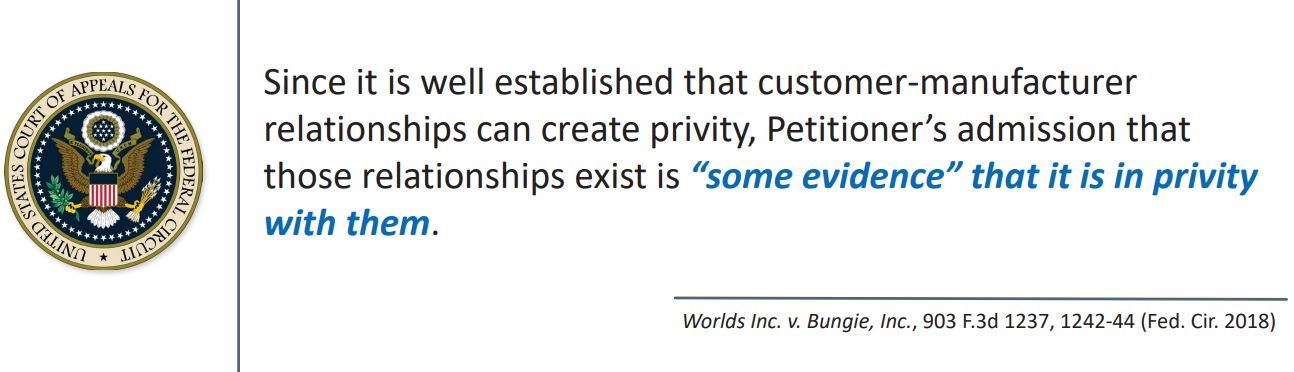
The case centers on Semiconductor Components’ (d/b/a onsemi) challenges to two Greenthread semiconductor patents (U.S. Patent Nos. 11,121,222 and 10,510,842). Greenthread had argued that the IPR petitions were time-barred under § 315(b) because Intel Corporation—allegedly in privity with Semiconductor Components—had been served with an infringement complaint more than one year before the petitions were filed. The idea that Intel may be a privy of the petitioner stems from their business relationship as supplier and customer. Greenthread had previously sued Intel over the same patents, and the two companies have an ongoing business relationship.

Time-Bar, Privity, and Discovery: 35 U.S.C. § 315(b) includes a strict timeline for filing an IPR petition to challenge a patent’s validity. The petition must be filed within one year of the petitioner being served a patent infringement complaint. Notably, the bar also applies if a “real party in interest” to the petition or “privy of the petitioner” was served. But, it is often difficult to know whether companies are privies of one another — especially in situations where several entities all have concerns about a particular patent. In district court litigation, this could be resolved through discovery, but such discovery is tightly limited in IPR proceedings to ensure efficient resolution. Dir. Stewart’s new order substantially cracks open that limitation.

The PTAB had denied Greenthread’s discovery motions seeking information about the relationship between Semiconductor Components and Intel. Then, in its Final Written Decisions, the Board held that Greenthread had failed to present sufficient evidence establishing a privity relationship.

In her Director Review decision, Stewart found that the Board abused its discretion in denying discovery because the patentee “raised more than a mere possibility that discovery would yield useful information on the privity issue given that Petitioner was a supplier of a time-barred party, Intel.” While acknowledging that Greenthread’s requested discovery was “broad,” Stewart found it was “not harassing or abusive.” The Board “either should have allowed whatever narrower discovery was appropriate or made it clear that Patent Owner could amend or resubmit its discovery motions. Instead, the Board denied Patent Owner’s motions and then cited the absence of evidence as a basis not to find a privity relationship.”

The Director remanded with instructions to allow targeted discovery on privity issues, including “any indemnification agreements between Petitioner and Intel and the terms and conditions of sale agreements between Petitioner and Intel related to products accused of practicing the challenged claims.” The Director’s intervention signals a shift away from some of the hardline positions the PTAB had taken on discovery matters. While the Board has historically been reluctant to permit extensive discovery, Stewart’s decision suggests that when basic fairness requires information exchange—particularly on jurisdictional issues like the § 315(b) time bar—reasonable discovery should be allowed.

Stewart also addressed the proper allocation of burden on the privity issue, instructing the Board to “determine on the full record whether Petitioner has met its burden of demonstrating it is not time-barred under § 315(b).” She cited Worlds Inc. v. Bungie, Inc., 903 F.3d 1237, 1242-44 (Fed. Cir. 2018), which held that while petitioners bear the ultimate burden of proving they are not time-barred, patent owners must first put the issue in dispute with some evidence beyond a “mere assertion.”

Beyond the privity issue, the Director review order addressed two procedural errors that are equally significant for PTAB practice:

First, the Board refused to consider certain Greenthread arguments concerning what was actually disclosed in the prior art – particularly the location of “graded dopant concentration” being different in the prior art than in the claimed invention, finding these arguments untimely despite being presented in Greenthread’s Response.

Stewart found the Board erroneously failed to consider Greenthread’s arguments, incorrectly finding these arguments were untimely when they had in fact been presented in the Patent Owner’s Response.

Second, Stewart concluded the Board improperly excluded district court claim construction orders that Greenthread had submitted with its Sur-Reply. She explained that “a legal ruling by another tribunal is not evidentiary in nature” and thus “is not the type of exhibit that falls within the prohibition against new evidence.” Stewart noted that “the Board may take administrative notice of another tribunal’s legal ruling” and should have admitted the district court claim construction rulings.

Importantly, Stewart rejected the Board’s characterization of claim construction orders as “evidence” subject to the limitations on new evidence in sur-replies under 37 C.F.R. § 42.23(b). She directed the Board to admit the claim construction orders and reconsider the parties’ arguments in light of them. This outcome potentially allows parties to submit relevant district court or Federal Circuit decisions at any time before (and perhaps even after) the oral hearing, though Stewart noted “the best practice is to file the decision as early as possible in the proceeding.”

The Director ordered the Board to issue a decision on remand within 30 days after Petitioner provides the authorized discovery, absent good cause.

This decision continues a trend under Director Stewart of Director-level interventions that have generally favored patent owners.