- Upcoming Event: ACI's 3rd Annual Paragraph IV Disputes on April 27-28, 2009 in New York City (Downtown Marriott). http://www.americanconference.com/ParagraphIV.htm . This is a good event because it is well attended by both the innovators (brands) and the generics. On the wednesday following the class, several speakers will walk through a brand-generic settlement agreement and work on mechanisms to avoid FTC & antitrust problems.
- PCT Search Offices: The PTO is warning PCT applicants to make sure that the selected International Search Authority (ISA) is certified for your particular type of claims. One problem, the EPO is not ready to handle business method claims. [Notice]
- Court Report: 2,875 patent lawsuits were terminated in the year ending Sept 30, 2008. Of those, only 3.8% (109) reached trial. Although 3.8% appears low, patent cases reach trial more often than many other claims brought in Federal Court. The same statistic for Copyright and Trademark cases shows 1.3% and 1.7% reaching trial respectively. During the past year, only six patent cases were filed in the Court of Federal Claims alleging infringement by the US Government. Read the Report.
Patently-O Bits and Bytes No. 96
- Upcoming Event: ACI's 3rd Annual Paragraph IV Disputes on April 27-28, 2009 in New York City (Downtown Marriott). http://www.americanconference.com/ParagraphIV.htm . This is a good event because it is well attended by both the innovators (brands) and the generics. On the wednesday following the class, several speakers will walk through a brand-generic settlement agreement and work on mechanisms to avoid FTC & antitrust problems.
- PCT Search Offices: The PTO is warning PCT applicants to make sure that the selected International Search Authority (ISA) is certified for your particular type of claims. One problem, the EPO is not ready to handle business method claims. [Notice]
- Court Report: 2,875 patent lawsuits were terminated in the year ending Sept 30, 2008. Of those, only 3.8% (109) reached trial. Although 3.8% appears low, patent cases reach trial more often than many other claims brought in Federal Court. The same statistic for Copyright and Trademark cases shows 1.3% and 1.7% reaching trial respectively. During the past year, only six patent cases were filed in the Court of Federal Claims alleging infringement by the US Government. Read the Report.
Patent Prosecution – Law Firm – Los Angeles, Calif.

PriorSmart: Tracking Patent Documents
The creative guys at PriorSmart (www.priorsmart.com) have created a very interesting tool for those of you frustrated by the PTO's bans on automated PAIR access. For a relatively small fee, PriorSmart will monitor the docket of any application, reexamination, or issued patent and then e-mail reports. To stay within the PTO's no-automation requirements, PriorSmart hires people to check the PAIR site and report on activities. Daily monitoring of an application costs $16 per month, a monthly report costs $4 per month. That price beats your paralegal. PriorSmart sees itself as filling a gap by allowing companies to "Track documents affecting your litigation or freedom–to–operate opinion; Monitor competitors en masse; [and] Be alerted to new continuations or divisionals."
Patently-O Bits and Bytes No. 95
- Injunctive Relief: I re-read Michelle Lee's (Google) statement about the need for patent reform. One issue that jumped-out this time: No mention of injunctions. Money is still at stake, but Google appears confident that it won't face a shut-down even if it loses a patent case. In that sense, Google is lucky that it is being sued by non-practicing entities who as a de facto rule don't get injunctive relief against infringers who have a major market share.
- Benefit of Trade Secrets: Avoid Charges of Infringement. In some senses, google is very public. Yet, its actual operation is quite secretive. One benefit of that type of operation is that it helps avoid charges of patent infringement. If patentee's can't tell how you operate, it makes it much more difficult to assert charges of infringement.
- Warranties and Copyright: My colleague Marc Roark has an interesting new paper: Limitation of Sales Warranties as an Alternative to Intellectual Property Rights: An Empirical Analysis of Iphone Warranties' Deterrent Impact on Consumers.
- The BPAI Watchdog: http://bpaiwatchdog.blogspot.com/. So far, Leigh Martinson is focusing on the BPAI's application of Bilski.
- European Bilski: The Enlarged Board of Appeal of the EPO is looking for third-party input on four issues:
-
- Is it only proper to exclude patents covering computer programs as such when explicitly claimed as a "computer program"?
- Does a claim avoid the computer program as such exclusion by mentioning a computer or data storage medium? (If not, what technical effect is needed?)
- Can a technical effect be non-physical? Is it sufficient if the physical entity is an unspecified computer?
- Does the activity of programming a computer necessarily involve technical considerations?
- Input on the European questions are due by the end of April. http://www.epo.org/topics/news/2009/20090219.html.
- Application for the job of PTO Director (by Prof Morris) http://www.stanford.edu/~rjmorris/pto.htm. I maintain that it is possible to find an excellent nominee who is not a patent attorney. However, any nominee who does not have extensive experience with the patent prosecution process will face an uphill credibility battle from day one.
Patently-O Bits and Bytes No. 95
- Injunctive Relief: I re-read Michelle Lee's (Google) statement about the need for patent reform. One issue that jumped-out this time: No mention of injunctions. Money is still at stake, but Google appears confident that it won't face a shut-down even if it loses a patent case. In that sense, Google is lucky that it is being sued by non-practicing entities who as a de facto rule don't get injunctive relief against infringers who have a major market share.
- Benefit of Trade Secrets: Avoid Charges of Infringement. In some senses, google is very public. Yet, its actual operation is quite secretive. One benefit of that type of operation is that it helps avoid charges of patent infringement. If patentee's can't tell how you operate, it makes it much more difficult to assert charges of infringement.
- Warranties and Copyright: My colleague Marc Roark has an interesting new paper: Limitation of Sales Warranties as an Alternative to Intellectual Property Rights: An Empirical Analysis of Iphone Warranties' Deterrent Impact on Consumers.
- The BPAI Watchdog: http://bpaiwatchdog.blogspot.com/. So far, Leigh Martinson is focusing on the BPAI's application of Bilski.
- European Bilski: The Enlarged Board of Appeal of the EPO is looking for third-party input on four issues:
-
- Is it only proper to exclude patents covering computer programs as such when explicitly claimed as a "computer program"?
- Does a claim avoid the computer program as such exclusion by mentioning a computer or data storage medium? (If not, what technical effect is needed?)
- Can a technical effect be non-physical? Is it sufficient if the physical entity is an unspecified computer?
- Does the activity of programming a computer necessarily involve technical considerations?
- Input on the European questions are due by the end of April. http://www.epo.org/topics/news/2009/20090219.html.
- Application for the job of PTO Director (by Prof Morris) http://www.stanford.edu/~rjmorris/pto.htm. I maintain that it is possible to find an excellent nominee who is not a patent attorney. However, any nominee who does not have extensive experience with the patent prosecution process will face an uphill credibility battle from day one.
Senior Patent Counsel – Large Corporation – Minneapolis, Minn.

Bilski v. Doll: Round I of Amicus Briefs
Bilski v. Doll (on petition for writ of certiorari 2009)
PTO’s Current Examination Standards for Applying Bilski
DATE: January 7,2009
TO: Technology Center Directors Patent Examining Corps
FROM: John J. Love
SUBJECT: Guidance for Examining Process Claims in view of In re Bilski
Patent Attorney – Law Firm – Reston, Va.
Patent Attorney – Law Firm – Houston, Texas

Reinstating Patents After Failure to Pay Maintenance Fee
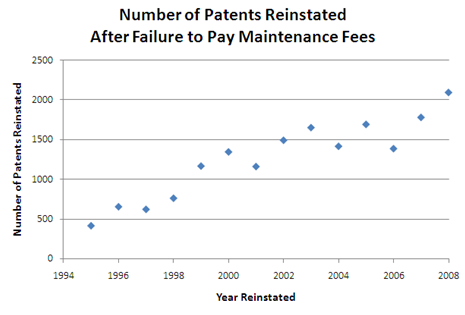
In a prior post, I discussed payment of maintenance fees. Ordinarily, three post-issuance maintenance fees must be paid in order to keep the patent in force for its entire term. A large entity pays $980 3.5 years after issuance; $2,480 7.5 years after issuance; and $4,110 11.5 after issuance. If the fee is not paid then the patent will expire at the next 4, 8, or 12 year mark. In that 6-month interim (e.g., between the 3.5 year due date and the 4 year expiration date), the fee can still be paid with a $130 surcharge. Once the patent expires, it can still be reinstated if the fee is paid along with an additional surcharge for either unavoidable failure to pay the fee ($700) or unintentional failure to pay the fee ($1,640). In addition, the Patent Office (PTO) must accept your explanation for the delay. Under 35 U.S.C. 41(c), revival for unintentional expiry is only available within two years of the expiration date. Later revival requires proof that the failure to pay the fee was unavoidable - a difficult standard to meet.
Congress Looks to Review Patent Examiner Goals
The current pending omnibus appropriations bill would provide $2.01 billion to the PTO so long as all of that money is obtained by the PTO through fees. [LINK]. As Greg Aharonian noted in his PATNEWS, none of the $800 billion bailout money is being directed toward improving the patent system.
Applying Supreme Court Precedent
Carlsbad Technology v. HIF Bio (Supreme Court 2009)
Patently-O Bits and Bytes No. 92
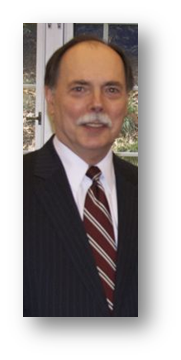 "Your job is much harder now than it was for me all those years ago. The technology of today's inventions is immensely more complex than ever before. The length and breadth of applications is greater. The volume of prior art is much larger. The legal issues are more intricate and harder to comprehend. And the law is in a continual state of change. Compounding all of this is the perception among some individuals that the work of the PTO in general, and the examiners in particular, is somehow of secondary importance and questionable quality. It is commonly said that the real action in patents is in private or corporate practice."
USPTO Maintenance Fees
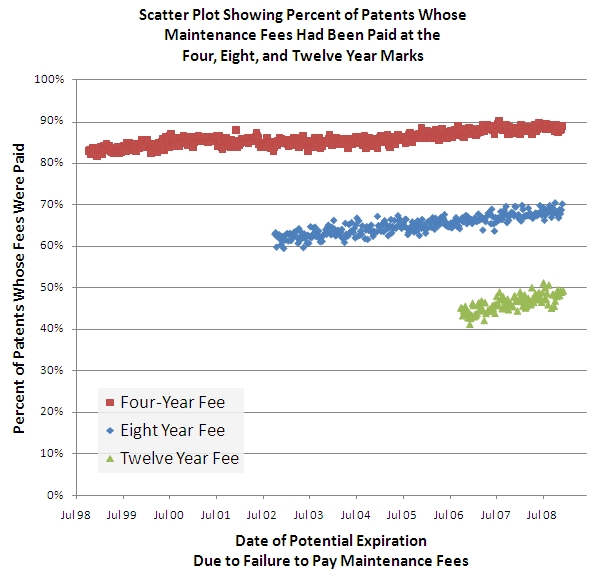
A large portion of PTO revenue comes through applicant’s payment of maintenance fees. Under the current fee structure, three post-grant maintenance fees must be paid in order to keep a patent from prematurely expiring. A large entity pays $980 3.5 years after issuance; $2,480 7.5 years after issuance; and $4,110 11.5 after issuance. If the fee is not paid then the patent will expire at the next 4, 8, or 12 year mark. In FY08, the PTO reported over $500 million in revenue from maintenance fees.
USPTO Maintenance Fees
A large portion of PTO revenue comes through applicant’s payment of maintenance fees. Under the current fee structure, three post-grant maintenance fees must be paid in order to keep a patent from prematurely expiring. A large entity pays $980 3.5 years after issuance; $2,480 7.5 years after issuance; and $4,110 11.5 after issuance. If the fee is not paid then the patent will expire at the next 4, 8, or 12 year mark. In FY08, the PTO reported over $500 million in revenue from maintenance fees.
Patent Office is Looking for New Leadership
The PTO is not planning to wait until a new Director is appointed before filling other key management slots. Two positions are listed on the PTO job board: (1) Deputy Commissioner for Patent Examination Policy; and (2) Patent Examination Policy Advisor. I believe that the Deputy Commissioner position will fill the spot left by John Love who is reportedly retiring at the end of this month. Pay is between $117k and $177k. For the right person, I will also throw-in a few free favorable Patently-O posts. Seriously, this is one of the top non-political slots at the PTO and a true expert is needed. The Patent Examination Policy Advisor is slightly lower in rank, but will also serve an incredibly important role at the PTO in "providing professional leadership and direction" in the Office of Patent Legal Administration (OPLA). OPLA is the office where the MPEP is written and new rules are drafted.
Survey Results: Next PTO Director
The Patent Bar has spoken – overwhelmingly choosing Todd Dickinson as the choice for the next director of the US Patent and Trademark Office. Dickinson is now leading the AIPLA after leaving his post as IP Director of GE. Previously, he was PTO director under Clinton and a partner at the Howrey firm.
IP Technology Specialist – Small Corporation – Cambridge, Mass.