by Dennis Crouch
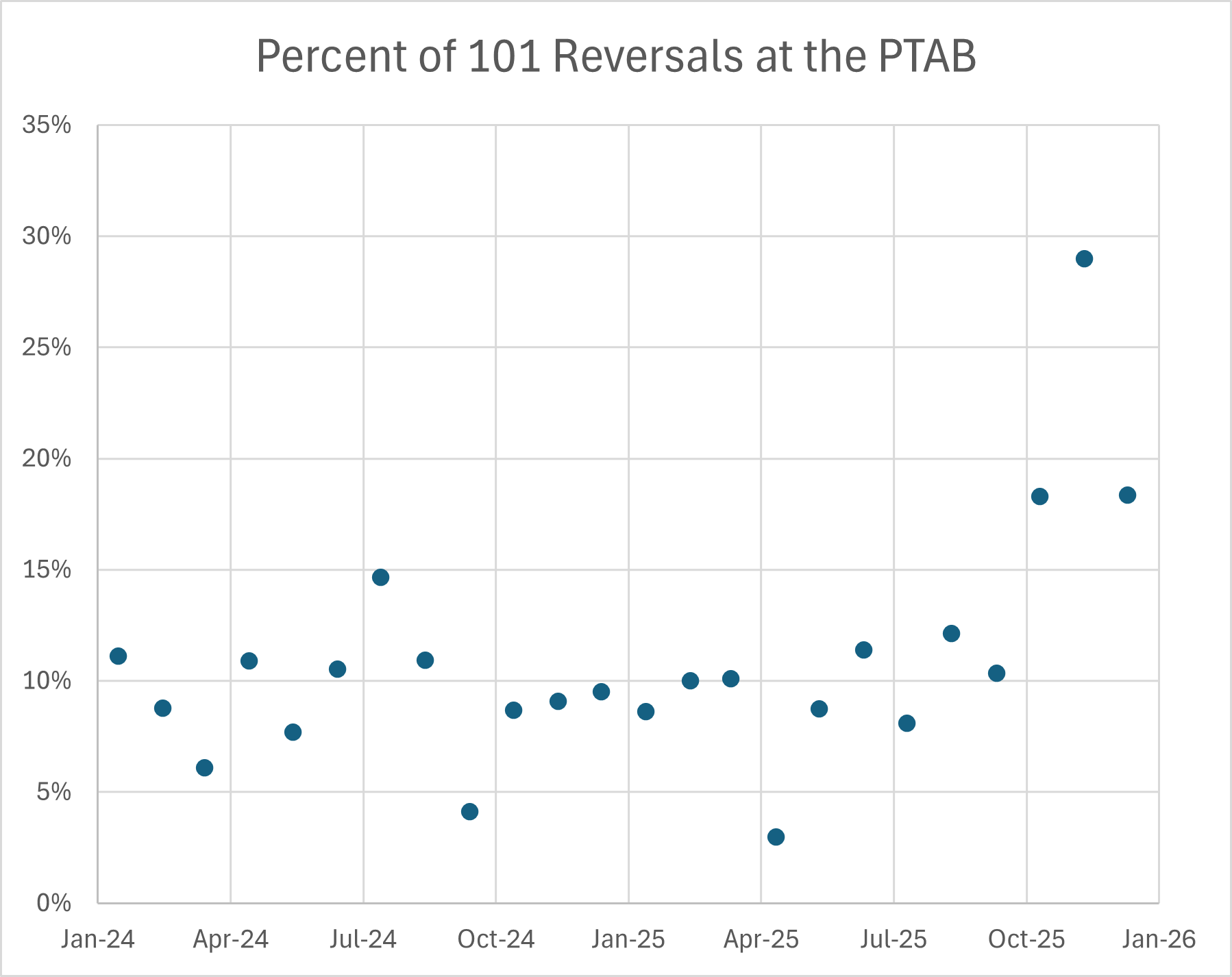
The Patent Trial and Appeal Board (PTAB) has doubled its rate of reversing Section 101 rejections since Director John Squires took office, according to my new analysis of ex parte appeal decisions involving eligibility challenges from 2024 and 2025. The reversal rate, which hovered between 8% and 12% for most of 2024 and early 2025, jumped to 18% in October 2025 and spiked to 29% in November. A recent rehearing decision in Ex parte Mercer, Appeal 2024-002371 (PTAB Oct. 31, 2025), illustrates one aspect of the Board’s new approach: demanding evidentiary support for findings that claimed elements are “well-understood, routine, conventional activity” under Alice step two.
The chart above shows the percentage of Section 101 rejections reversed by the Board (without a new ground of rejection) in ex parte appeals, by month. As I discussed in October, the Board’s Section 101 reversal rate began climbing shortly after Director Squires took office. Dennis Crouch, PTAB Responds to New Director with Increased § 101 Reversals, Patently-O (Oct. 2025). The trend has accelerated. The November 2025 reversal rate of 29% represents nearly a threefold increase from the rates that prevailed through most of 2024.
A case in point is Ex parte Mercer. The application claims methods for achieving synchronized execution across geographically dispersed servers. The core problem addressed is network latency: when a primary server needs multiple remote servers to act simultaneously, varying transmission delays mean messages arrive at different times. The claimed solution involves the primary server determining an execution time, packaging that time with each message as an instruction, transmitting those instructions to geographically dispersed secondary servers, and having each secondary server store the execution time and perform its action only when the local current time matches. The specification frames this approach in the context of high-frequency trading, where a trader dividing a large order across multiple exchanges needs each portion executed simultaneously to avoid market impact. In March 2025, a Board panel affirmed the examiner’s eligibility rejection in a detailed 24-page decision. In October 2025, a reconstituted panel granted rehearing and reversed in barely two pages, finding “insufficient support” for the conventionality determination under Berkheimer.
The original March 2025 decision, authored by Administrative Patent Judge Lorin and joined by Judges Mohanty and Silverman, exemplified the Board’s traditional approach to Section 101. The panel walked through each claim limitation, finding the claims directed to “a scheme for synchronized execution” falling within the “certain methods of organizing human activity” grouping of abstract ideas. The panel characterized any asserted improvement as “an aspiration devoid of technical detail,” observing that the claims contained “no requirement that the execution at the secondary servers be performed simultaneously.”
On Alice step two, the original panel found the additional elements (the primary and geographically dispersed secondary servers) generic and conventional. The decision cited paragraph 47 of the specification, which states that “instead of a trading server storing a transaction order, it may simply be an ordinary server or a primary server that can store a primary message.” The panel treated this as “intrinsic evidence that the recited servers are generic,” concluding that it “sufficiently establishes the well-understood, routine, or conventional nature of the elements.” This methodology, using specification language describing components as “ordinary” to support conventionality findings, had been standard Board practice.
The applicant’s rehearing request attacked this evidentiary foundation. Under BASCOM (Fed. Cir. 2016), “an inventive concept can be found in the non-conventional and non-generic arrangement of known, conventional pieces.” And under Berkheimer (Fed. Cir. 2018), “a factual determination is required to support the conclusion that an additional element (or combination of additional elements) is well-understood, conventional activity.” The applicant argued that acknowledging individual servers as “ordinary” did not establish that the specific claimed combination was conventional. No prior art or other evidence showed that systems using the claimed approach of transmitting execution times to distributed servers for synchronized local action were known.
The October 2025 rehearing decision had a slightly different panel. Judge Lorin had retired, and Judge Cynthia Murphy was designated to take his place. The reconstituted panel’s entire substantive analysis spans two paragraphs:
After careful consideration of the Appellant’s arguments, we grant the request for a rehearing and reverse the Examiner’s § 101 rejection. In reaching this decision, we can confine our analysis to step two of the Alice framework, and we do so.
As noted by the Appellant (see Request 19), “an inventive concept can be found in the non-conventional and non-generic arrangement of the known, conventional pieces.” BASCOM Global Internet v. AT&T Mobility LLC, 827 F.3d 1341, 1350 (Fed Cir. 2016). As noted by the Appellant (see Request 19), a factual determination is required to support the conclusion that an additional element (or combination of additional elements) is well-understood, conventional activity. Berkheimer v HP, Inc., 881 F.3d 1360, 1368 (Fed. Circ. 2018). We are persuaded by the Appellant’s arguments that, on the record before us, there is insufficient support for such a factual determination.
The decision does not explain what evidence would have sufficed, nor does it address why the specification’s “ordinary server” language was inadequate. The original decision’s detailed claim analysis, its distinction between the broader divisional claims and narrower parent claims that a prior Board panel found eligible, its finding that the claims lacked “technical detail” – none of this is engaged. The rehearing panel simply found the evidentiary record wanting – and a reminder that it is the Examiner’s job to establish a prima facie case of invalidity. I see this Mercer rehearing is one example of the Board’s new approach. In other cases applicants were able to poke holes in various aspects of the 101 analysis.
The Board is also issuing fewer new grounds of rejections on eligibility but is more often suggesting that the examiner consider eligibility on remand. There are also increasing cases where the PTAB refuses to decide eligibility or reverses pro forma in situations where the claims are indefinite.
For examiners, the shift underscores the need to identify prior art or other evidence showing that the specific claimed arrangement was well known. This burden may prove difficult to meet in cases involving novel combinations of otherwise conventional computing elements. The inherent tension: how does one show that a particular combination was “well-understood, routine, conventional” without essentially conducting a Section 103 obviousness analysis?