Verdict Deflated: Fed Circuit Punctures Coda’s $64M Win Over Goodyear

by Dennis Crouch

A jury awarded $64 million to a Czech inventor who claimed Goodyear stole his self-inflating tire technology. The district court threw out the verdict. The Federal Circuit has now affirmed that decision, holding that no reasonable jury could have found trade secret misappropriation on any of the five asserted trade secrets. Coda Development s.r.o. v. Goodyear Tire & Rubber Co., No. 2023-1880 (Fed. Cir. Dec. 8, 2025). The decision offers a thorough examination of what it means to define a trade secret with "sufficient particularity" under state uniform trade secret acts (UTSAs), distinguishing between those that describe functional outcomes versus those that identify actual protectable knowledge.

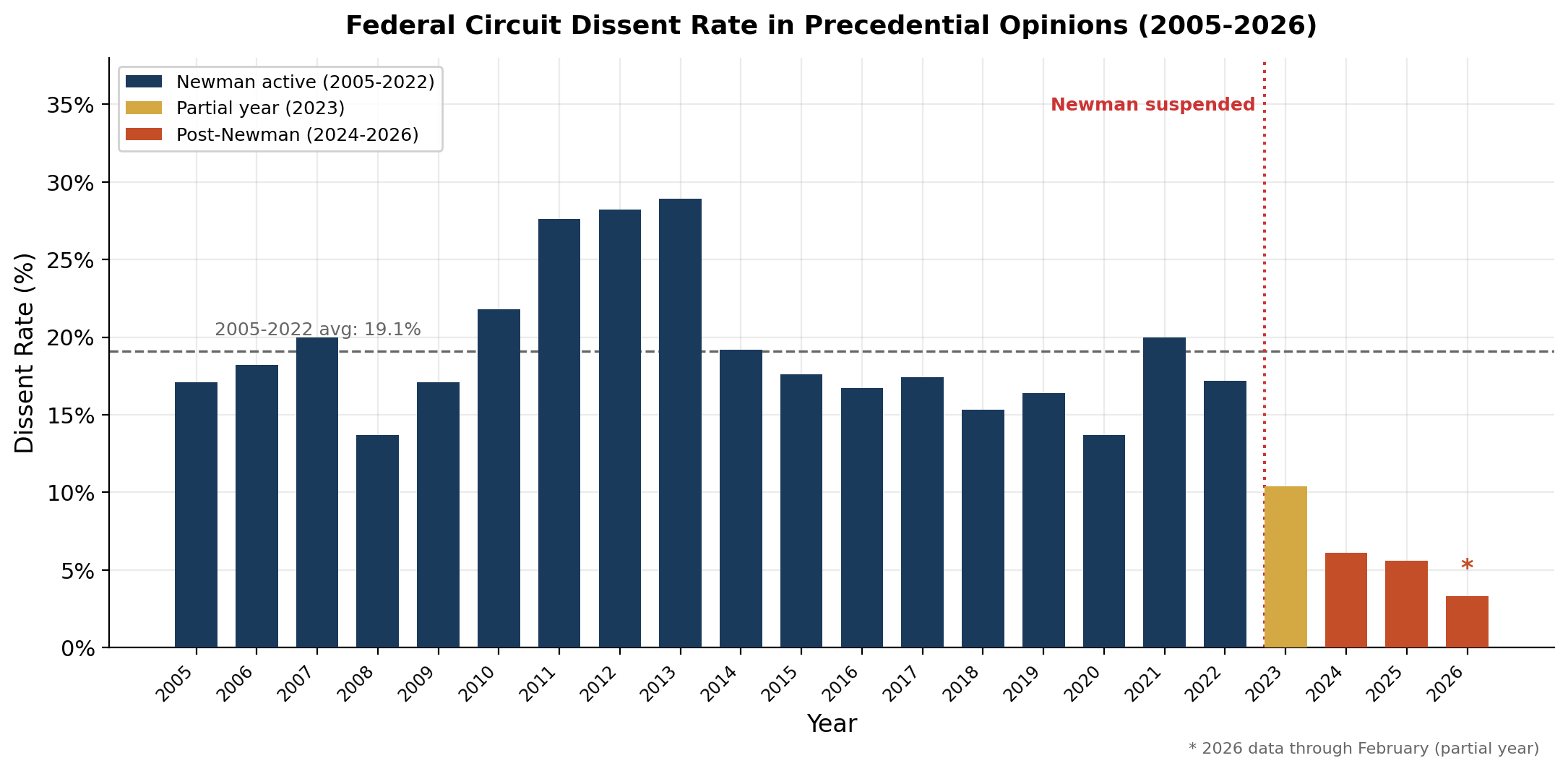
The case also continues an observable pattern at the Federal Circuit: juries finding for IP holders, only to have courts conclude that no reasonable jury could have reached that verdict. The following is an incomplete list of some of these anti-jury pro-JMOL cases from 2024 and 2025 that I've been tracking in the patent context:


To continue reading, become a Patently-O member. Already a member? Simply log in to access the full post.

Subject Matter Eligibility Declarations (SMEDs) to Overcome Eligibility Rejections

by Dennis Crouch

The USPTO has issued new guidance on using Rule 132 declarations to address subject matter eligibility rejections. The two memoranda, signed by Director John A. Squires on December 4, 2025, provide a new roadmap for how applicants can submit evidentiary declarations to overcome § 101 rejections. One memorandum is directed to the Patent Examining Corps, explaining how examiners should evaluate these submissions. The other is directed to applicants and practitioners, outlining best practices for preparing what the USPTO now calls "Subject Matter Eligibility Declarations" or SMEDs. The guidance does not create new procedures but instead highlights an existing and underutilized path under 37 C.F.R. § 1.132 for submitting evidence that may help establish patent eligibility.

The SMED guidance arrives as part of Director Squires's broader effort to address what he has characterized as "conflicting (and confusing) questions about patent subject matter eligibility." In his view, Examination and Eligibility are two distinct issues that should be separated. On his first day in office, Squires signed two patents in technical fields that have frequently faced eligibility challenges: distributed ledger/crypto technologies and medical diagnostics. Three days later, he issued the In re Desjardins Appeals Review Panel decision, Appeal No. 2024-000567 (PTAB Sept. 26, 2025), vacating a PTAB sua sponte § 101 rejection of claims directed to training machine learning models while preserving prior tasks. That decision, which Squires designated as precedential on November 4, 2025, warned against overbroad eligibility rejections and emphasized that improvements in "computational performance, learning, storage, data sets and structures" can constitute patent-eligible technological advancements under the Alice framework. The SMED memoranda represent the next step in this initiative, providing applicants with tools to build an evidentiary record supporting eligibility.

In the past, many patent attorneys have avoided filing Rule 132 declarations except as a last resort. The reasons are familiar: expense, the difficulty of establishing a sufficient nexus between the evidence and the claims, and concern about seeding the prosecution record with testimonial statements that could later be used against the patent owner in litigation. But I believe the SMED memoranda represent a new opportunity. Here, the Director is affirmatively inviting these submissions and signaling that they will be given meaningful weight in the eligibility analysis. For applications of potential value, practitioners should consider whether a SMED might strengthen their response to a § 101 rejection, ideally after vetting the approach with experienced patent litigation counsel who can help navigate the prosecution history implications.


To continue reading, become a Patently-O member. Already a member? Simply log in to access the full post.

The Mythic Source of USPTO Institution Discretion?

by Dennis Crouch

We have another mandamus petition at the Federal Circuit challenging the USPTO's IPR institution denials. In re Tesla, Inc., No. 26-116 (Fed. Cir. filed Dec. 2, 2025). The case involves patents asserted by Granite Vehicle Ventures LLC against Tesla's Self-Driving technology. But the petition's significance extends well beyond this particular dispute. Tesla advances a statutory interpretation argument that, if accepted, would fundamentally constrain the USPTO's claimed authority to deny IPR institution based on factors Congress never authorized.

The core legal question is simple: Does 35 U.S.C. § 314(a) grant the Director unfettered discretion to invent new reasons to deny IPR institution? The USPTO has increasingly claimed discretionary power to justify denials based on a variety of novel explanations including "time-to-trial" concerns, "settled expectations," and other criteria that do not appear in AIA or its legislative history.  In its petition, Tesla argues the USPTO's approach transforms a provision limiting the Director's authority into an unlimited grant of power to nullify IPR entirely.


To continue reading, become a Patently-O member. Already a member? Simply log in to access the full post.

Guest Post: The Supreme Court Should Clarify How to Apply Loper Bright in the Patent Law Case of Lynk Labs, Inc. v. Samsung Co. Ltd.

By Professor Timothy T.  Hsieh, Associate Law Professor, Oklahoma City University School of Law

For the past five years, I have taught Legislation & Regulation at Oklahoma City University School of Law, a course situated at the intersection of administrative law, statutory interpretation, and legislative design. Each semester, my students and I return to a foundational question: when, if at all, should courts defer to agency views, and when must the judiciary exercise independent interpretive judgment?

Loper Bright and Administrative Law

When the Supreme Court issued Loper Bright Enterprises v. Raimondo last year—squarely rejecting Chevron and instructing courts to independently interpret statutes—it marked a watershed moment in administrative law. Yet nearly a year later, the Court has provided virtually no guidance on how Loper Bright should be applied. That silence leaves courts, practitioners, and those of us training future lawyers without real-world examples to illuminate this new interpretive landscape.

That is why I submitted an amicus brief in Lynk Labs, Inc. v. Samsung Co. Ltd., urging the Court to grant review. Although the case arises in the patent arena, it presents a far more universal question: whether lower courts may quietly sidestep Loper Bright by elevating agency policy preferences over statutory text. (more…)

When Juries Don’t Matter: Written Description Effectively Becomes a Question of Law

by Dennis Crouch

In consecutive weeks, the Federal Circuit has reversed two jury verdicts totaling over $80 million in pharmaceutical patent disputes, holding in both cases that the specifications failed (as a matter of law) to satisfy §112(a)'s disclosure requirements. Seagen Inc. v. Daiichi Sankyo Company, Ltd., Nos. 2023-2424 (Fed. Cir. Dec. 2, 2025); Duke University v. Sandoz Inc., No. 2024-1078 (Fed. Cir. Nov. 18, 2025).

In my view, these cases represent a significant doctrinal development. I see these as revealing three interconnected trends:

  1. The Federal Circuit's increasing willingness to treat patent specifications as legal texts subject to judicial interpretation of the text rather than factual determinations of its meaning;
  2. The practical (re)convergence of written description and enablement into a unified adequacy inquiry; and
  3. The court's growing confidence in overturning jury verdicts on §112(a) grounds as a matter of law.

To continue reading, become a Patently-O member. Already a member? Simply log in to access the full post.

So You’re Telling Me There’s a Chance: IPR Institution Rate Rises to 4%

by Dennis Crouch

The big USPTO news is that IPR grant rate has shifted from 0% up to 4%.  Although this is still incredibly low, breaking that zero-energy threshold is a major event. It calls to mind the immortal words of Lloyd Christmas (played by Jim Carey) "So you're telling me there's a chance."  

Since late October 2025, USPTO Director John Squires has issued a series of notices deciding institution of IPR petitions under his centralized review policy. The results through December 1, 2025 tell a stark story: of 105 IPR petitions fully processed, 99 were denied on discretionary grounds, 2 were denied on the merits, and just 4 have been granted institution. For finalized decisions, the institution rate now stands at approximately 4%.  I expect this to rise somewhat as the remaining 65 receive their judgment, but the numbers will not quickly return to the historic average institution rate of roughly 67%. 


To continue reading, become a Patently-O member. Already a member? Simply log in to access the full post.

Objective Boundaries or Bust: CAFC Reaffirms Indefiniteness for the Best Metrics

by Dennis Crouch

The Federal Circuit has affirmed a judgment invalidating patent claims for indefiniteness where the claims used "optimal" and "best" language without providing objective boundaries for those terms of degree. Akamai Technologies, Inc. v. MediaPointe, Inc., No. 2024-1571 (Fed. Cir. Nov. 25, 2025).


To continue reading, become a Patently-O member. Already a member? Simply log in to access the full post.

USPTO’s “Don’t Ask, Don’t Tell” Policy: The Quiet Death of Thaler and the Legal Fiction of Human Inventorship

by Dennis Crouch

The Federal Circuit's 2022 decision in Thaler v. Vidal seemed to settle a fundamental question: only natural persons can be inventors under U.S. patent law.  But, the bigger near-term question has always been about human-AI collaboration - and what level of human contribution is sufficient to qualify as inventive.  Director Kathi Vidal implemented a team-based framework that allowed patenting if the human made a "more than insignificant contribution" to the invention.  This approach basically asked whether the human had done enough to be considered a joint joint inventor (alongside the AI). While that approach had some conceptual problems (permitting patenting without complete human inventorship), it - at least - set a standard for the agency to consider.

In a November 2025 guidance, new USPTO Director John Squires has rejected the Vidal approach and instead established a "don't ask, don't tell" policy for AI-assisted inventions creates a presumption of human inventorship so long as any natural person is willing to sign the oath.  For all practical purposes, this approach is also a repudiation of Thaler, so long as the patent applicant is able to find a human close to the invention willing to self-identify as the inventor. The system now effectively rewards an old habit in invention culture: when attribution becomes optional and unverifiable, someone will always be willing to step forward and claim the mantle of inventor.  In a chapter I wrote a few years ago examining corporate invention, I observed: "It is easy to identify a human with some relation to the product or innovation and prop-up that human as the inventor." Dennis Crouch, Legal Fictions and the Corporation as an Inventive Artificial Intelligence in R. Abbott ed., Research Handbook on Intellectual Property and Artificial Intelligence (Edward Elgar Publ’g 2022).


To continue reading, become a Patently-O member. Already a member? Simply log in to access the full post.

Happy Thanksgiving: CLE and a Tax Question

It is wonderful to spend a few days with friends and family.  This morning I’m booking travel for some upcoming events.

Hope to see you there.

CLE can be expensive: My understanding is that US lawyers can now use a 529 Education plan to pay for CLE (tuition but not travel). Is this something that lawyers are doing, or is it not available if being reimbursed by the firm? And, does it matter if characterized as client development?

Can Money Talk? Latest IPR Mandamus Petitions Seek Workarounds to § 314(d) Bar

by Dennis Crouch

Three new mandamus petitions recently arrived at the Federal Circuit, each attempting to navigate around the court's November 6 decisions that rejected challenges to the USPTO's expanded use of discretionary denials.

The new petitions raise arguments their counsel contend are distinct from those already rejected in In re Motorola Solutions, Inc., No. 2025-134 (Fed. Cir. Nov. 6, 2025) (precedential). The petitions challenge both the "settled expectations" rule and parallel proceeding denials, while advancing novel theories designed to overcome the § 314(d) bar that has proved insurmountable for prior petitioners. Whether these distinctions carry legal weight remains to be seen, but the filings reflect a coordinated effort to keep pressure on the Federal Circuit as Director John Squires continues to deny IPR institution at a 0% rate.

Since assuming personal control of all IPR institution decisions in October 2025, Director Squires has denied every petition reaching his desk, now totaling 91 consecutive denials. These summary notices contain no reasoning or analysis, listing only IPR numbers alongside the statement institution "is denied." The practice stands in stark contrast to the PTAB's historic institution rate of approximately 67%. Meanwhile, the USPTO's proposed rulemaking (comments due December 2, 2025) would codify categorical bars to IPR institution without addressing the "settled expectations" doctrine or the practice of no-explanation denials. (Note that these  new petitions are all based upon actions by Acting Dir. Stewart, the Squires-prompted petitioners are coming next month).


To continue reading, become a Patently-O member. Already a member? Simply log in to access the full post.

Should American Trademark Law Speak English

by Dennis Crouch

The Solicitor General has urged the Supreme Court to deny certiorari in Vetements Group v. Squires, defending the PTO's practice of translating foreign-language marks into English to assess their protectability. The French fashion company petitioned SCOTUS for review after the Federal Circuit affirmed the TTAB's refusal to register VETEMENTS (the French word for "clothing") as a trademark for clothing and clothing-related retail services. The government's opposition crystallizes a fundamental dispute about whose understanding of the marketplace should control trademark registration: Should marks be evaluated as encountered by American consumers in their linguistic diversity, or should they be systematically translated into English to prevent monopolization of generic terms?

Beneath the doctrinal arguments lies a deeper tension between two competing visions of American identity. One tradition emphasizes English as the baseline language of American commerce, treating foreign terms as American consumers actually encounter them (often without understanding their meaning). The opposing tradition recognizes America's multilingual reality, where millions speak French, Spanish, and Chinese; and insists their understanding must count in the marketplace. The case asks the Court to choose: is there an "ordinary American consumer" who processes commerce in English, or are we a polyglot nation where linguistic diversity shapes how brands communicate meaning?

The focus here is the continued vitality of the "doctrine of foreign equivalents," a judicially created guideline that requires translation of foreign words from common modern languages to determine whether they are generic or merely descriptive. The Federal Circuit applied this doctrine to conclude that an "appreciable number" of American consumers would "stop and translate" VETEMENTS into "clothing," rendering it generic and thus ineligible for federal registration. Vetements Group argues this translation-first approach conflicts with 19th Century Supreme Court precedent treating foreign terms as inherently protectable and with the consumer-perception principle that the Court reaffirmed in USPTO v. Booking.com, 591 U.S. 549 (2020). The government responds that the doctrine reflects sound policy, has deep historical roots predating the Lanham Act, and was implicitly ratified by Congress in 1946.


To continue reading, become a Patently-O member. Already a member? Simply log in to access the full post.

Time to Merge the Copyright Office with the USPTO

by Dennis Crouch

In May 2025, President Trump terminated Copyright Register Shira Perlmutter from office, one day after she released a report concluding that in some situations AI training on copyrighted works scraped from the internet does not qualify as fair use.  But, the D.C. Circuit Court of Appeal put her back in office pending resolution of the lawsuit.  Most recently, the Trump Administration has asked the Supreme Court to vacate that injunction in Blanche v. Perlmutter, No. 25A478, arguing that Article II empowers the President to remove executive officers regardless of their organizational placement within the government.  The crux of the dispute centers on the odd structure of the Copyright Office -- designated as part of the Library of Congress and under Congressional control rather than as an executive branch.

A new bill introduced by Rep. Morgan Griffith would restructure the Copyright Office entirely, severing it from the Library of Congress and reconstituting it as a standalone executive branch agency under direct presidential control. H.R. 6028. The Legislative Branch Agencies Clarification Act, represents one approach to resolving the separation of powers problems now before the Court.

I believe there is a better path forward: Consolidating the Copyright Office with the United States Patent and Trademark Office to create a unified United States Intellectual Property Office (USIPO).


To continue reading, become a Patently-O member. Already a member? Simply log in to access the full post.

0% Institution Rate Holds, but Shows Signs of Potential Rise

by Dennis Crouch

Director John Squires has released a new set of IPR institution decisions. The third grouping since taking personal charge of the institution decision making process in October 2025. Once again, the institution rate remains 0%, but the newest batch include some ray of hope for petitioners.

Let me explain. By mid-November, Dir Squires had decided 34 institution decisions - denying each and resulting in my 0% institution rate post.  The newest batch includes three groupings:

  • 56 new cases discretionarily denied;
  • 31 new cases that were not denied, but that still need to "be reviewed for
    merits and non-discretionary considerations;"
  • 1 new case denied on the merits; and
  • 0 new cases instituted.

To continue reading, become a Patently-O member. Already a member? Simply log in to access the full post.

Federalism on Trial: Idaho’s Attempt to Regulate Patent Litigation

by Dennis Crouch

Micron v. Longhorn IP, Appeal No. 2023-2007 (Fed. Cir. 2025)

This interesting pending case focuses on an Idaho state law  regulating patent trolls. Idaho Code § 48-1703(1).

"It is unlawful for a person to make a bad faith assertion of patent infringement in a demand letter, a complaint or any other communication."

Back in 2022, Katana, an affiliate Longhorn, sued Micron for patent infringement in the W.D.Tex. Micron responded in two ways: it asserted a counterclaim under Idaho's statute in the Texas case and, one month later, filed a separate Idaho action against Longhorn under the same theory. The cases were later consolidated in Idaho, and Judge David Nye ordered Longhorn or Katana to post an $8 million bond under the Idaho law before the case could move forward.  In the process, Judge Nye upheld the Idaho law against preemption and First Amendment (petition the government) challenges and also found a "reasonable likelihood" of bad faith assertion by Katana. The case is now on appeal before the Federal Circuit with oral arguments held recently before Judges Lourie, Schall, and Stoll.

Idaho is the only state whose anti-troll statute expressly regulates complaints filed in federal court. Most states, including Vermont, explicitly exclude litigation conduct from their statutes. Vt. Stat. Ann. tit. 9, § 4197(a). Idaho's statute also authorizes an uncapped bond when a target shows "reasonable likelihood" of bad faith, without requiring findings equivalent to either the Federal Circuit's established standard for bad faith assertion liability which requires objective baselessness plus subjective bad faith.  See also, Professional Real Estate Investors, Inc. v. Columbia Pictures Industries, 508 U.S. 49 (1993) (sham litigation test).


To continue reading, become a Patently-O member. Already a member? Simply log in to access the full post.

Smartrend and the Stretching of Markman: When Specification Parsing Becomes a Question of Law

by Dennis Crouch

This post gets a bit into the weeds of the doctrine of equivalents -- focusing on how courts identify the "function" of a claimed element when analyzing infringement under the doctrine of equivalents (DoE).  In this post, I use the court's new SMG decision to help frame the discussion. Smartrend Manufacturing Group (SMG), Inc. v. Opti-Luxx Inc., No. 2024-1616 (Fed. Cir. Nov. 13, 2025).  Writing for a unanimous panel, Judge Dyk reversed a jury verdict finding that Opti-Luxx's illuminated school bus sign infringed SMG's U.S. Patent No. 11,348,491 under the doctrine of equivalents. The appellate court held that no reasonable jury could find the accused product's frame performed the same function as that claimed.

The basic rule here is that the fact finder should first look to the patent's written description and specification to determine the function of a claimed element. But, if (only if) the patent is silent or ambiguous on the function, then turn to the perspective of one of ordinary skill in the art via extrinsic evidence such as expert testimony.

Almost everyone is a bit uncomfortable with the DoE. Almost by definition, the doctrine only arises when the infringer is doing something different than what is claimed in the patent. I.e., they don't literally infringe what has been claimed. With the DoE, they might be tagged for doing something close enough - but where is that fuzzy threshold?  The discomfort with this fuzziness has led the courts to develop various mechanisms to cabin-in the DoE to avoid overreach. And, the court's approach here in Smartrend is one such example.  Most often, mechanisms operate as tools for  a district court to take the decision out of the hands of the jury via summary judgment or JMOL.

The leading test for DoE requires an element-by-element function-way-result test.  To infringe, the accused product must perform each and every element of the claim in substantially the same function, in substantially the same way, to achieve the same result. If any element fails this three-part test then there is no infringement.

For the first part of this test - same function - we really have a two step algorithm: (1) first figure out the function of the claimed element; then (2) determine whether the accused activity achieves that same function. Although these two steps are both questions of fact for the jury, Smartrend largely transforms step-1 into a claim construction exercise that seems to hand authority to the Judge as another tool for avoiding the jury.


To continue reading, become a Patently-O member. Already a member? Simply log in to access the full post.

Lost Profits: Market Reconstruction and Noninfringing Substitutes

by Dennis Crouch

The Federal Circuit has reversed a lost profits award in a patent infringement case involving self-balancing unicycles, holding that the district court applied the wrong legal standard when it excluded evidence of noninfringing substitutes that were not actually "on sale during period of infringement." In Inventist Inc. v. Ninebot Inc. (USA), No. 2024-1010 (Fed. Cir. Nov. 14, 2025) (nonprecedential), the court reaffirmed the principle from Grain Processing Corp. v. American Maize-Products Co., 185 F.3d 1341 (Fed. Cir. 1999), that available alternatives (even if not on the market) may preclude lost profits damages if the accused infringer shows they were readily available and acceptable to consumers.

This decision has some parallels to Masimo v. Apple, where Apple argues that damages should account for its prior noninfringing Apple Watch version that already included heart rate notifications before adding the patented double-check refinement. See Dennis Crouch, Masimo v. Apple: Does "Patient Monitor" Cover Apple's Consumer Wearable, Patently-O (Nov. 17, 2025).


To continue reading, become a Patently-O member. Already a member? Simply log in to access the full post.

Masimo v. Apple: Does “Patient Monitor” Cover Apple’s Consumer Wearable

by Dennis Crouch

Last week a California jury gave a big win to Masimo with a $634 million verdict against Apple Watch patent infringement.  I'm confident that additional post-verdict motions will be coming, but these are foreshadowed by Apple's JMOL motion and objection to jury instructions.

Apple's Rule 50(a) motion for judgment as a matter of law (made before the verdict) argues that no reasonable jury could find the Apple Watch satisfies the "patient monitor" claim limitation of the asserted US10433776 which claims high and low heart rate notification.  Apple's basic argument is that the patent appears to be focused on hospital-grade clinical devices.  But the claims themselves are not so limited.  But, Apple's hook is the the claim term "patient monitor" -- where Apple watch users are not even patients.  The patent expired in 2022.


To continue reading, become a Patently-O member. Already a member? Simply log in to access the full post.

WALLSTREETBETS arrive at SCOTUS

by Dennis Crouch

In Rogozinski v. Reddit, the Supreme Court is being asked to resolve trademark ownership for a mark for a user-created online community.  The Ninth Circuit held that Reddit, not Rogozinski, owns the WALLSTREETBETS trademark because Reddit “created and provided the services that enabled Reddit’s many users to contribute to the discussion” on the subreddit r/wallstreetbets. Rogozinski argues this reasoning conflicts with bedrock trademark principles, contradicts TTAB decisions, and only conflicts with Reddit’s claims of Section 230 immunity.

The key trademark cases relate to manufactures vs distributors, with manufacturers typically having superior rights over distributors. But petitioners argue that the content creators (reddit users) are the manufacturers and the platform (reddit itself) is merely a distributor.  (more…)

Cutting the Gordian Knot of Prior-Art Enablement

by Dennis Crouch

Agilent Technologies has petitioned the Supreme Court to review the Federal Circuit's June 2025 decision affirming PTAB invalidation of two pioneering CRISPR gene-editing patents.  The case turned on a prior art abandoned patent application containing prophetic examples that were never reduced to practice.  Citing prior precedent, the Federal Circuit held that the reference was presumed to be enabling and required no additional proof of efficacy.  The petition challenges these holdings, asking:

1. Should printed publications be presumed to be enabling when a party challenging the validity of issued patent claims asserts that a printed publication is anticipatory prior art, such that the burden of proving that the printed publication is nonenabling lies with the patentee?

2. Should the holding in Rasmusson v. SmithKline Beecham Corp., 413 F.3d 1318, 1326 (Fed. Cir. 2005), that “proof of efficacy is not required in order for a reference to be enabled for purposes of anticipation,” be vacated or significantly narrowed?

Agilent Petition. See also, Dennis Crouch, Federal Circuit Clarifies Enablement Standards: Amgen Doesn’t Control Anticipatory Prior Art, Patently-O (June 11, 2025).

The petition arrives at this important moment as AI systems threaten to flood the patent system with billions of speculative disclosures. As most of us have experienced, the difficulty with GenAI outputs is that the technical hypotheses often seem reasonable on the surface and are presented with confident, authoritative language, but they typically suffer from the major defect of having little grounding in reality. With billions of new AI-generated documents published over the past few years, separating the wheat from the chaff ex ante becomes practically impossible.  But after-the-fact, patent challengers will be able to identify the winners in hindsight. The result is a prior art landscape increasingly populated with plausible-sounding but potentially non-operative disclosures that the current legal framework treats as equivalent to genuine inventions.


To continue reading, become a Patently-O member. Already a member? Simply log in to access the full post.

Shutting the Patent Office Door: YMTC and the Entity List

By Dennis Crouch

USPTO Director John Squires is increasingly positioning the patent system as an instrument of both national and international technology policy.  In October 2025, Dir.  Squires foreshadowed an anti-China approach within the U.S. patent system.  That endeavor appears to now be taking its first steps with a Show Cause order requiring Yangtze Memory Technologies Company (YMTC) to justify why its IPR petitions against Micron patents should proceed despite being named on the Department of Commerce's Entity List as an organization "reasonably believed to be involved, or to pose a significant risk of being or becoming involved, in activities contrary to the national security or foreign policy interests of the United States."  Yangtze Memory Technologies Co. v. Micron Technology, Inc., IPR2025-00098, IPR2025-00099, Paper 33 (USPTO Nov. 10, 2025).  YMTC's Ropes & Gray attorneys have until the 24th of November to reply.

To be clear, YMTC is not an ordinary China-based company.  YMTC reached the Entity List after first being placed on the Unverified List in October 2022 when BIS was unable to complete end-use checks to verify that exported technology was being used as declared. Under President Biden, YMTC was added to the Entity List based on findings that the company creates a major risk of diversion (sharing key technology) with other parties on the entities list, including Huawei and Hangzhou Hikvision.  In January 2024, the Department of Defense also designated YMTC as a "Chinese Military Company Operating in the United States." The company was founded in 2016 by partially state-owned Tsinghua Unigroup with approximately $24 billion in initial investment including substantial funding from the Hubei provincial government and the state-owned China Integrated Circuit Industry Investment Fund, and later received billions more in government capital infusions. Congressional correspondence has highlighted YMTC's alleged ties to the Chinese Communist Party and People's Liberation Army, and noted that some YMTC executives previously worked for Semiconductor Manufacturing International Corporation, another Entity List designee.

So, the idea here is that YMTC is a potential quiet saboteur.  Micron has been ringing this bell loudly for years.  Of course, Micron also has an enormous financial interest in villainizing YMTC.  In addition to its Entity status, Micron has also argued that the Chinese Government is a Real-Party-in-Interest that should have been named in the IPR petition. And, in the background is a legalistic argument that Return Mail should be extended to preclude IPR petitions where a any national government is petitioner or RPI.  Although this post is focused on YMTC, I also want to note that the Entity List has become a principal tool of U.S. economic and technology policy toward China, with hundreds of Chinese entities now listed.

One question here is whether USPTO actions against YMTC can be reconciled with U.S. commitments under international patent treaties.

Paris Convention National Treatment Obligations


To continue reading, become a Patently-O member. Already a member? Simply log in to access the full post.