by Dennis Crouch
The upcoming Supreme Court petition in Lynk Labs, Inc. v. Samsung Electronics Co., 125 F.4th 1120 (Fed. Cir. 2025), presents more than just another dispute about inter partes review scope. In my mind, it highlights a fundamental conceptual tension that has largely gone unnoticed in patent law discourse: the ambiguity in what we mean by “prior art” itself. This manifests as a clash between two competing frameworks that I call “prior art as document” versus “prior art as process.” This distinction is crucial because it explains why seemingly straightforward statutory language in 35 U.S.C. § 311(b) becomes so contentious when applied to the “secret” or “springing” prior art under § 102(a)(2).
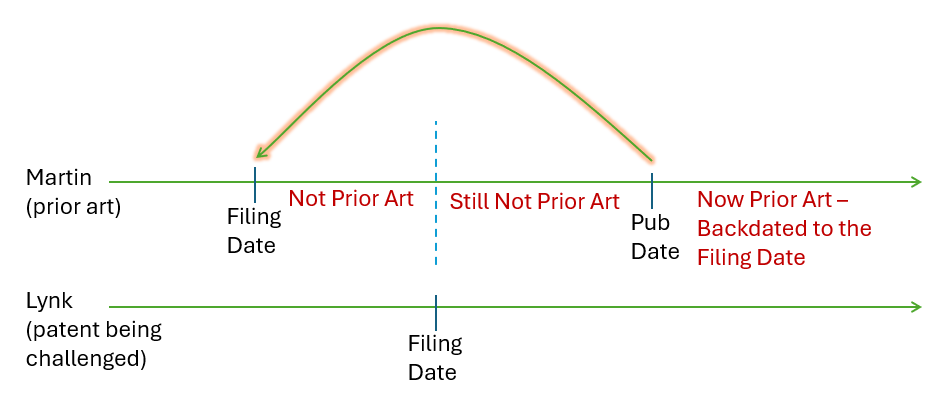
In Lynk Labs, the Federal Circuit held that a patent application filed by a competitor but kept secret until after the challenged patent’s filing date could be used as prior art in an IPR proceeding. Samsung had successfully challenged Lynk’s patent using an earlier-filed patent application (the “Martin” reference) that was filed in April 2003—months before Lynk’s February 2004 priority date—but did not publish until October 2004, well after Lynk’s filing. The court concluded that this reference satisfied § 311(b)’s requirement that IPR challenges be based on “prior art consisting of patents or printed publications” because the prior application had, by the time of the IPR, become a “printed publication” and § 102(a)(2) independently established its prior art status. Although 102(a)(2) does not define a “prior art . . . printed publication,” it does create “prior art,” and the documentary evidence is a “printed publication.”
- Dennis Crouch, Secret Springing Prior Art and Inter Partes Review, Patently-O (Oct. 2024), https://patentlyo.com/patent/2024/10/secret-springing-partes.html.
- Dennis Crouch, Publications Before Publishing and the Federal Circuit’s Temporal Analysis, Patently-O (Jan. 14, 2025), https://patentlyo.com/patent/2025/01/publications-publishing-gymnastics.html.
- Dennis Crouch, Prior Art as of the Effective Filing Date, Patently-O (Nov. 2023), https://patentlyo.com/patent/2023/11/prior-effective-filing.html.
- Lynk Labs Extension Application.
Prior Art as Document: The Everyday Understanding
When patent practitioners discuss prior art in everyday practice, we typically think in documentary terms. Prior art is “a patent,” “a journal article,” or “a technical manual”—concrete things that can be cited, attached to office actions, or entered as exhibits in litigation. This document-centric view treats prior art as essentially synonymous with the physical or digital reference itself. You can point to a printed publication and declare “this is the prior art that anticipates claim 1.”
This documentary conception aligns perfectly with Congress’s language in § 311(b), which requires that IPR challenges be based on “prior art consisting of patents or printed publications.” 35 U.S.C. § 311(b). The word “consisting” suggests that prior art is made up of these tangible documentary components, much like saying a library consists of books and periodicals. When Congress restricted IPR challenges to objective, documentary evidence, it was embracing this document-centric model.
This framework works seamlessly for traditional prior art scenarios such as 102(a)(1) patents and printed publications. A journal article published in 1995 became prior art as of its publication date. An issued patent becomes prior art as of its issue date. The document and its prior art status are temporally synchronized—when the document becomes publicly accessible, it simultaneously becomes available as prior art.
Prior Art as Process: The Statutory Reality
But a reading of § 102 reveals a different conceptual framework entirely. Each subsection of § 102 is written not as a description of documents, but as a description of actions or processes that, when performed, negate patentability. This process-oriented language makes historical-etymologic sense when we recall that “art” is an old patent law term reaching back to the Patent Act of 1790, which allowed for patenting of “any useful art.” Act of Apr. 10, 1790. Congress later updated this terminology in § 101, replacing “art” with “process.” Under this historical framework, prior art requires a prior action or process, not simply the prior existence of an inanimate document.
Merger and Distinction:
The merger between process and document works seamlessly with traditional prior art categories of patents and printed publications. The document is created and the required action—public disclosure—occurs simultaneously. The process (public disclosure) and the document (the patent or publication) align perfectly in time. This temporal synchronization explains why the document-centric view feels so natural for these categories.
But this framework becomes more complex with other prior art categories. Public use and on-sale prior art clearly involve actions (using publicly, offering for sale) that create prior art effects without necessarily generating any lasting document, with the most clear of these being public use. Even here, however, patent law participants have increasingly pushed toward a documentary model by treating these as “system prior art” that can be captured and described in written form.
Secret Prior Art: Where the Frameworks Collide
Under pre-AIA law (which governs the Lynk Labs patent), 35 U.S.C. § 102(e) provided that an earlier-filed, later-published patent application by another could bar a later-filed application. The current § 102(a)(2) serves a similar function. In both cases, the law creates a form of prior art that exists in a temporal paradox: it derives its prior art effect from an early filing date, but its status as a “printed publication” comes only from later publication.
Secret springing prior art under § 102(a)(2) falls uncomfortably between these two conceptual poles, creating the interpretive challenge that explains much of the confusion in Lynk Labs. Here, there is ultimately a document—the published patent application—but the prior art process is temporally complex and fractured. The key action that triggers prior art status is not the publication itself (which occurs too late to be prior art), but rather the earlier filing combined with eventual publication.
This creates a situation where the document exists, but it becomes prior art through a complex legal process rather than through straightforward public disclosure at the relevant time. The prior art effect is deliberately disconnected from the document’s actual public accessibility, creating what is essentially a legal fiction that treats later-disclosed information as if it were publicly available earlier.
Statutory Interpretation Implications
This temporal fracture is what makes the Lynk Labs statutory interpretation question so difficult in my mind. Under the document-centric view, the Martin reference clearly qualifies. It is, indisputably, a printed publication—it was eventually published by the USPTO. The fact that this publication occurred after Lynk’s filing date doesn’t change the document’s essential character. Section 102(a)(2) independently establishes that this document can serve as prior art when backdated to its filing date. Both statutory requirements are satisfied: there is a printed publication, and § 102 makes it prior art.
Under the process-centric view, however, the analysis becomes more complex. The question is not simply whether a document exists, but whether the prior art process was completed at the relevant time. And Lynk Labs argues that a “printed publication” in § 311(b) inherently requires public accessibility at the relevant time—that is, the publication process must have been completed before the challenged patent’s filing date.
I find Lynk Labs fascinating as a way to think of patent law fundamentals, but it is also important — recognizing that 102(a)(2) is the key prior art in fast-moving fields. Except for self-defeating prior art, we don’t care about a prior art patent’s issued date, only its filing date. This substantially expands the scope of available prior art in post-grant proceedings and makes it substantially easier to challenge patents.
Note on Discretionary Denial: Even if the Supreme Court denies certiorari, the USPTO Director could use her discretionary denial authority to blunt the practical impact of § 102(a)(2) prior art. But, so far, the USPTO has strongly supported Samsung’s case.
Note on Extending the Case: The logic of the Federal Circuit’s decision potentially applies to “system” prior art that is later published. For instance, let’s say an inventor recounts in a 2025 journal article that she showed her particular experimental to a group of visiting researches back in 2020, providing detailed technical specifications. Under the Lynk Labs reasoning, this article could potentially be used in an IPR to challenge a 2022 patent covering similar technology, even though the article describing the 2020 system was not published until well after the challenged patent’s filing date. The article would satisfy § 311(b)’s “printed publication” requirement as a documentary matter, while the described 2020 system use could arguably constitute prior art under § 102(a)(1) as a “public use” or as being “otherwise available to the public”—depending on the specific circumstances. This scenario illustrates how the disaggregation documentary approach endorsed in Lynk Labs could significantly expand the temporal scope of available prior art in IPR proceedings beyond just unpublished patent applications. The key insight is that once we accept that a “printed publication” need not have been publicly accessible at the relevant prior art date, any later-published description of earlier activities potentially becomes fair game for IPR challenges, fundamentally altering the landscape of post-grant patent validity disputes.
I may well missing something here, but I do not understand the indicated problem? In the six years of AIPLA debate over the content of what became the AIA patent statute it was widely agreed that the AIA would continue to give full 103 prior art effect to the contents of a patented or published patent application running from its original pre-publication filing date.* [Even expanded to proper foreign priority application filing dates.] No distinction was drawn between the prior art effect of a process [versus hardware or chemicals] disclosed therein. A truely unpublished article does not become 102 or 103 prior art unless and until it is shown to enough people skilled in the art that CAFC case law considers it to then be a publication. [If there is a sufficient public admission by the author that the subject process was actually being used, that could also be an admission against interest of “public use” as of the admitted date thereof.]
*Presuming the spec contents were not substantively changed between filing and publication.
*The EPO “novelty only” system of only Partial prior art effect during the time period between application filing and application publication was not adoped in the AIA.
If a published patent application was Not fully effective prior art as of its filing date there would be a constant problem of two or more applicants being able to obtain patents on the same or essentially the same invention.
That was actually happening before the AIA, when foreign filed application priority date was prior to the filing date of a U.S. applicant but that prior foreign filing date was not the prior art date for the U.S. applicants.