Call for Papers

Akron IP Journal is hosting a symposium issue on Patentable Subject Matter and welcomes academic papers on the topic with a deadline of December 1, 2014.  Submit in Word format to lawreview@uakron.edu attn: Jarrett Wyatt (Managing Editor).

The Patent Information Users Group (PIUG) is calling for papers for its 2015 Annual Conference held this year in the Chicago area. The conference focuses on patent search strategies & technology but the group is also looking to hear from attorneys on their application in support of patent drafting, prosecution, opposition or litigation matters. [LINK].


A Major Drop in Patent Infringement Litigation?

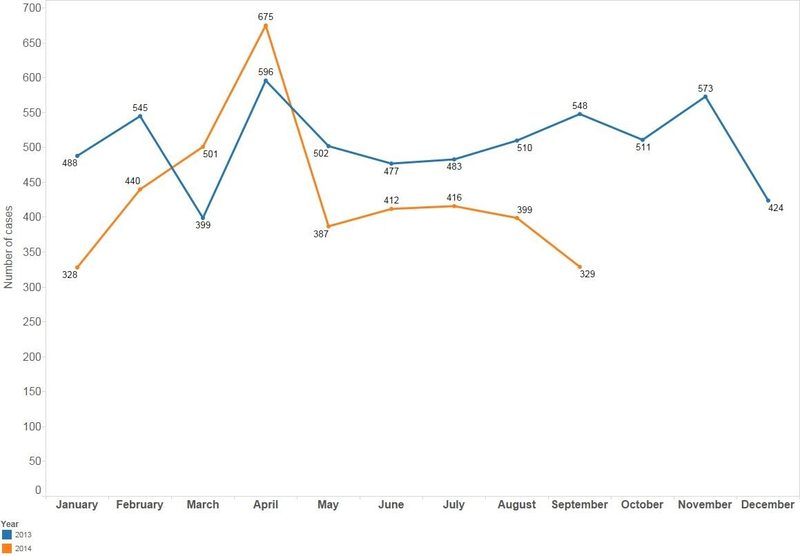
New patent litigation (original complaint filing) is down 40% from this time last year. The chart below comes from LexMachina whose founder, Mark Lemley, offers the speculation that the drop is largely due to the Supreme Court’s recent patent law activity — especially the fall-out from Alice Corp.  Along with Alice, we have a set of additional legal issues that favor accused infringers, including indefiniteness (Nautilus) and fee shifting (Octane Fitness).  Further, we are also well into the reign of post-issuance reviews (IPR, CBM, and now PGR) and the vast majority of repeatedly-asserted patents are involved in a parallel administrative review.  All these factors come together to provide plenty of reason for patent holders to slow-down on complaint filings. Of course, the change and the purported cause cannot be said to be ‘significant’ in the statistical sense.

PatentCases

We previously discussed the jump in April 2014 as a likely artifact caused by a threatened retroactive fee-shifting legislation.

In thinking about this issue, I was surprised to see HP’s most recent lawsuit as a plaintiff where it asserted three seemingly weak patents. U.S. Patent Nos. 6,089,687, 6,264,301, and 6,454,381.  These patents serve as HP’s attempt to control the market for replacement ink cartridges for its printers and have titles such as “providing ink container extraction characteristics to a printing system”; “identifying parameters in a replaceable printing component”; and “specifying ink volume in an ink container.”  The defendant in this case is Chinese ink-knockoff manufacture Ninestar.

The claims of these patents are clearly susceptible to Alice Corp in that the seeming points of novelty are basically very simply data structures.

The following is claim 1 of the ‘687 patent:

1. An ink-jet printing system comprising:

a printer portion for depositing ink on media in response to control signals, the printer portion configured for receiving a supply of ink;

a replaceable ink container for providing a supply of ink to the printer portion, the replaceable ink container including an electrical storage device for providing parameters to the printer portion, the electrical storage device containing:

an ink container scale parameter for selecting an ink container volume range from a plurality of ink container volume ranges,

a fill proportion parameter for specifying a fill proportion for the selected ink volume range;

wherein the printer portion determines an ink volume associated with the ink container based on the fill proportion parameter and the selected ink volume range.

Here, my understanding is that the hardware components were all known prior to the application here and the invention is simply to store two parameters on the cartridge (ink container scale parameter (specifying container volume) and fill proportion parameter (specifying how full it is)). The use of these parameters was also well known prior to the invention, but (apparently) they had never been put on an ink cartridge before.  Until recently, we would think this claim has an obviousness problem.  Now, it looks like it has patent eligibility problems as well. See HP v. Ninestar, 14 cv 4473 (N.D. Cal., complaint filed October 6, 2014).

STC.UMN v. Intel: Co-owners are necessary parties but may not be involuntarily joined

By Jason Rantanen

STC.UMN v. Intel Corp. (Fed. Cir. 2014)

Original panel: Rader (author), Dyk, Newman (dissenting)
Denial of rehearing en banc: Dyk, concurring (joined by Moore and Taranto); Newman, dissenting (joined by Lourie, O’Malley, and Wallach); O’Malley, dissenting (joined by Newman, Lourie and Wallach)

Panel opinion

Denial of rehearing en banc

The issue at the core of this appeal was whether a co-owner of a patent can be forced to join an infringement lawsuit brought by another co-owner or instead effectively block the suit by refusing to participate. The Federal Circuit is deeply split on this issue, as evidenced by both the June 2-1 panel opinion  and the 6-4 refusal to rehear the decision en banc. The panel majority held that a co-owner may not be forced to join the infringement suit and because the full court denied rehearing en banc, that holding stands unless the Court grants cert. Judge Newman and Judge O’Malley both wrote dissenting opinions.

The patent right and co-owners. Co-owners of a patent may separately exercise all the rights of a patent owner: they may make, use, offer for sale, and import the patented invention without needing the permission of the other co-owner. They may also grant a license to the patent. Importantly, they may do all of this without giving the other co-owner a dime; unlike for copyrighted works, there is no right of accounting for patents.

A consequence of this is that if there are co-owners of a patent, a prospective infringer need only obtain a license from one co-owner. This makes unity of patent rights important for any party who wishes to actually enforce those rights as against future conduct.

This rule is clear as to future conduct; the complexity comes about when dealing with past infringing activities. A patent co-owner may only grant a prospective license to the patent and a release as to its own claims for liability for past infringing conduct; it may not release infringers from liability to the other co-owner for past infringement. However, it is also blackletter law that all owners of a patent must be parties to an infringement suit for there to be standing. But not all co-owners may cooperate with the party wanting to bring the suit. Perhaps they have some contractual obligation to the accused infringer; perhaps they are even directly connected to the accused infringer. Or perhaps, as in this case, the co-owner just wants to remain “neutral.” Does the uncooperative co-owner have the right to do so?

This case can be seen as an old fight renewed. The origins of the split go back to the Federal Circuit’s 1998 decision in Ethicon v. United States Surgical, 135 F.3d 1456. The majority opinion, written by Judge Rader, dismissed the suit on the ground that a co-owner could not and did not consent to the infringement. This conclusion followed the following statement of law:

Further, as a matter of substantive patent law, all co-owners must ordinarily consent to join as plaintiffs in an infringement suit.9 Consequently, “one co-owner has the right to impede the other co-owner’s ability to sue infringers by refusing to voluntarily join in such a suit.” Schering, 104 F.3d at 345.

Footnote 9 referred to two exceptions: where the co-owner has waived its right to refuse to join the suit and where there is an exclusive licensee, the exclusive licensee may sue in the owner’s name.

Judge Newman dissented in Ethicon. While much of her dissent focused on the issue of whether an inventor on only some of the claims is a co-owner of the patent as a whole (Judge Newman would have held no), she also pointed out that Rule 19’s involuntary joinder rule should apply here.

Involuntary Joinder Does Not Apply: Drawing heavily upon Ethicon, the panel opinion in this case – also written by Judge Rader -extended the rule that co-owners of a patent may refuse to voluntarily join an infringement suit to preclude operation of Federal Rule of Civil Procedure 19(a). The relevant portion of that rule states:

(1) Required Party. A person who is subject to service of process and whose joinder will not deprive the court of subject-matter jurisdiction must be joined as a party if:

(A) in that person’s absence, the court cannot accord complete relief among existing parties; or

(B) that person claims an interest relating to the subject of the action and is so situated that disposing of the action in the person’s absence may:

(i) as a practical matter impair or impede the person’s ability to protect the interest; or

(ii) leave an existing party subject to a substantial risk of incurring double, multiple, or otherwise inconsistent obligations because of the interest.

(2) Joinder by Court Order. If a person has not been joined as required, the court must order that the person be made a party. A person who refuses to join as a plaintiff may be made either a defendant or, in a proper case, an involuntary plaintiff.

A few things to note: First, no one appears to be disputing that Rule 19 has the force of law or that a co-owner may refuse to voluntarily participate in a patent infringement suit. Rather, the disagreement boils down to (1) whether the co-owner has a “substantive right” not to participate in a patent infringement suit and (2) if there is such a right, whether it preclude the application of Rule 19.

Unfortunately, as Judge O’Malley’s dissent points out with particular rigor, the panel majority opinion is is quite short on the basis for this “substantive right.” The basic legal move the majority makes is to rely on precedent holding that a co-owner may refuse to voluntarily participate in a patent suit as providing the basis for a substantive right not to join an infringement suit, with the policy basis that the anti-involuntary joinder rule ” protects, inter alia, a co-owner’s right not to be thrust into costly litigation where its patent is subject to potential invalidation.”

Concurring in the denial of en banc review, Judge Dyk’s opinion fleshes out the argument in more detail. In Judge Dyk’s articulation, the question is whether there is a “substantive obligation” for the co-owner of a patent to join the suit; in the absence of a “substantive obligation,” the co-owner cannot be forced to join through the operation of procedural rules, such as Rule 19. Judge Dyk thus flips the question: while he points to cases where the co-owner did not consent, and thus the suit was dismissed, he also points out the lack of patent cases imposing a “substantive obligation on a patent co-owner to consent to the assertion of an infringement claim.” This allocation of substantive rights cannot be changed by application of Rule 19.

Writing in dissent to the denial of rehearing en banc, Judge O’Malley challenged both the basis for the substantive right as well as way such a “right” interacts with Rule 19. Walking through Ethicon and the other cases cited by Judges Rader and Dyk, Judge O’Malley challenges the precedential basis for such a “right.” Nor, Judge O’Malley argues, is there any basis in statute for this “right;” indeed, it is directly contradicted by other statutory “rights,” particularly Section 154(a)(1), “the right to exclude others.” And in any event, Rule 19 is *mandatory.* “By its terms, therefore, when a person satisfies the requirements of Rule 19(a), joinder of that person is required.”

So what’s going to happen? As Hal Wegner has noted in his email newsletter, a petition for certiorari is expected in this case. And, given that the core issue is one of civil procedure, albeit intertwined with an issue of the nature of the patent right, it may be particularly appealing for the Court – especially coupled with the deep split and thoughtful opinions of two of the Federal Circuit’s sharpest thinkers.

An odd issue raised by the majority rule here: What happens when one co-owner sends out threatening letters to an accused infringer but the other does not. Can the accused infringer bring a declaratory judgment action against both co-owners? If not, must the declaratory judgment action be dismissed for lack of standing? Or is this sufficiently different from an affirmative suit for infringement as to make the “all parties required” rule not apply?
The New Role for Post Grant Review Proceedings (PGR)

by Dennis Crouch

It has now been just over 18-months since we started filing patent applications under the new first-to-file patent system mandated by the America Invents Act (AIA) of 2011.  And, slowly but surely, FTF patents are now beginning to issue.  Those new patents also bring us into a new era of Post-Grant-Review-Proceedings (PGR).

My expectation is that PGR will quickly prove itself as an incredibly powerful tool for challenging patents. Importantly, PGR proceedings allow a third party to challenge the validity of a patent on any of the validity grounds that could be raised in court as a defense under 35 U.S.C. 282 – these include novelty, obviousness, written description, enablement, indefiniteness, utility, and subject matter eligibility. This list represents a major expansion of challenge-justifications over inter partes review (IPR) proceedings or reexaminations. These same doctrines have already been available for covered-business-method review (CBM) proceedings and have been used successfully if only on a narrow class of patents (those covering financial business methods).

Two recent PGR proceedings have been filed.  In one case, LaRose Indus. has challenged Patent No. 8,684,420 that covers the popular children’s “Rainbow Loom.”  Although the patent claims a 2010 priority date, the particular application was filed as a continuation in July 2013 and, at least according to the petitioner, added new mater to the claims at that point.  The second case PGR case involves Patent No. 8,598,291 that covers a liquid formulation of a particular nausea control drug used by chemotherapy patients. The petition argues that the claims fail the requirements of written description, enablement, and definiteness.

The most important limitation on the PGR process is the relatively short 9-month window for filing a PGR petition. Namely, the petition must be filed within 9-months of the patent issuance.  This puts some pressure on parties to monitor competitor patents and patent families.  It also provides patent owners at least some incentive to hold-off asserting their patent until after that window has closed (unless the patentee would welcome the review).  I suspect that the set-up in the LaRose Rainbow Loom market will be fairly common. The patentee (Choon) had previously sued LaRose on a previous patent and so LaRose has been closely monitoring the continuation applications.

= = = = =

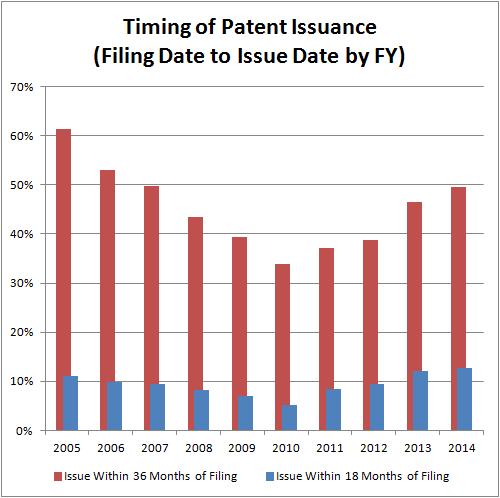
In thinking about how soon the AIA cases will come on-board, I created the chart below. The chart provides some information on the timing of patent issuance — showing the percentage of patents issued with 18-months of filing and 36-months of filing respectively.  A big caveat for this particular chart is that it looks at the actual application filing date and does not consider the priority date that will typically control whether a patent will be examined under the AIA. Thus, even at the three-year date (March 2015), I would expect that significantly less than half of the recently issued patents would be FTF patents.

You’ll note the trend beginning in FY2011 of issuing more patents more quickly.  I largely attribute the change to two initiatives pushed by David Kappos during his term as PTO Director that resulted in (1) more funding to hire more examiners; and (2) a greater allowance rate.  Those factors have continued through the succeeding interim leadership terms of Terry Rea, Peggy Focarino, and now  Michelle Lee.

TimingOfPatentIssuance

Moving Toward A Way of Searching Through Cited References

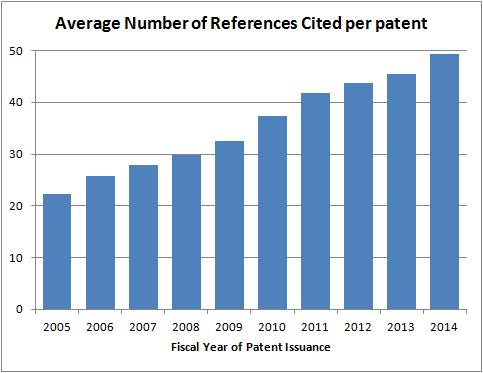
The average number of references cited per patent has continued to grow over the past decade and now almost reaches 50 per patent with no sign of slowing-down.  When the reference-count was much lower, many examiners apparently assumed that applicant had already ensured that the cited references did not disclose the patented invention.  However, today neither patent applicants nor their patent attorneys have time to read through and fully consider such a large number of references.  Obviously, examiners also do not have time to read 50 references.  In my view, technology could offer a nice solution that would easily allow examiners to conduct an internal textual search that is limited particularly to references that have been submitted in this case and perhaps those previously cited in similar cases. So far, that search capability does not appear to be available for the examiners – especially for non-patent prior art.

ReferencesCited

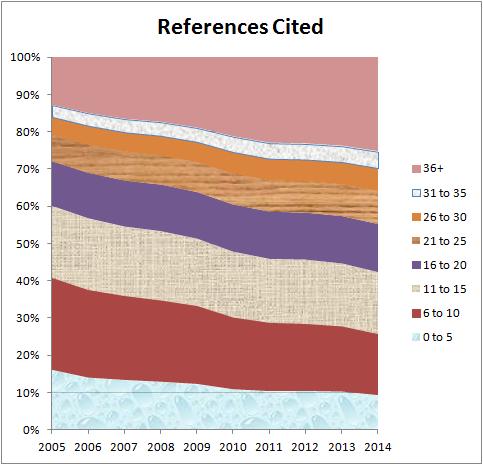
Now, I should mention here that the ‘averages’ are a problematic figure for references cited because the distribution is quite skewed. Namely, there are a fairly small number of cases that cite a very large number of references, and those cases have a major impact on the results.  The chart below shows a more nuanced version of the distribution.

ReferencesCited2


Integration vs Filtration: Federal Circuit Asked How to Determine Eligibility

University of Utah and Myriad Genetics are back at the Federal Circuit after losing a motion for preliminary injunction against the genetic testing company Ambry Genetics.  The case still focuses primarily on BRCA genetic testing, although the asserted claims are different from those in the Supreme Court decision.

For instance, Utah has asserted claim 7 of its Patent No. 5,753,441 listed below.

7. A method for screening germline of a human subject for an alteration of a BRCA1 gene which comprises

comparing germline sequence of a BRCA1 gene … from a tissue sample from said subject … with germline sequences of wild-type BRCA1 gene…

wherein a difference in the sequence of the BRCA1 gene … of the subject from wild-type indicates an alteration in the BRCA1 gene in said subject, [and]

wherein a germline nucleic acid sequence is compared by hybridizing a BRCA1 gene probe which specifically hybridizes to a BRCA1 allele to genomic DNA isolated from said sample and detecting the presence of a hybridization product wherein a presence of said product indicates the presence of said allele in the subject.

Because Claim 7 is a dependent claim, I have rewritten it to include the limitations of independent claim 1 and also eliminated some language written in the alternative.  I have also eliminated some redundancy.

The advance embodied by the University of Utah’s BRCA patents all center around the researchers’ discovery of the genetic sequence and location of the naturally occurring BRCA1 and BRCA2 genes and that the mutations correlate with a high risk of cancer.  That discovery itself is not patentable because it is a law of nature, or alternatively, an abstract idea or perhaps even a product of nature.  The question then is whether the claim includes the necessary “something more” – an “inventive concept” that transforms the invention into one that is patent eligible in a way that ensures that fundamental building blocks of science and technology are not monopolized through the patent.  A problem for Myriad on this front is that the tools of hybridized screening were already known and were not themselves inventive concepts at the time.  However, clearly the invention as a whole is practical, transformative, and inventive.

On October 6, 2014, the Federal Circuit heard oral arguments on the case with a panel consisting of Chief Judge Prost, Judge Dyk, and Judge Clevenger.  Oral arguments focused largely on the question of integration versus filtration.  Namely, when applying the second step of the Alice/Mayo analysis, is it proper to consider the invention as a whole integrated invention or must the court first filter-out the excluded subject matter and then ask whether an inventive concept can be found in the remains. It will be interesting to see how the court resolves this important and tricky question.

Berkeley Center for Law and Technology is looking for an Executive Director

By Jason Rantanen

About a week ago I highlighted several schools that are seeking clinical IP faculty.  Rob Merges of the Berkeley College of Law recently reached out to me to share that the Berkeley Center for Law and Technology is looking for a new Executive Director.

The BCLT is at the core of Berkeley’s extensive law and technology program: it coordinates research funding and the many course offerings in this field at Berkeley Law, organizes terrific conferences and workshops, and serves as a hub for lawyers and scholars interested in IP, privacy, and other aspects of law and technology.  The current Executive Director is Robert Barr, former Chief IP Counsel for Cisco and past Executive Dirctors have included Ray Ocampo, former General Counsel for Oracle (and Olympic luger).

From the job posting:

The Berkeley Law Center for Law & Technology (BCLT) invites applications for the position of Executive Director. This is a 100% full-time appointment.
BCLT is a research center at the University of California, Berkeley, School of Law. For the past fourteen years, BCLT has been rated by US News & World Report as one of the top intellectual property programs in the country, in part because of the high quality, high impact research conducted by its faculty and students. BCLT’s research includes intellectual property, electronic commerce, telecommunications regulation, cyberlaw, privacy and other areas of law that are affected by new information technologies.

Read more at the official posting: https://aprecruit.berkeley.edu/apply/JPF00563

US Patents: Where are the Inventors Located?

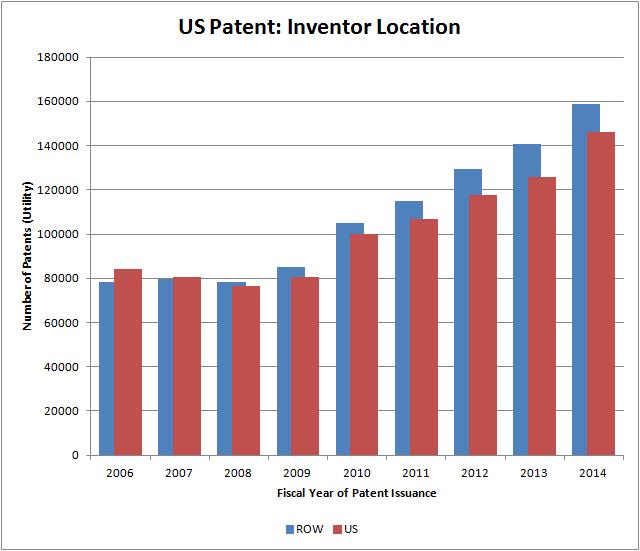
InventorLocation

Country of First Named Inventor FY2014 Patent Count
Japan 54975 18%
Germany 16730 5%
Korea 16280 5%
Taiwan 11303 4%
China 7694 3%
Canada 7218 2%
France 6812 2%
UK 6700 2%
Israel 3453 1%
India 3005 1%
Sweden 2754 1%


* The numbers above are based upon the inventor country as listed for the first-named inventor on the face of each U.S. utility patent.  Although there are an increasing number of cross-country patents (with inventors listing different countries), those numbers are negligible in a population analysis such as this. The results for assignee-country are virtually parallel with the exception that about 6% of U.S. patents are issued without a listed assignee.

Update: Using IPR to Manipulate the Stock Price of Patentees Which Won in District Court

The creativity of American lawyers never ceases to amaze.  I’ve heard of variations on this theme:  using an IPR to coerce payment, a license, or something from the patentee.  Variation on the theme:

A third party sees that a patentee has won a big judgment, defending its patent against a charge of invalidity.  The third party then cobbles together an IPR petition based upon the arguments that failed in the district court, relying upon the lower burden of proof and broader claim construction that will apply in IPR, and sends it to the patentee with a note:  “pay us or we’ll file this.”  This was discussed a few months back here.

A third party uses IPR as a tool to manipulate stock price:  sell the stock short and then file the IPR.  Or, it sees the patentee is in litigation and says, “give us a license (which we’ll turn around and use to license the defendants) or we’ll file an IPR.”  A story about that allegedly happening is here.

Gotta love America.

The ethics of this are fascinating:  it may be that the OED could be brought in to show that the IPR was filed for an improper purpose and nip it in the bud.  But that’s probably a long shot, given the right to petition and what-not.  Perhaps Congress limiting standing in IPRs to competitors?  It’s too early for me to think in depth about a creative solution to this creative problem.

Court Affirms Inequitable Conduct for Inventor’s Failure to Submit Prior Art

American Calcar v. American Honda (Fed. Cir. 2014)

Back-Link: Jason Rantanen previously discussed the court’s first decision in the case here: Calcar v. Honda: CAFC’s First Post-Therasense Inequitable Conduct Opinion (2011).

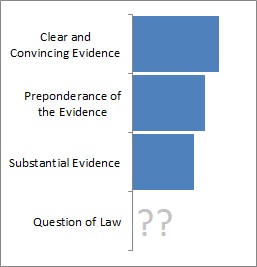
EvidentiaryStandardsIn a split opinion, the Federal Circuit has affirmed the district court’s determination that Calcar’s three asserted patents are unenforceable due to inequitable conduct during prosecution.  The case teaches about “but-for materiality” and holds that the withholding of information can be the but-for cause of a patent issuance even if that information is insufficient to render any of the patent claims invalid in court. See also Therasense. The court winds this tale by noting the evidentiary difference: PTO only requires a preponderance of evidence of nonpatentability while invalidation in court requires clear and convincing evidence.

Duty of Disclosure, Candor, and Good Faith Dealing: Although lawyers always bear certain good faith obligations, those practicing before the before the PTO bear a more significant duty of disclosure, candor, and good faith dealing.  Failure to meet this high standard has a number of potential repercussions — for patent owners, the greatest issue is the potential that resulting patents may be held undenforceable due to inequitable conduct in proceedings before the USPTO.  Importantly, for any particular patent case, the duty of disclosure extends to all “individuals associated with the filing or prosecution.” 37 C.F.R. 1.56. This certainly includes named inventors as well as “every other person who is substantively involved” with the application.  Id.

Therasense En Banc: In Therasense (Fed. Cir. 2011) (en banc), the court made it a bit more difficult to render a patent unenforceable by requiring (a) proof of a ‘bad’ act that is a but-for cause of the patent issuing as well as (2) particular intent that the act was intended to deceive the PTO.  Conventional wisdom is that Therasense (as well as Excergen) has dampened many claims of unenforceability — especially those where the allegation is merely a failure to fully disclose to the USPTO all information related to patentability of the case in question.

large-luxury-carFailure to Disclose Photos Taken of Prior Art: This case involves a family of three patents directed to a multimedia system used to access vehicle information and control vehicle functions.  The district court found that Calcar’s founder and named inventor Michael Obradovich had particular information about a prior Acura 96RL navigation system that he failed to submit to the PTO.  In particular, prior to starting work on his invention, Obradovich had driven the Acura, operated its navigation system, and taken photographs as well written a “QuickTips” guide.  Although the application identified the 96RL system as prior art, Obradovich did not write a summary of his experiences or submit the photographs or the owner’s manual.  The district court found this failure to be material to patentability and also that the “only reasonable inference from the evidence” was that Obradovich withheld the information with “specific intent to deceive the PTO.”  On appeal, the Federal Circuit affirms.

But For Materiality: An interesting aspect of this case comes from the fact that the jury considered the non-submitted prior art but found that it failed to render any of the patent claims invalid. Yet, the courts here hold that the non-submitted prior art can still be considered a but-for cause of the patent issuing in the first place.  The reasoning for this discrepancy is that that the PTO’s evidentiary standard for refusing to issue a patent is only a preponderance of evidence – a much lower standard that the clear and convincing evidence required to invalidate an issued patent.  Here, the finding is that the USPTO would have found at least one of the claims obvious if it had seen the non-submitted prior art.

But Obviousness is a Question of Law: Under Graham and KSR, obviousness is a question of law that relies upon an underpinning of factual determinations. Although the court ignores the Graham inquiry in its analysis here, it appears that the only disputed issue is the ultimate legal question of obviousness and not the factual underpinning.  The fact that we’re talking about a question of law is important because questions of law are not governed by evidentiary standards but rather both the PTO and Courts must approach that ultimate question with the same framework of simply correctly determining the law based upon the evidence presented.

The majority opinion was written by Chief Judge Prost and joined by Judge Wallach. Judge Newman wrote in dissent.

Judge Newman focuses on an interesting issue. She argues that, rather than speculating about what the PTO might do, lets look at what it actually did when it saw the references.  Namely, the ‘497 patent (invalidated by the jury and not at issue here) was reexamined by the PTO during the course of the litigation and the examiners reviewed the previously non-submitted prior art and then confirmed all of the claims as patentable.  However, Judge Newman’s arguments appear more appropriately addressed to the earlier court opinion in this case.

Nonetheless, my colleagues rule that the patents are unenforceable based on the initial failure to send the Owner’s Manual and photographs to the PTO. The inequitable conduct with which Mr. Obradovich is charged is that he “did not tell Mr. Yip [his patent attorney] about his experience with the 96RL, nor did he provide Mr. Yip with the Owner’s Manual or the photos of the navigation system display screens.” Dist. Ct. Op. at 11. However, the PTO established, on reexamination of the ’497 patent, that the purportedly withheld information was not material to patentability. In accordance with Therasense this ended the inequitable conduct inquiry, for the PTO sustained patentability in view of this information.

In addition, there was no evidence of intent to deceive the PTO. The panel majority impugns Mr. Obradovich’s credibility, although they do not say what is disbelieved. The jury heard and saw Mr. Obradovich, on examination and cross-examination, and did not find deceptive intent. My colleagues “infer” clear and convincing evidence of deceptive intent from Mr. Obradovich’s initial failure to send his patent attorney the Owner’s Manual and the photographs of the Acura display. They postulate that a savvy inventor and businessman such as Mr. Obradovich
would have known the information was material to patentability and would therefore withhold it in order to deceive the PTO. However, a more likely inference is that a savvy inventor and businessman would know that a patent obtained through concealment of a material reference is not a reliable commercial asset.


For Patents, It Still Comes Down to the Jury Verdict

Jury verdicts are fascinating with their simple power.  The jury is not asked to provide a long winded studied response to the case but rather to provide very simple responses to very difficult and complicated questions.  A lawyerly answer would be ‘its complicated,’ but that option is not allowed on the verdict form.

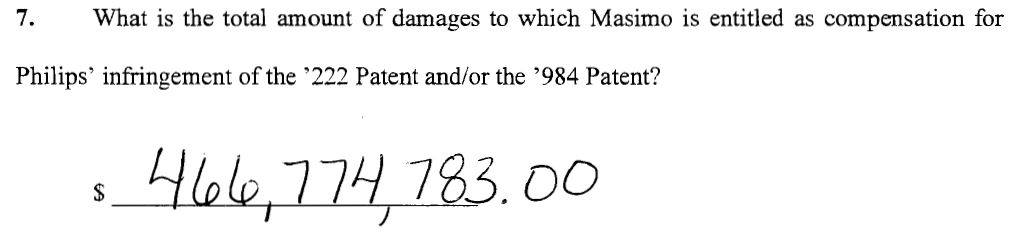
Masimo v. Philips involved a two week jury trial — two weeks of testimony where the two companies cross-asserted blood-oxygen monitor patents with competing experts at every front. Following that, the jury was given a simple form and it sided with Masimo to the tune of  $466 million dollars for past infringement.

MasimoDamages MasimoVerdict

Joe Re led the trial team for Masimo.

Double Patenting when you have a Common Assignee but No Common Inventors

This is a bit of an in-the-weeds question, even for Patently-O.

Because firms tend to operate within a certain market area and use a particular technological approach, it makes sense that a patentee may well create prior art that blocks future innovations. One solution offered by the law is the “common owner ship excption.”  In particular, the statutory definitions of prior art include the ‘common owner exception’ that excludes a right-owner’s prior-filed patent applications from the scope of prior art for later-filed applications so long as those prior applications were not published by the filing date of the later applications.

AIA Expansion of Exception: This is one area where the AIA reduced the scope of prior art. Namely, before the AIA the common owner exception excluded the prior applications only with regard to obviousness consideration (assuming different inventors). The AIA expands the exception to also exclude these prior-applications from anticipation consideration.  With this expansion, we might expect some increase in double patenting problems.

Double Patenting Common Assignee but No Common Inventors: My question relates to the statements in MPEP 804 that examiners should issue double-patenting rejections when two commonly-owned inventions claim the same subject matter even when there is no overlapping inventorship:

Claims in commonly owned applications of different inventive entities may be rejected on the ground of double patenting. This is in accordance with existing case law and prevents an organization from obtaining two or more patents with different expiration dates covering nearly identical subject matter. See In re Zickendraht, 319 F.2d 225, 138 USPQ 22 (CCPA 1963) (the doctrine is well established that claims in different applications need be more than merely different in form or content and that patentable distinction must exist to entitle applicants to a second patent) and In re Christensen, 330 F.2d 652 (CCPA 1964). . . .

[A rejection is proper even when] the reference … and the pending application are … by a different inventive entity and are commonly assigned even though there is no common inventor.


The problem with the MPEP here is that the cases cited are not on-point – i.e., they do not say anything about whether a double patenting rejection may persist when there are no inventors in common.  We know that statutory-double patenting is said to stem from 35 U.S.C. 101 and, likewise, we learned in AbbVie v. Kennedy Institute that obviousness-type-double-patenting also finds its roots in Section 101.  The problem with that approach is that Section 101 remains old-school and still focuses on “inventors” rather than applicants or owners.

My Question: What is the legal source of the MPEP’s declaration that a double patenting rejection is proper based upon common-ownership even when the two documents have no common inventor?  I suspect that there is a case on this, but I don’t know. 

Would you like 10,000 Cloems with that Patent?

[April 30, 2024 update: Cloem appears to be defunct, but there are many others]

by Dennis Crouch

Although you might be the first-to-file a patent application covering a particular new innovation, certain market areas are so competitive that you should expect follow-on patents from competitors that take the original idea and push it in other similar-but-different directions.  Those follow-on patents won’t block you from practicing your core invention, but they may well block you from implementing practical and important elements of a market-ready solution.

One potential partial solution to this problem is being offered by a new company out of Canes, France.  The company, known as Cloem, has an interesting business model of creating tens-of-thousands of what they call “cloems” based upon a client’s submitted claim set. A cloem is a computer-generated claim (or statement of an invention) that is created by the various permutations possible as well as by considering alternative definitions for terms as well as “synonyms, hyponyms, hyperonyms, meronyms, holonyms, and antonyms.”  The owner’s idea is that the cloems will be immediately published and then serve as prior art to prevent competitors from claiming rights to the whitespace surrounding the original patent.  Customers might also want to cloem a competitor’s patent application to prevent them expanding that subject matter.

www.cloem.com

Cloem admits that a substantial number of its results are nonsense, but a substantial number are also on-the-money and, with 50,000 cloems per patent, they can afford to waste a few.

Questions remain: (1) whether these smart-but-random computer-generated cloems should count as prior art; (2) when one of the cloems represents a seemingly patentable invention, who is the inventor and is it patentable?  Robert Plotkin wrote a book that considers some of this: The Genie in the Machine: How Computer-Automated Inventing is Revolutionizing Law and Business


Upcoming Events

I’m looking forward to a few upcoming events for patent law professionals:

  • HOUSTON: On the evening of November 5, 2014, I will be delivering the University of Houston’s IP IL Annual Fall Lecture at the Four Seasons Hotel in Houston (Sponsored by the Katz Foundation). My talk will be on incentives (current and future) for patent clarity. [LINK]. Thank you to the University of Houston Law Center for hosting this event.
  • AUSTIN: November 6-7, 2014, I will be down in Austin Texas participating in the annual Advanced Patent Law Institute with a talk titled Evidence Based Patent Law: Trends and Statistics, and What they Mean for Your Practice and your Patent Portfolio. [LINK]. Other speakers include Professors Golden (UT Austin), Lemley (Stanford), Wegner (formerly with GWU), and Hricik (Mercer); the Hon. Terry Rea and Randy Rader; Rob Sterne, et al.
  • WASHINGTON DC: Unfortunately, a great conference is also scheduled in DC for November 6-7, 2014 in Washington DC.  The Patents in Telecom conference, co-sponsored by University College of London (UCL) faculty of laws and GWU.  Excellent and varied set of international speakers including Qualcomm president Derek Aberly, AT&T Chief IP counsel Glenn Blumstein, and Sir Christopher Floyd, Lord Justice at the Court of Appeal of England and Wales. Patently-O readers get a 10% discount with code: patently-o-2014
  • WASHINGTON DC: On December 9, 2014, the IPO Education Foundation will be awarding its Distinguished IP Professional Award to Judge Richard Linn. Excellent choice and well deserved honor.  The IPO has more information on the award dinner and their reasons for choosing Judge Linn. Hugh Herr will also be named inventor of the year for his work on prosthetics.
  • VAIL: January 7-11, 2015, I will be in Vail, Colorado talking about patent law as part of the 32nd National CLE Confrence where they also happen to have “amazing skiing.” Conference co-chairs are Scott Alter (Baker Daniels) and David Bernstein (Debevoise & Plimpton ). [LINK]
  • NAPLES: February 7-10, 2015: Hal Wegner’s annual Patent Experts Conference in Naples (FL) at the Naples Beach Hotel.
  • USPTO: The USPTO’s AIA Roadshow continues with stops in Denver (Oct 2), Cupertino (Oct 7), and Atlanta (Oct 9). [LINK]
  • COPENHAGEN: A late entry to this list is the October 21 event at Aarhus University in Denmark focusing on the upcoming UNIFIED PATENT COURT in Europe. Judge Rader will deliver the keynote. I would be most interested in hearing the discussion of how the UPC may impact patent licensing, competition and enforcement. [Link]

We also have a set of new job postings on the Patently-O Job Board.

USPTO Breaks New Ground with 300,000 Patents Issued This Fiscal Year

PatentsPerYear


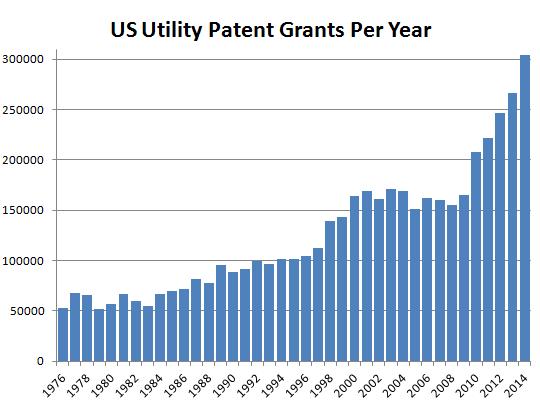
Fiscal Year 2014 has just ended for the Federal Government and – as expected – we have a new record number of US patent grants. For the first time, the USPTO has issued more than 300,000 utility patents in one fiscal year. Don’t worry, there remain more than 1,000,000 applications pending in the pipeline and more than 25,000 appeals remain pending before the Patent Trial and Appeal Board. During the fiscal year, the 8,300 patent examiners ‘disposed of’ more than 600,000 cases which in some circles will be calculated as an allowance rate of about 50%.*

Although I reported a rumored pull-back of allowed applications following the Alice Corp. decision in June 2014. However, the numbers do not reflect any dramatic reduction in the number of patents granted during this time period.

An important aspect of this new set of patents is that most corporate-owned U.S. patents are actually owned by foreign corporations stemming from inventions first created outside of the U.S.  I believe that shift in who is directly benefiting from patent rights is an important element of the current US political-economy of patent law. Namely, while only US-operators are being sued for patent infringement, patent ownership is often vested in non-US operators.

* The USPTO identifies a case as being disposed of if it (1) issues as a patent (or when allowed), (2) is abandoned, or (3) is the subject of a request for continued examination (RCE). Because I see RCE filings as simply a part of the prosecution process, I do not think it should be used in calculating allowance rate.  Result being that the allowance rate is effectively increased to about 70%.


Doctrine of Equivalents: What Elements Are you Narrowing?

Capture2Millipore v. AllPure (Fed. Cir. 2014)

Patent cases are incredibly expensive to litigate.  However, in a series of recent cases courts have appeared more willing to dismiss cases on summary judgment or even on the pleadings.  This case follows that trend with a holding that the defendant does not infringe the asserted patent claims — neither directly nor under the doctrine of equivalents.  In a prior generation patentees could typically get to a jury with an allegation of infringement doctrine of equivalents. However, the court has simultaneously tightened the rules for DOE infringement and loosened the rules summary judgment — result being that infringement under the doctrine of equivalents is now regularly a summary judgment issue.

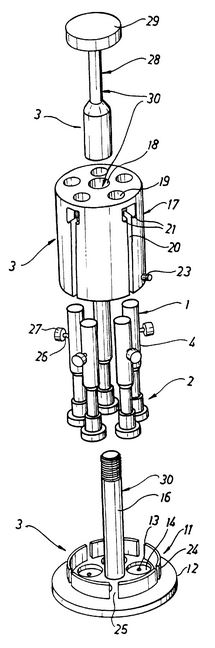
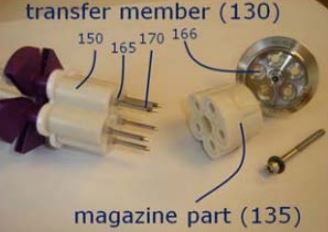
Millipore’s U.S. Patent No. 6,032,543 covers an aseptic system designed to add & remove fluid from a container without contamination.  The asserted claims require, inter alia, a “removable, replaceable transfer member . . . comprising a holder, a seal for sealing said aperture, a hypodermic needle . . . wherein the seal has a first [bellows-shaped] end . . . and a second [self sealing membrane] end.” Now, it turns out that the accused AllPure TAKEone industrial aseptic sampling system has all these elements – a holder, a seal with the bellow and membrane ends, and the needle.  In addition all of these parts are removable and replaceable.

Capture

AllPure’s key difference from the patented claim is that the collection of these parts are not removable as a unit but rather may only be removed by dis-assembly.  In construing the claims, the district court wrote: ““the [remove] implies movement or separation of something as a whole, whereas [disassemble] implies deconstruction. . . What Millipore characterizes as removal of a transfer member from the magazine part is, in fact, disassembly of a transfer member.”  Based upon that characterization of the patent and the accused device, District Court Judge Woodlock (D. Mass) found that the claims were not infringed.

On appeal, the Federal Circuit has affirmed — finding that the claimed “removable” transfer member requires that the transfer member be removable as a unit.

We agree with AllPure and the district court. If a transfer member does not exist when the device is disassembled, as even Millipore’s counsel admitted, then there is no genuine issue of material fact over whether the TAKEONE device contains a “removable, replaceable  transfer member” as is literally required by claim 1.

Doctrine of Equivalents: Section 271 of the patent act identifies an infringer as someone who “without authority makes, uses, offers to sell, or sells any patented invention.”  Although the “patented invention” is defined by patent claims, courts have long allowed patentees to enforce their exclusive rights to stop activity that is just-outside the literal scope of the claims. This doctrine of equivalents (DOE) has been with us for over 150 years  See Winans v. Denmead, 56 U.S. 330 (1853)(‘The exclusive right to the thing patented is not secured, if the public are at liberty to make substantial copies of it, varying its form or proportions.’).  However, the doctrine has been substantially limited by the all-elements-rule, Warner-Jenkinson Co. v. Hilton Davis Chem. Co., 520 U.S. 17 (1997), prosecution history estoppel, Festo Corp. v. Shoketsu Kinzoku Kogyo Kabushiki Co., 535 U.S. 722 (2002), and the doctrine of vitiation. see Wright Medical Technology, Inc. v. Osteonics Corp., 122 F.3d 1440 (Fed. Cir. 1997).

Narrowing Amendment Estoppel: In this case (as in most patents), the applicant had amended its claims during prosecution following a rejection by the patent office examiner to specify the portions of the seal (bellow-shaped and membrane ends).  Although at the time the applicant also made a broadening amendment, this particular amendment was seen as narrowing and designed to recite limitations not found in the prior art.  In particular, following the amendment the patentee argued that “none of the references show or disclose a seal formed like the present one.”  A narrowing amendment is seen as a no-no for the doctrine of equivalents since allowing DOE would essentially allow the patentee to regain patent scope that had been given-up during the prosecution process.  Under Festo, a narrowing amendment during prosecution creates a rebuttable presumption of prosecution history estoppel (PHE) with the result of estopping the patentee from claiming equivalents (DOE) to recapture the narrowed scope.  Here, the appellate panel found that presumption had not been overcome and thus that the patentee was estopped from claiming equivalents.

Narrowing of Sub-Assembly = Narrowing of Whole Assembly: A problem with the defendant’s argument here (and what Judge Prost failed to explain) is the linkage between the narrowing amendment and the asserted equivalents.  In particular, the narrowing amendment added limitations to the definition of the seal sub-assembly but the claimed equivalent was focused on the nature of the whole accused assembly as being disassemblable rather than removable as claimed. The only clue offered by the court is one phrase indicating that the amendment “narrows the seal limitation, which in turn narrows the transfer member limitation.”

Hierarchy of Elements: The battle over a hierarchy of limitations is common in modern doctrine of equivalents. Typically, the battle plays out in terms of the all-elements rule that requires the accused infringer practice each element of the asserted claim either literally or by equivalent.  For patentees, this type of equivalents is typically easier to prove when each “element” is seen as a grouping of limitations – such as the “removable, replaceable transfer member” – and defendants typically look to further granularize the invention so that the “removable” limitation itself would be an element that must satisfy the function-way-result test.   In this case – involving prosecution history estoppel – the patentee would have been better off with the more granularized framework in order to logically separate the “removable” limitation from the narrowed seal limitations.  However, the appellate court glosses-over all of this analysis in its short decision with the unfortunate result of leaving district courts to do the same.

Patenting Software in the US as compared with Europe

Guest post by Shubha Ghosh and Erika Ellyne

This post compares and contrasts the United States approach to patentable subject after last term’s Alice v CLS decision, with that in the European Union. The bottom line is that the EU may be now more favorable to software claims than the US.

In its 2014 Alice decision, the US Supreme Court makes clear that a two step test applies to determination of when an invention is patentable subject matter. First, the reviewer of the patent, whether patent examiner or judge, must determine if the patent covers an excluded area from patenting, such as an abstract idea or law of nature. If the patent covers an excluded area, the reviewer moves on to the second stage: whether there is an inventive concept that is an application of the abstract idea or law of nature. This two part test is a capstone to the Court’s prior decisions in Bilski v. Kappos (2010)(business method patents) and Prometheus v. Mayo (2012)(medical diagnostic and treatment patents).

By contrast, software is more easily patentable in Europe despite the existence of an express provision on the excludability of software. Article 52 of the EPC famously recites a list of ‘non-inventions’ that are excluded ‘as such’. The reading of this last condition has lead to a de minimis application of the provision. ‘Technical character’ is synonymous with invention in the EPO Board of Appeals’ (BoA) case law; any demonstration and degree of ‘technical character’ passes the patent eligibility threshold. The role of the technical feature is irrelevant; to the point that the mere use of technical means, such as a computer, renders a patent claim eligible (even the inclusion of the term ‘email ‘has ‘transformed’ a previously ineligible claim into an eligible one).

The European approach has been to adopt a formalistic rather than substantive approach; making patent eligibility a derisively low threshold. The US, on the other hand, has actively rejected this type of formalistic approach; neither adding the words ‘apply it’ to excluded subject matter nor the recitation of a computer can render the ineligible eligible. In Europe, the patent eligibility standard has become a question of drafting, a practice abhorred by patent Courts on both side of the Atlantic. In the end the standard is of little to no effect, looking at the context of its application no mixed claims (which recite a non invention along with other man made subject matter- where most questions arise) are ever rejected.

A technical application test can potentially help overcome the gaps/superficiality left open by the technical character test. The US approach suffers from its own ambiguities; the first branch of the US test, the determination of what is an ‘abstract idea’/subject matter is vague and in need of clarification/objectification. The European notion of ‘technical’, which is used in opposition to abstract in European case law as well, despite its numerous short comings could serve as a road map to a more developed test for abstraction. That is a subject for another day.

There are those that would counter that this is a determination for inventive step, that there is confusion here between eligibility and obviousness. It is true that in Europe, much of what is caught out under the US eligibly standards is further culled in the inventive step stage. However, in the inventive step assessment, much of inventive step is not about obviousness at all, but identification of the ‘invention’: the technical solution. The ‘problem solution’ approach usually proceeds first by the identification of the invention, the technical solution, to then derive the problem thereof. In this identification of the ‘technical solution’ a very controversial point is what extent ‘non technical features’, i.e. subject matter found under 52.2, can contribute to the technical effect/solution. At this stage, there is in fact a re-formulation of the invention; the main point of the tasks is a question of defining the invention not of ‘obviousness’ per se. The non-obvious determination is actually more a methodology than a veritable measure of ‘obviousness’ as such.

Shubha Ghosh is the Vilas Research Fellow & George Young Bascom Professor of Business Law at the University of Wisconsin School of Law where he is also the Associate Director of the Initiatives for Studies in Transformational Entrepreneurship (INSITE). Erika Ellyne is a law graduate and doctoral candidate at the Vrije Universiteit Brussel (Free University Brussels)

Patent Invalid for Unduly Preempting the Field of “Automatic Lip Synchronization For Computer-Generated 3D Animation Using a Rules-Based Morph Target Approach”

by Dennis Crouch

McRO (Planet Blue) v. Activision Blizzard, et al. (C.D. Cal. 2014) Decision PDF

In his second major Section 101 decision in as many weeks, Judge Wu (C.D. Cal) has relied upon Alice Corp. (2014) to invalidate all of McRO’s asserted patent claims.  The case is quite important because it is one of the first major applications of Alice Corp. to invalidate non-business-method claims.  Here, the invention is directed toward a specific technological problem that had troubled the field of animation – automatically animating lip synchronization and facial expression of animated characters. See U.S. Patent Nos. 6,307,576 (“‘576 Patent”) and 6,611,278 (“‘278 Patent”).  The appeal will be interesting and may serve as one of the Federal Circuit’s first opportunities to draw a new line in the sand. (more…)