by Dennis Crouch
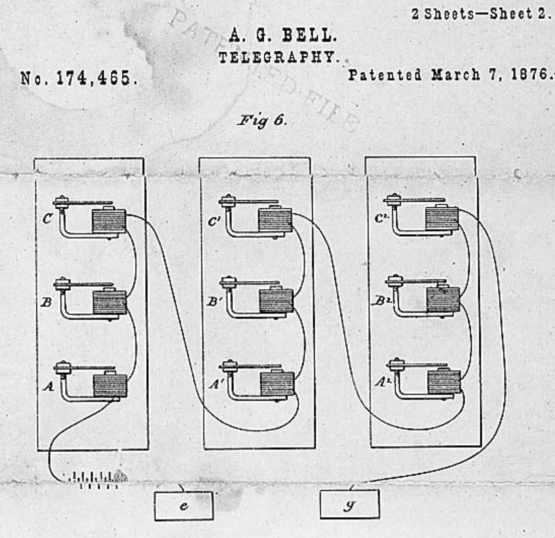
When Alexander Graham Bell filed his patent application on February 14, 1876, he titled it “Improvement in Telegraphy.” Not “Telephone.” Not “Apparatus for Transmitting Speech by Electricity.” Just a modest tweak to the existing telegraph art. The United States government later alleged this was no accident. In United States v. American Bell Telephone Co., 128 U.S. 315 (1888), the government’s bill of complaint charged that Bell “purposely framed his said application and claim in ambiguous and general terms” and “did not set forth or declare that his alleged invention had any relation to the art of transmitting articulate speech by means of electricity.” The strategy worked, at least initially: the Patent Office examiner “did not understand the application to lay claim to the art of transmitting speech” and so “did not make an inquiry as to the state of that art or the patents or the printed publications concerning it.” No search for the work of Reis, Meucci, or even the caveat filed that same day by Elisha Gray. Bell got his patent on March 7, 1876, three weeks after filing. The case raised serious fraud allegations that the Supreme Court addressed in a companion case, The Telephone Cases, 126 U.S. 1 (1888), but the patent survived.
Nearly 150 years later, patent attorneys are still doing the same thing, though the tools are better and the practice now has a name: targeted drafting. The basic idea is to frame an application so the USPTO routes it to a favorable art unit, where the examiner corps is more likely to allow claims. The mechanism is different from Bell’s era, but the impulse is identical. A good negotiator picks a willing counterpart. A good patent prosecutor picks an art unit where the odds favor allowance. Analytics vendors have for years been marketing tools to predict art unit assignment and suggesting language changes to steer applications toward friendlier examiners.
The routing mechanism has been in transition. For many years, newly filed applications went to a classification contractor who assigned a classification code based on the application’s technical language, abstract, and claims, with the USPTO then mapping that code to an art unit. The classification criteria followed defined rule sets, assignments were predictable, and practitioners learned to draft toward favorable classifications. The USPTO has been shifting toward advanced automated classification systems that analyze the full context of applications rather than isolated keywords, but the basic pipeline — classify, then route — remains the same. And as long as classification drives routing, the drafting choices that influence classification will influence which examiner sees the case.
Grant rates vary significantly across art units, even among units examining similar technologies. Practitioners report that the difference between landing in one art unit versus another can mean the difference between a smooth prosecution and years of rejections. Some of the difference has to do with a general art unit focus on issues such as eligibility, but often it can also be explained by two or three examiners that are exceptionally tight (or loose).
Applicants are particularly wary of business method art units. Applications written with broad or commercially focused language may be routed to business-method art units rather than technology-specific ones. A sparsely populated technical disclosure combined with claim language that sounds functional or commercial is likely to receive dreaded Class 705 (the business methods classification). By emphasizing detailed technical aspects, practitioners try to ensure the application lands in a technology-aligned art unit where examiners have relevant technical expertise that includes fewer eligibility rejections and higher allowance rates.
This is where Bell’s approach and modern targeted drafting diverge in an important respect. Bell, according to the government’s allegations, was trying to suppress the examiner’s understanding of what his invention actually did. He called it telegraphy to avoid triggering a search that would have revealed competing work on telephony. Modern targeted drafting is less about deception and more about emphasis. The invention is what it is; the question is which aspects of the technology to foreground. That said, the game is getting harder. The newer classification tools look at overall technological substance, not just titles or abstracts. The old trick of swapping individual terms no longer reliably steers an application.
The ethical question is the one that Bell’s case has always raised: where does skillful advocacy end and manipulation begin? Forum shopping is a familiar concept in litigation, where parties choose among available courts based on favorable precedent or jury pools. Art unit targeting is its administrative agency analog. The patent bar treats it as legitimate strategy, and the vendors who sell prediction tools frame it as an exercise in understanding the system rather than gaming it. This is a fair point as far as it goes. But, at some point we may see a more aggressive USPTO Director, OED chief, or antitrust enforcement agency that decides targeted drafting has crossed a line. The Bell case is instructive here, and not just as metaphor. The government’s bill of complaint in United States v. American Bell Telephone Co. charged that Bell’s framing of his application “did deceive and defraud” the United States and that “but for the said false and fraudulent statements . . . the said patent would not have been issued.” The case was ultimately dismissed on the threshold question of whether the executive branch had authority to cancel a patent at all — a power Congress eventually granted for reexamination and AIA review. But the underlying theory — that deliberately steering an application away from the examiner corps best equipped to evaluate it is a fraud on the office — has never been tested on the merits (as far as I know). A practitioner who systematically manipulates classification language to avoid a searching examination is doing in 2026 what Bell was accused of doing in 1876: avoiding scrutiny. The tools are better. The ethical problem is the same.
