Search Results for: 높은 적중율을 자랑하는 NCP-CI-Azure 100%시험패스 덤프 덤프는 Nutanix Certified Professional - Cloud Integration - Azure (NCP-CI-Azure v6.7) 시험패스의 조건 💙 《 www.itdumpskr.com 》의 무료 다운로드➤ NCP-CI-Azure ⮘페이지가 지금 열립니다NCP-CI-Azure시험덤프공부
Attorney Fees Designed to Deter Future Wasteful Litigation
This week in Property: Efficient Infringement
Guest Post: Fast Examiners; Slow Examiners; and Patent Allowance
Federal Circuit asked to Decide whether US Patent Law Excludes Non-Human Inventors
Supreme Court: Judicial Stock Ownership and the Requirements of Recusal
En Banc Question: When does Remote Work Become an “Established Place of Business?”
Prosecution Suspended
Old Dog, New Tricks: Government Defends 200-Year-Old ODP Doctrine Even Under Modern Statutes
BPAI Shuts Down Dissent in Favor of Efficiency
The Board of Patent Appeals (BPAI or Board) is very much a quasi-judicial body. The emphasis for today is on quasi. 35 USC §6 calls for each appeal to be heard by at least a three judge panel. Yet, the Board appears to be taking steps to limit the effectiveness of those panels. These changes are apparently motivated by a need for efficiency in the face of budget shortfalls and increased appeals.
Like examiners, BPAI judges have a count system. BPAI Judges are expected to sit on about 300 panels per year and draft about 100 opinions. In the past, judges would receive credit for drafting full dissents and concurring opinions. That has changed. In an internal email, BPAI Vice-Chief Jay Moore has indicated that these extraneous opinions will no longer ordinarily garner any credit. According to Vice-Chief Judge Moore, "[c]oncurrences, dissents, and remands are not normally efficient mechanisms for securing the 'just, speedy, and inexpensive' resolution of an appeal before the Board." The e-mail is reproduced below:
====
From: Moore, James T
Sent: Thursday, May 07, 2009 9:57 AMTo: All BPAI Judges
Cc: MacDonald, Allen; Fleming, Michael R.; Santiago, AmaliaSubject: Policy Clarification on Dissents, Concurrences and Remands
Importance: High
Colleagues:
Please note that, effective immediately, if you would like a dissent, concurrence, or remand to be considered towards your productivity totals, you must submit a request. The form is attached, and may be used retroactively for cases prior to this date. For cases after this date, it must be submitted to your Vice Chief Judge within one week of mailing of the dissent, concurrence, or remand in order to be considered.
Concurrences, dissents, and remands are not normally efficient mechanisms for securing the “just, speedy, and inexpensive” resolution of an appeal before the Board. (Bd. R. 1). As indicated in the PAPs, a productivity credit is not automatically earned for a concurring opinion, dissenting opinion, or remand. Accordingly, justification is required to explain the need to undertake the extra work and occasion the extra delay in order to ensure efficient and proper utilization of our resources. Further, any credit given for a concurring opinion, dissenting opinion, or remand will be commensurate in scope with the justification provided and the scope of the extra work.
Please see Al or Jay if you have any questions.
Thanks,
Jay Moore
Allen MacDonald
====
The push for efficiency at the BPAI is also seen in the non-judge "patent attorney" program. Many of the BPAI opinions are now ghost written by newly minted patent attorneys and then signed by the BPAI judges. The real problem with this program is that when the patent attorneys are used, the BPAI judge is given a much higher throughput quota.
According to an anonymous observer - "the time constraints [under the Patent Attorney program] are so serious that for many cases, not a single one of the judges signing off on a decision will have read the underlying papers detailing the facts of the case." This observer asked to remain anonymous based on "the intolerance of dissent at the Board."
This need for efficiency is also the driver behind the still-pending BPAI appeal rule changes.
Evidence Based Prosecution: Non-Patent Prior Art Leads to Rejections
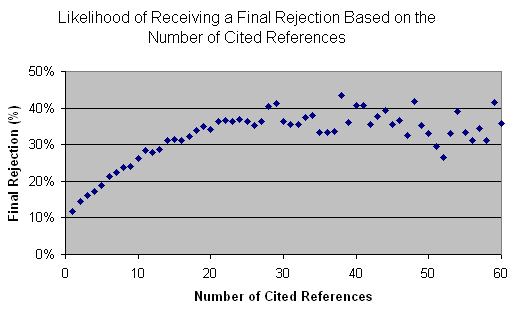 Quality patents depend upon our ability to find and examine prior art regardless of its form. Most prior art cited by the USPTO arrives in the form of patent-related references — most notably, issued U.S. patents, published patent applications, and foreign patent documents. We know, for instance, from Columbia Professor Bhaven Sampat that about 90% of cited non-patent prior-art references are provided by the applicant, and that only 10% are examiner references. Link.
In some technologies where patenting has a long and extensive tradition, the lack of non-patent prior art is not a serious problem. In other areas such as software and biotechnology, non-patent references harbor most of the important prior art.
Results: My new study of 100,000 recently issued patents reveals that patent that cited non-patent literature are significantly more likely to receive rejections from the PTO. Specifically, patents citing at least one non-patent reference have a 39% greater chance of receiving a final rejection when compared with patents that issued without citing any non-patent references. Regarding non-final rejections, citing non-patent prior art increased the likelihood of receiving a rejection by 9%.
Ineligible Subject Matter: 35 USC 101 Finds its Teeth (Biting into Nonobviousness)
Patently-O Bits and Bytes
Patently-O Bits and Bytes No. 6.
Oakley’s Sunglasses and Design Patents
PTO Press Release: Deputy Peterlin Leaving PTO
 Margaret Peterlin has announced that she will be leaving the PTO in August. She has sparked resistance from the patent community ever since her appointment as deputy director of the USPTO in May 2007. She is considered an expert at legislative tactics at a time when the PTO was asking for legislation opposed by many patent practitioners. In late 2007, a DC District dismissed a lawsuit against the USPTO requesting that Peterlin be removed from office. The complaint alleged that she lacked the intellectual property law experience required by statute for her position. In many ways, the negative reaction to Peterlin was simply a reflection of frustrations felt by many patent practitioners. In an internal message to PTO employees, Director Jon Dudas indicated that Peterlin is also expecting her first child later this year. Congratulations and Good Luck!!