All posts by Dennis Crouch

About Dennis Crouch

Law Professor at the University of Missouri School of Law.

EPO: Lies, Damned Lies and Statistics

Guest Post by Peter Arrowsmith. Arrowsmith is a patent attorney and partner at the London based firm Cleveland IP

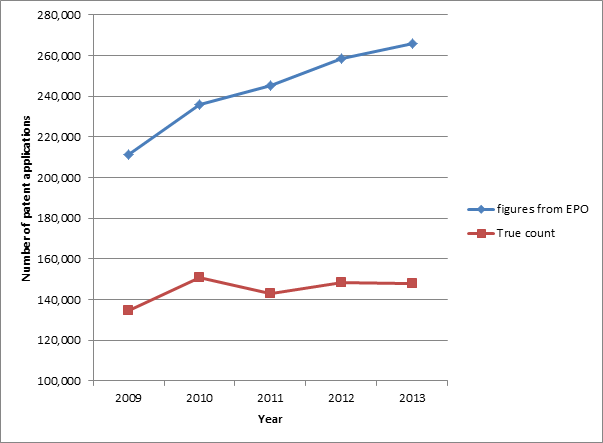
Amid great fanfare the European Patent Office has recently released its annual report, proclaiming another record year for the office: an all-time high in the number of filings and a 2.8% increase on the 2012 figures. These figures have been quoted widely in global media, and they create a positive impression about innovation and the success of the European patent system.

On closer inspection of the underlying data, however, a different picture emerges. It is apparent from these data that the EPO base their claims on the number of direct European patent applications added to the number of international-phase PCT applications, whether or not these international applications subsequently enter the European regional phase. This is immediately striking as a very strange measure for the number of European patent applications. Technically the figures from the EPO are not incorrect because Article 153(2) EPC says that an international application that designates the EPO shall be equivalent to a regular European application. However, the figures are misleading because the majority of international-phase PCT applications do not enter the European regional phase.

A more meaningful measurement of the number of European patent applications would comprise the number of direct European patent applications added to the number of PCT applications that enter the European regional phase. By this measurement it is apparent that the number of European patent applications actually decreased by around 0.5% in the last year. Also, the total number of applications is more than 100,000 less than the number quoted by the EPO. In fact, it would appear that the number of European patent applications filed reached a peak in 2010 and that there have been significantly fewer applications in each of the following years.

The President of the EPO blogged about the statistics on 12 March 2014, saying: “The filing figures for 2013 confirm the trends of the past few years, with an overall increase (266 000 filings, +2.8% versus 2012) resulting once more in an all-time high”. Although not technically incorrect, this statement from the President is, at best, misleading. At worst the EPO are engaging in a wilful misrepresentation of the facts.

Of course, the EPO has an interest in promoting its own role in stimulating innovation. Therefore, it is not surprising that the organisation attempts to put a positive spin on facts. However, it is troubling when this spin is relied upon by governments, industry and individuals when it comes to important decisions on the patent system.

Upcoming Events of Interest

  • My former MBHB colleague Richard Carden is hosting a live Webinar on March 25, 2014 on privacy issues involved with big data with consideration of both US and international data privacy issues. Free to participate, but you must register in advance. [Link]
  • On March 20-21, the Florida Bar will be hosting its annual IP Symposium in Tampa with Chief Judge Rader, and William Covey along with a host of interesting speakers and events. A syllabus is here: http://flabizlaw.org/images/pdf/ip14.pdf.
  • Microsoft and the Hispanic National Bar Association are again co-sponsoring a summer IP Law Institute for up to twenty five Latino law students. Looks like a great event being held June 1-7. [Register by March 29, 2014]

Software Patent Eligibility: Alice Corp v. CLS Bank on the Briefs

By Dennis Crouch

Alice Corporation Pty. Ltd. v. CLS Bank International, Supreme Court Docket No 13-298 (2014)

Later this term, the US Supreme Court will shift its focus toward the fundamental question of whether software and business methods are patentable. More particularly, because an outright ban is unlikely, the court’s more narrow focus will be on providing a further explanation of its non-statutory “abstract idea” test. The Supreme Court addressed this exclusionary test in its 2010 Bilski decision, although in unsatisfactory form. As Mark Lemley, et al., wrote in 2011: “the problem is that no one understands what makes an idea ‘abstract,’ and hence ineligible for patent protection.” Lemley, Risch, Sichelman, and Wagner, Life After Bilski, 63 Stan. L. Rev. 1315 (2011).

In this case, a fractured Federal Circuit found Alice Corp’s computer-related invention to be unpatentable as effectively claiming an abstract idea. See, U.S. Patent No. 7,725,375. In its petition for writ of certiorari, Alice presented the following question:

Whether claims to computer-implemented inventions – including claims to systems and machines, processes, and items of manufacture – are directed to patent-eligible subject matter within the meaning of 35 U.S.C. § 101 as interpreted by this Court.

Oral arguments are set for Mar 31, 2014 and a decision is expected by the end of June 2014. In addition to the parties, a host of amici has filed briefs in the case, including 11 briefs at the petition stage and 41 briefs on the merits. Although not a party to the lawsuit, the Solicitor General has filed a motion to participate in oral arguments and steal some of the accused-infringer’s time.

The invention: There are several patents at issue, but the ‘375 patent is an important starting point. Claim 1 is directed to a “data processing system” that includes a number of elements, including “a computer” configured to generate certain instructions, “electronically adjust” stored values, and send/receive data between both a “data storage unit” a “first party device.” The claims also include “computer program products” and computer implemented methods. The underlying purpose of the invention is to provide certain settlement risks during a time-extended transaction by creating a set of shadow credit and debit records that are monitored for sufficient potential funds and that – at a certain point in the transaction the shadow records are automatically and irrevocably shifted to the “real world.”

It is unclear to me what makes this invention novel or nonobvious and many believe that it would fail on those grounds. However, the sole legal hook for the appeal at this stage is subject matter eligibility. One thing that we do know is that CLS Bank is alleged to be using the patented invention to ensure settlement for more than a trillion dollars daily.

Important case: The claim structure here is quite similar to that seen in hundreds-of-thousands of already issued patents and pending patent applications where the advance in software engineering is a fairly straightforward, but is done in a way that has an important impact on the marketplace. One difference from many software patents is that the underlying functionality is to solve a business transaction problem. However, there is a likelihood that the decision will not turn (one way or the other) on that field-of-use limitation.  In his brief, Tony Dutra argues that the key here is utility, and that an advance in contract-settlement is not useful in the patent law context.

[Brief of the US Government] The most important brief in a pile such as this is often that filed by the U.S. Government. Here, Solicitor General Donald Verrilli and USPTO Solicitor Nathan Kelley joined forces in filing their brief in support of CLS Bank and a broad reading of the abstract idea test. In particular, the U.S. Government argues that none of the claims discussed are subject matter eligible. The brief begins with an importance argument – that “the abstract idea exception is patent law’s sole mechanism for excluding claims directed to manipulation of non-technological concepts and relationships.” This notion – that the abstract idea is the final and ultimate bulwark – places a tremendous pressure on the Court to create a highly flexible test. In my view, the Government largely loses its credibility with that argument – somehow forgetting about the host of other overlapping patent law doctrines that each address this issue in their own way, including requirements that any patented invention be useful, enabled, described in definite claims, and nonobvious. The ultimate backstop is likely the US Constitutional statement regarding “Inventors” and their “Discoveries.”

The government brief goes on to endorse the approach of first identifying whether the claim would be abstract if the computer technology were removed from the method claims and, if so, move on to consider whether the computer technology limitations are sufficient to transform a non-patentable abstract idea into a sufficiently concrete innovation in technology, science, or the industrial arts. “The ultimate inquiry is whether the claims are directed to an innovation in computing or other technical fields.” The brief then reviews the precedent on this topic from Bilski, Mayo and Flook.

Addressing the computer system and software claims, the U.S. Government agrees that they are certainly directed toward “machines” and “manufactures.” However, according to the government, those claims to physical products are properly termed abstract ideas because the physical elements “do not add anything of substance.”

One interesting element from the brief is that the US Government notes that, although a question of law, invalidity for lack of subject matter eligibility requires clear and convincing evidence in order to overcome the presumption of validity. In its brief, CLS Bank argues otherwise as does Google, who actually takes time to cogently spell out the argument with citation to leading authorities.

[Brief of CLS Bank] In its merits brief, CLS Bank somewhat rewrote the question presented – focusing attention on the Supreme Court’s decisions in Mayo.

Question Re-framed: An abstract idea, including a fundamental economic concept, is not eligible for patenting under 35 U.S.C. §101. Bilski v. Kappos, 130 S. Ct. 3218 (2010). Adding conventional elements to an abstract idea does not render it patent-eligible. Mayo Collaborative Servs. v. Prometheus Labs., Inc., 132 S. Ct. 1289 (2012). The asserted claim of the patents-in-suit recite the fundamental economic concept of intermediated settlement, implemented using conventional computer functions. The question presented is:

Whether the courts below correctly concluded that all of the asserted claims are not patent-eligible.

The basic setup of the CLS Bank is the argument that a newly discovered abstract idea coupled with conventional technology is not patent eligible. CLS Bank’s point is well taken that an outright win for Alice Corp. here would involve something of a disavowal rewriting of Mayo.

[Brief of Alice Corp.] Alice Corp’s brief obviously takes a different stance – and argues first that the non-statutory exceptions to patentability should be narrowly construed and focused on the purpose of granting patents on creations of human ingenuity and that the idea behind Alice’s invention is not the type of “preexisting, fundamental truth” that should be the subject of an abstract idea test. Alice also reiterated its position that the claimed invention should be examined as a whole rather than divided up as suggested by the Government brief.

[Brief of Trading Technologies, et al.] TT’s brief (joined by a group of 40 patent-holding software companies as well as Prof. Richard Epstein) argues that the “abstract idea” test is focused on scientific truths and scientific principles. In that construct, Alice Corp’s ideas regarding the settlement system would not be seen as ineligible. TT also challenges the court to think beyond the computer as “merely a calculator and that programming merely instructs the computer to perform basic mathematical calculations. “While this may have been true of many of the applications programmed on the earliest computers over 40 years ago, it is simply not the case today. . . . Viewing computers as merely calculators is completely disconnected from the reality of where innovation is occurring today and where most innovation will occur in the future.” In his brief, Dale Cook agrees and further makes the argument that a distinction between hardware and software is illusory – citing Aristotle to make his point. [Brief of Dale Cook]. Supporting that notion is the Microsoft brief that sees “software-enabled inventions” as the “modern-day heirs to mechanical inventions. [Brief of Microsoft HP]. Pushing back on this argument, Public Knowledge seemingly shows that the entire claimed method can be implemented in seven lines of software code. Thus, while some software is complex. PK makes the argument that the software at issue here is exceedingly simple.

TT also warns against the Government’s position that a strong eligibility guideline is needed in cases such as this. In particular, explains “inventions that do nothing more than use a computer to implement time-worn concepts in obvious and traditional ways will not receive patent protection notwithstanding the fact that they concern eligible subject matter. On that note, TT asks for clarification from the Supreme Court that “Mayo does not support importation of novelty, nonobviousness, and other patentability criteria into the ‘abstract idea’ analysis.”

[Brief of ABL] The final brief in support of petitioner was filed on behalf of Advanced Biological Labs by Robert Sachs. ABL argues that a claim should only be seen as problematic under the abstract idea test when there are no practical alternative non-infringing ways of practicing the abstract idea. On that point, ABL further pushes for the notion that the test should be considered from the framework of one skilled in the art rather than simply the-mind-of-the-judge and based upon clear and convincing evidence. Pushing back against this notion is the brief of the American Antitrust Institute (AAI) drafted by Professor Shubha Ghosh. The AAI argues that the purpose of the Abstract Idea exclusion is to prevent undue harm to competition and innovation. Seemingly, the AAI contends that a claim directed an abstract idea is per se anticompetitive and that even when coupled with technology it may still be unduly preemptive. Oddly however, later in the brief AAI argues for a test that is not based upon market competition or preemption.

[Shultz Love Brief] A leading brief on the side of ineligibility is that filed by Professors Jason Shultz and Bryan Love on behalf of about 22 other professors. The professors make the argument that the world would be a better place without software patents. For its conclusions, the brief largely relies on the work of Brian Love, Christina Mulligan, Colleen Chien, James Bessen, & Michael Meurer. The EFF brief from Professor Pamela Samuelson, Julie Samuels, and Michael Barclay make a parallel argument: “If anything, evidence shows that the U.S. software industry is harmed by the exponential growth of vague software patents.” Without denying the problems created by software patents, Professors Peter Menell and Jeff Lefstin argue that the solution is not to rely upon the “abstract idea” test to solve that problem. IBM offers the starkest contrast to the Shultz-Love brief – arguing that the failure to clearly offer patent rights for software inventions “endangers a critical part of our nation’s economy and threatens innovation.”

The ACLU has been more frequently involved with patent law issues and was a backer of the Myriad case. In its brief, the ACLU argues that the abstract idea exception is the patent law proxy for free speech and that monopolization of abstract ideas would be a violation of the First Amendment. That conclusion is supported by the Software Freedom Law Center & Eben Moglen. The First Amendment argument has the potential of twisting on the ACLU: if the justices fail to see that patents create any First Amendment concern then they may be more likely to support a narrowing of the abstract idea exception. Notably, in the most recent patent law oral arguments on fee-shifting, Justice Roberts arguably suggested that patents did not create any first amendment concerns.

I mentioned Microsoft’s brief earlier. Microsoft argues that software should be patentable – but not the software in this case. In particular, Microsoft agrees with the notion that simply adding “a computer” to an otherwise abstract idea does not fix the problem. Microsoft’s solution is to consider “whether the claim as a whole recites a specific, practical application of the idea rather than merely reciting steps inherent in the idea itself.” Microsoft goes on to admit that its test adds little predictability.

The Intellectual Property Owners Association and AIPLA similarly argue that software “if properly claimed” is patent eligible. On its face, that argument may not sit well with the Court who may see the “as claimed” notion designed to create loopholes for sly patent drafters whose noses are made of wax. A collective brief from Google, Facebook, Amazon, and others support this notion that patent eligibility should not turn on “clever drafting.” On an ancillary (but important) point Google argues that Section 101 defenses should be considered at the outset of most cases. cf. Crouch & Merges, Operating Efficiently Post-Bilski by Ordering Patent Doctrine Decision-Making.

Should the Claim Construction Standard for PTAB Post-Grant Proceedings Be Changed?

Guest Post by Bernie Knight. Knight is a partner at McDermott Will & Emery LLP and was USPTO General Counsel from 2010-2013.

Now that the new post-grant proceedings of the America Invents Act (AIA) have been underway for over a year, some have questioned whether the claim construction standard used by the Patent Trial and Appeal Board (PTAB) is the correct one.  Currently, proposed legislation in Congress would change the claim construction standard for PTAB post-grant proceedings from the broadest reasonable interpretation to the same standard used by district courts, i.e., one having a goal of preserving validity in deference to 35 U.S.C. Sec. 282.   Of course, outside of such legislation, the USPTO has the ability to change the claim construction standard by amending the regulations and the practice guide.  The question arises, would changing the claim construction standard improve the patent system?

The answer is no. Yet, with that said, there is a certain tension between the claim construction standard and the patent owner’s ability to amend claims in the new post-grant proceedings. Recent decisions of the PTAB have made it difficult for patent owners to amend their claims. When we decided to adopt the broadest reasonable interpretation claim construction standard, we did so under the assumption that patent owners would be able to amend their claims without significant impediments. This was a sound decision for the patent system and follow-on innovation because the claims would be amended with more precise language. It would then be easier for other companies and inventors in the same technology space to design around the amended claims. Simply put, the broadest reasonable interpretation claim construction standard seems like a fair standard in light of the patent owner’s ability to amend claims. Such an approach also seems good for the patent system and follow-on innovation.

A tension arises with this trade off because of recent decisions of the PTAB requiring the patent owner to establish that the amended claims are patentable not only over the cited prior art, but also any art of which the patent owner has knowledge. See, e.g., IPR2012-00027, paper 66 (Final Written Decision). In addition, the PTAB sometimes requires that the patent owner submit an expert declaration to establish the understanding of a person of ordinary skill in the art to determine whether the new claim limitations are obvious. At the urging of many patent owners, Congress is responding by proposing legislation that would change the claim construction standard for USPTO proceedings to the same standard employed by the district courts.

The PTAB has done a terrific job handling the onslaught of petitions that have been filed since enactment of the AIA.  It is reported that the USPTO has the third busiest patent docket in the country, after the Eastern District of Texas and the District of Delaware.   I had the pleasure of working with the PTAB in getting the final AIA rules issued and the proceedings implemented within the one year period mandated by Congress. So, here comes the “but.” This is a good time for the USPTO to look at the requirements for a patent owner’s amendment to make certain that because the claims are broadly construed, the patent owner still has a reasonable opportunity to amend the claims.

The regulations that we implemented provide that amendments will be allowed if they are supported by the written description in the application, the amendments are narrowing amendments and the amendments relate to a claim and ground upon which the proceeding was instituted. See 37 C.F.R. 42.121, 42.221. The patent owner must make an initial showing that the amended claims are patentable. The question arises how much support should be required from the patent owner at the time of the motion to amend claims and how much of the burden should be placed on the petitioner to show that the amended claims are unpatentable.

The additional requirements placed on the patent owner by the PTAB make it more difficult for a proposed amendment to survive a PTAB proceeding. An alternative approach might be to only require the patent owner to show that the amended claims are patentable over the prior art cited by the petitioner and relied on by the PTAB in instituting the proceeding. If the patent owner fails to disclose prior art that the patent owner has knowledge of and that can affect the validity of the claims, there may be a future inequitable conduct defense if the patent owner brings an infringement action. In addition, there may be a basis for an Office of Enrollment and Discipline complaint if evidence that is contrary to a position being taken at the USPTO is intentionally withheld by the patent owner. With respect to the need for expert witnesses to support the amendments, a possible alternative approach would be to place the burden on the petitioner to produce the expert to support an obviousness challenge to the new amended claims. The current PTAB decisions place that burden on the patent owner up front to disprove such an argument even before it is raised. More of the burden might be placed on the petitioner to show that the amended claims are unpatentable.

If the requirements for a patent owner amendment were less onerous, then a much stronger case can be made that the broadest reasonable claim construction standard should be retained. Without the ability to reasonably amend the claims, the broadest reasonable interpretation claim construction standard seems a bit unfair to the patent owner because the claims are broadly construed with little opportunity to amend.

The views expressed here are solely those of the author and do not necessarily reflect the views of McDermott Will & Emery or its other partners.

A Patentee Must Prove Infringement (Or Else Lose)

By Dennis Crouch

Medtronic v. Boston Scientific (Fed. Cir. 2014)

Earlier this year, the Supreme Court issued a decision in this case – holding that the patentee has the burden of persuasion on the issue of infringement – even in cases that arise as a declaratory judgment action brought by a licensee in good standing against the patentee. The original Federal Circuit panel opinion had shifted the burden in this situation to the DJ plaintiff alleging non-infringement.

On remand, the Federal Circuit panel has modified its opinion – holding that the district court had properly sided with the DJ plaintiff in finding non-infringement.

The basic issue here was that neither party provided evidence sufficient to either prove or disprove infringement of the Boston Scientific patents. In that situation, the party with the burden of persuasion loses. We know from the Supreme Court decision that the patentee always has the burden of persuasion on infringement and therefore that Boston Scientific loses.

Note: Updated on 3/12 to correct parties. 

Obamacare and Innovation: #GeeksGetCovered

By Dennis Crouch

Over the years, I have spoken with a substantial number of potential entrepreneurs who do not make the leap and instead remain employees. The most common justification for the inertial phenomenon is that the job provides benefits – namely health care coverage. Part of the hope for the Affordable Care Act (ObamaCare) is that it can provide a straightforward and cost-effective way for these entrepreneurs to have some family security on the health care front that is not dependent upon a regular employer. The White House is announcing its #GeeksGetCovered publicity campaign on this front. See the video:

)

White House Chief Technology Officer Todd Park writes:

Geeks are a critical driver of America’s innovation ecosystem, from the entrepreneurs launching startups in Silicon Valley to the scientists experimenting in university research labs to the whiz kids building gadgets in their parents’ garages.

The Obama Administration cares deeply about innovation, and about helping to make sure that geeks across the country, those coming up with new discoveries and exciting inventions—and creating jobs along the way—have the freedom and security to keep innovating. 

It will be interesting to watch this issue moving forward.

Scholarship: What Patent Attorney Fee Awards Really Look Like

By Dennis Crouch

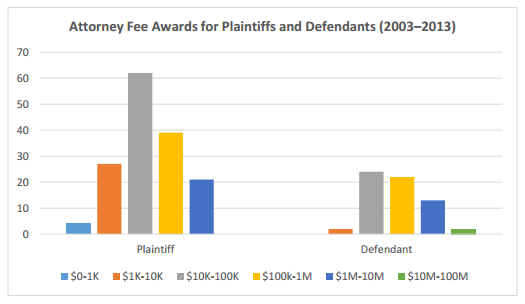
The debate over attorney fee shifting continues both in Congress and in cases before the Supreme Court. In an interesting new article, Saurabh Vishnubhakat compiles fee award statistics for the past decade. The study reports that prevailing plaintiffs are more likely to receive a fee award, but that the median award of prevailing defendants is much higher.

Sources:

Today’s Supreme Court [Land] Patent Decision

by Dennis Crouch

Today the Supreme Court decided an interesting patent case in Brandt v. U.S. The patent at stake was a land patent that the Supreme Court here defined as “an official document reflecting a grant by a sovereign that is made public, or ‘patent.'”

The case involved an 83-acre plot in Wyoming owned by Marvin Brandt. The U.S. government originally owned the land as part of the 1803 Louisiana Purchase.  In order to expand rail-road coverage in the US, the Government offered a free right-of-way to RR builders. General Railroad Right-of-Way Act of 1875.  In 1911, the Laramie Hahn’s Peak & Pacific Railway Company (LHPP) took advantage of that offer and build a RR across the land that was later patented to Brandt’s.  Thus, in 1976, when the Brandt’s took fee simple ownership, that ownership was “subject to those rights for railroad purposes as have been granted to [LHPP], its successors or assigns.”  Finally, in 2004, LHPP (now part of Union Pacific) removed its tracks and expressly abandoned its right of way.  (more…)

Ongoing Royalty against Apple: Higher than Back Damages and Willfulness a Given

By Dennis Crouch

VirnetX and SAIC v. Apple (E.D. Tex 2014)

The VirnetX/SAIC/Leidos patents cover methods of creating virtual private networks (VPNs) and secure domain name services. Here, SAIC is the multi-billion-dollar government contractor and the patents were apparently developed as part of SAIC’s work for the CIA and NSA. SAIC spun-off several of its IP assets to VirnetX who is an independent publicly traded patent enforcer. Apparently, VirnetX’s market cap is around $1B based almost on its 80 patents and several court wins. However, the company only has 15 employees. SAIC/Leidos retain a revenue stream from patent profits as well.

A jury found that Apple infringed the VirnetX patents with its FaceTime and VPN On Demand applications. The jury awarded $368 million in past damages. However, District Court Judge Davis denied VirnetX’s motion for injunctive relief to stop ongoing infringement. Those decisions are on appeal to the Federal Circuit.

Meanwhile, Judge Davis severed the case so that he could separately consider the issue of ongoing damages. Now, Judge Davis has awarded an ongoing royalty of 0.98% for devices configured to run either FaceTime or VPN ON Demand. Breaking-down that award: 0.65% in damages and 0.33% in enhanced damages for the willfulness of the ongoing infringement.

The ongoing damage award rate is substantially higher than that awarded for back-damages. The explanation is several fold: the patents have now been adjudged valid; Apple’s ongoing infringement is now willful; and some changed circumstances. Regarding the changed circumstances – since the verdict, VirnetX licensed its patents to Siemens at a substantially higher rate than its pre-verdict licenses.

One issue that appeared to stick to Judge Davis involved Apple’s changed theories during the case. In particular, at trial, Apple had argued that the invention was rather minimal and that it would have only cost Apple $3.6 million to make a “very simple change” to its servers so that they would operate in a way that VirnetX admits would be non-infringing. Later, when VirnetX sought injunctive relief, Apple “dramatically reversed course” and argued that implementation of a design around would be incredibly expensive and disruptive. (The actual numbers of estimated costs are redacted from the filings.) Apple appeared to lose significant credibility with those arguments. Judge Davis wrote:

While Apple has taken steps to mitigate its infringement, Apple grossly misrepresented its ability to implement a non-infringing alternative to the jury. The huge disparity between Apple’s position at trial and Apple’s position post-judgment also warrants increasing the implied royalty rate.

Regarding enhanced damages for willfulness, Judge Davis suggests that post-verdict infringement should generally be considered willful and subject to enhanced damages.

= = = =

In my mind there is a minor, but million dollar issue with the decision. Judge Davis awarded a 0.65% ongoing royalty and then enhanced the damage award by an additional 50% of that. In my calculation, that would take the award to 0.975%. However, Judge Davis rounded up to 0.98%. The Judge wrote: “Considering four factors favor enhancing the implied royalty rate, the ongoing royalty rate [of 0.65%] is increased 50% to 0.98%.” Those five thousandths of a percent appear small, but will likely add to at least a million dollar difference.

= = = =

Further reading:

USITC Asks En Banc Federal Circuit for Power to Block Imports Whose Distribution Induce Infringement in the US

by Dennis Crouch

Suprema, Inc. and Mentalix v. US International Trade Commission and Cross Match Tech. (Fed. Cir. 2013/2014)

Image of Finger Print Scanner PatentThe US International Trade Commission (USITC) is a branch of the US Government that offers an alternative forum for patent enforcement. There are a number of benefits to pursuing an action in the USITC as well as a number of quirks. Importantly, the USITC has no authority to award damages for patent infringement — rather, the sole available award is an exclusion order that would block infringing imports.

Here, Cross Match’s asserted patent covers a fingerprint-scan methodology that includes both hardware and software.  In this case, the hardware is manufactured abroad and imported by Suprema and then, once in the US, combined by Mentalix with the software to make a product used to infringe. Of importance, the imported hardware does not – by itself – directly infringe the patent. However, the USITC found that Suprema was liable for inducing infringement under 35 U.S.C. 271(b).

On appeal, the Federal Circuit reversed – holding instead that the USITC’s power only extends to block articles that are themselves infringing at the point of importation. The result for this case is that the inducement theory of infringement could not stand because the direct infringement that is predicate for an inducement holding was not occurring until after importation. Oddly, however, the majority did find that the USITC may still have power when the cause of action is contributory infringement rather than inducement. This distinction was based upon the notion that inducement is focused on the “conduct of the inducer” and “is untied to an article.”  Judge O’Malley penned the Federal Circuit opinion and was joined by Judge Prost.

Writing in dissent, Judge Reyna argued that the majority opinion “overlooks the Congressional purpose of Section 337, the long established agency practice … of conducting unfair trade investigations based on induced patent infringement, and related precedent by [the Federal Circuit] confirming this practice.”  Judge Reyna provided a full-page long string citation of decisions where the USITC issued exclusion orders based upon an inducement theory where the direct infringement occurred post-importation.

Now, both the USITC and the patentee Cross Match have petitioned the Federal Circuit for a rehearing en banc and the Court has offered some signal that it is interested in the case (requesting briefing from the accused infringers).

In the en banc request, the US Government makes an interesting argument that the Federal Circuit precedent is contradicted by the Supreme Court’s decision in MGM v. Grokster, 545 U.S. 913 (2005) as well as the Federal Circuit’s decision in Standard Oil v. Nippon Shokubai Kagaku Kogyo, 754 F.2d 345, 348 (Fed. Cir. 1985). The Grokster case is a copyright case, but is directly applicable for a number of reasons, including the fact that the USITC statute at issue also provides jurisdiction over cases involving imports that infringe US copyrights.

The basic notion from Grokster is that inducement is infringement, and that culpability can attach well before the later direct infringement by another.  In Standard Oil, Judge Rich wrote that inducement attaches “as of the time the [inducing] acts were committed, not at some future date.”  Of course, the inducement doctrine has been significantly tightened since Judge Rich’s time. And the language of Grokster is not as direct and on-point as the US ITC suggests. Still, the government and Suprema (as discussed below) make a strong case that the original panel decision is wrong.

Suprema similarly argues that the decision is contrary to the statutory text. In particular, (1) the statute does not require a full cause-of-action for infringement at the time of importation and (2) the notion that inducement is “untied” from the actual infringing article “is fundamentally flawed.”  The first of these arguments seems to be a clear winner – since the statute particularly provides authority against “the sale within the United States after importation.”

I suspect this case will be moving forward. It will be interesting to see whether the original panel retracts its opinion or whether the en banc court is forced to act.

Files:


Court: Claim Term Lacks Definiteness but is not Legally Indefinite

Every Penny Counts v. Wells Fargo Bank, 2014 U.S. Dist. LEXIS 28106 (M.D. Fl. 2014).

In a ruling this week, Judge Merryday rejected Wells Fargo’s indefiniteness argument made in a pre-trial summary judgment motion. Like claim construction, indefiniteness is seen as a question of law that can be resolved by a district court judge. In fact, the Federal Circuit has written that “Indefiniteness is a matter of claim construction, and the same principles that generally govern claim construction are applicable to determining whether allegedly indefinite claim language is subject to construction.” Praxair, Inc. v. ATMI, Inc., 543 F.3d 1306, 1319 (Fed. Cir. 2008).

EPC’s invention is software for rounding-up credit and debit transactions to the nearest dollar and then putting the extra money to a special use. See U.S. Patent 8,025,217. Claim 1 of the ‘217 patent is listed as follows:

1. A system for accumulating credits from a customer account belonging to the customer and managed by an institution and placing the credits into a provider account, comprising:

an information processor; said information processor including a data store with data identifying the customer, the rounding determinant, the managed institution, and the account;

said data store including machine readable instructions authorizing the processor to access and read the customer account;

said data store including machine readable instructions to calculate rounders after receiving a plurality of payment transactions from the read customer account and to calculate an excess based on the rounders;

said data store including machine readable instructions to withdraw the excess from the customer account;

said data store including machine readable instructions to transfer the withdrawn excess to the provider account.

The indefiniteness issue with the claim is that the claim introduces two types of accounts – a customer account and a provider account – and then refers to “the account” without identifying which of the two accounts are being referenced. Wells Fargo argues that there are “at least four equally plausible interpretations” of “the account” – it could be the customer account, the provider account, both accounts, or some other account. Adding to the difficulty of interpreting the term, Wells Fargo highlights the fact that the patent itself is riddled with seeming typographical errors that make interpretation difficult. The court writes:

The patent is infested with scrivener’s (and other) errors, and the prospect of a missing “s” fits comfortably within the patterns discernible in the patent. For example, the patent states, “The actual transfer . . . concludes with the [transfer of] funds to each listed PC (provider account) . . . .” “PC” is used nowhere else in the patent, and the patent later clarifies that “PA” is the intended acronym for “provider account(s).” But even the creation of the correct acronym, “PA,” is tardy – by the time the patent defines the acronym, the patent has already deployed either “provider account” or “provider accounts” four times and “PA” twelve times. And after the “PA” acronym is created, the patent no longer uses the acronym but uses “provider accounts.” In other examples of error, the patent bungles nearly every acronym, conflates “i.e.” and “e.g.,” and writes “invention invention,” “FIG. 7A” (not “FIG. 7” – no figure 7A exists), “FIG. 4B” (although Figure 4B exists, “FIG. 4C” is intended), step “8120” (not”120″), “2 $300.14” (not “$300.14”), “pa id” (not “paid”), “saving s,” and “piece s.” These errors – which say nothing of the drafter’s grammatical and syntactical incompetence and bemusing judgment – confirm that “account” lacking an “s” by mistake accords with the level of compositional adroitness and dexterity that pervades the patent.

In sum, as used in claims 1 and 2, the phrase “the account” lacks definiteness. “[T]he account” might mean “the customer account,” “the provider account,” or otherwise; no informed and confident choice is available among the contending definitions.

Now, here’s the trick – after finding that the phrase lacks definiteness, the court next went on to hold that the phrase is not legally indefinite. Rather, there exist a spectrum of definiteness levels, and the forfeiture of patent rights due to indefiniteness (currently) requires extreme indefiniteness. Thus, a claim term that is only somewhat indefinite will not render its respective claim invalid as indefinite. And, because of the conceptual separation of most patentability doctrines, the lack of definiteness shown here will have no other adverse impact on the patent.

In particular, a claim term is only found indefinite if clear and convincing evidence sufficient to overcome the statutory presumption of validity proves that the claim is “insolubly ambiguous” and “not amenable to claim construction.” Taking that standard, the court could only find the claim sufficiently definite:

Although the entire patent is awkwardly drafted, the oppugned claim is simple. The specification is simple. The drawings are simple. The patent as a whole, notwithstanding the deficiencies, seems understandable; the claim seems understandable. In short, the indefiniteness of the term “the account” leaves no unmanageable gap in the information available for determining the scope of the claim. No practical incapacity or disabling uncertainty appears as a consequence of the fact that “the account” might mean one thing or the other. In sum, the extent of the indefiniteness in the term “the account” is inconsequential and falls far short of the “insoluble ambiguity” required to invalidate the claim.

Holding: Claim not invalid as indefinite.

This case tightly linked to the outcome in Nautilus. If the court changes the standard for determining indefiniteness there then we’ll likely see a modified holding here as well.

[Updated on 3/8/14 with updated information that opinion was written by Judge Merryday not Magistrate Judge McCoun. Via W.Pollack]


In Memoriam: Prof. Sarah Tran

Up until last week, Sarah Tran was a law professor at SMU in Dallas where she taught patent law among other courses. She passed away this past week at the age of 34 from leukemia. A fund has been created for her two young children. [Tran Children Development Fund][Texas Lawyer Article].

In the patent field, I will remember Sarah most for her series of recent articles focusing on the power dynamic between the USPTO and the Federal Circuit. Patent Powers, 25 Harvard J. Law & Tech. 595 (2012); Administrative Law, Patents, and Distorted Rules, 80 Geo. Wash. L. Rev. 831 (2012); Policy Tailors and the Patent Office, 46 U.C. Davis L. Rev. 487 (2013). The articles collectively argue that courts have been wrong to deny substantive rule-making authority and deferential review to the USPTO; and that the new USPTO powers found in the America Invents Act (AIA) add a further exclamation point to that conclusion. These articles have strong merit and will likely serve as one focal point in upcoming administrative patent law battles.  She was also a regular contributor to the fabulous Written Description blog.

– Dennis

Federal Circuit to Take on Corporate Law Question of CEO Liability for False Submissions

By Dennis Crouch

US v. Trek Leather (Fed. Cir. 2014) (en banc rehearing)

The Federal Circuit today granted the US Government’s petition for en banc rehearing of a case stemming from the United States Court of International Trade. The USCIT is an Article III court formerly known as the US Customs Court that hears cases involving customs, duties, and anti-dumping rules. Appeals from the USCIT are heard by the Federal Circuit Court of Appeals – about fifty per year.

Although the meat of this case is the statutory interpretation of 19 U.S.C. § 1592, patent professionals (and corporate attorneys in general) will likely be interested in the veil piercing aspects of the case. The case is also an important reminder that someone’s status as a director or owner of a limited liability entity does not immunize that person from individual tort liability. See, e.g., Frances T. v. Village Green Owners Assn., 42 Cal.3d 490 (1986).

Briefly, Trek Leather’s president and majority owner, Mr. Harish Shadadpuri submitted false entry documents to Customs & Border Patrol (CPB) that undervalued the men’s suits being imported with the result being an under-collection of customs duties owed. The money-owed was later paid, but the US Government also filed suit under section 1592 – asking that Mr. Shadadpuri be personally fined for the misrepresentation. The USITC court awarded summary judgment to the US Government based upon a finding that Shadadpuri had been grossly negligent in his statements. On appeal, the Federal Circuit reversed – finding that the statute did not permit veil piercing of this sort. In particular, the appellate panel held that section 1592 penalties could not be imposed upon a person who was acting in his capacity as officer of a corporate “importer of record” for negligently filling out entry papers required of the corporation, absent a piercing of the corporate veil or a showing of fraud. (Opinion by Judge O’Malley). Judge Dyk dissented and argued that both the plain language of the statute and its legislative history would permit this action even absent veil piercing or fraud.

Here, the statute is fairly clear: “no person, by fraud, gross negligence, or negligence—(A) may enter, introduce, or attempt to enter or introduce any merchandise into the commerce of the United States by means of (i) any document … which is material and false.” 19 U.S.C. § 1592(a)(1). The statute seems to suggest that, since Shadadpuri is a person, then he would be liable for the submission. This result would also comply with the traditional notions of common law tort liability that would find the individual actor liable for negligence (even if someone else is also liable under an agency or joint tortfeaser doctrine). The majority opinion of the Federal Circuit recognized the section 1592 argument, but looked to other sections of Title 19 that discussed only the “importer of record” being the party who submits the entry documents – the result being that (by construction of law) the submission by Shadadpuri should be seen as coming only from his company Trek Leather and not from Shadadpuri personally.

The en banc rehearing will focus on the following set of questions:

A) 19 U.S.C. § 1592(a) imposes liability on any “person” who “enter[s], introduce[s], or attempt[s] to enter or introduce” merchandise into US commerce by means of fraud, gross negligence, or negligence by the means described in § 1592(a). What is the meaning of “person” within this statutory provision? How do other statutory provisions of Title 19 affect this inquiry?

B) If corporate officers or shareholders qualify as “persons” under § 1592(a), can they be held personally liable for duties and penalties imposed under § 1592(c)(2) and (3) when, while acting within the course and scope of their employment on behalf of the corporation by which they are employed, they provide inaccurate information relating to the entry or introduction of merchandise into the United States by their corporation? If so, under what circumstances?

C) What is the scope of “gross negligence” and “negligence” in 19 U.S.C. § 1592(a) and what is the relevant duty? How do other statutory provisions in Title 19 affect this inquiry?

Amicus briefs may be filed without leave in the case.

Sarah Harris as Next USPTO General Counsel

By Dennis Crouch

According to Pam MacLean at Reuters, Sarah Harris has now been tapped by USPTO Deputy Director Michelle Lee as the next USPTO General Counsel. Bernie Knight left the position in August of 2013 for private practice and Will Covey has been acting GC. Covey is expected to now return to his role as Director of the Office of Enrollment and Discipline.

Article: http://www.reuters.com/article/2014/03/05/uspto-harris-idUSL1N0M21MD20140305

Harris is most recently the Deputy General Counsel for AOL in charge of Intellectual Property and has spent time in-house at several high-tech companies.

General Counsel is seen as the principal legal advisor to the USPTO Director and generally supervises court representation for the agency. Although the role does deal with substantive IP issues, it delves deeply into all sorts of additional issues involving government contracts, employment issues, etc.

From the article:

“The disappointing aspect of this news is that we’re building up a leadership structure in the USPTO without actually having an appointed director in charge,” said Dennis Crouch, a patent attorney and author of the Patently O blog, which covers U.S. patent law issues.

Crouch praised the Harris appointment, saying, “she will bring strong pragmatic leadership in that role.”

Ordinarily, a director would first be named and then given some authority to build his or her team. That was the approach that David Kappos was able to use to great success. It may be more difficult to now find a USPTO leader who fits easily into this already-forming team of supporting cast members.

Thank you foliovision

By Dennis Crouch

Many of you have noticed our new blog format and comment structure. In the background, we have also installed new servers and a system that allows the blog to present well on all sorts of screen sizes, including hand held devices. For those of you with sensitive eyes, the comments are hidden unless requested. This is also intended to make printing more straightforward. Those 25,000+ who see the blog only through the email distribution will not notice much of any difference. [Subscribe here]. The Job Board remains quite active as does David Hricik’s Ethics site. [Note, for instance, Hricik’s most recent final post on Section 101].

The changes are a result of the hard work of Ryan Swarts, who is both a lawyer and design professional, and also the hard work of foliovision. The folks at foliovision provided full service and hands-on conversion from my legacy Typepad system over to WordPress. With over 4,000 posts, 150,000 comments, and several thousand additional media files, the conversion was not simple. However, foliovision handled these well and have worked well with us through the few inevitable bugs. As some of you know, I try to run the blog on a shoestring budget. It is helpful then that foliovision’s price was really good too. Thanks foliovision!

Examining Eligibility: USPTO Guidelines on Products of Nature, Laws of Nature, and Natural Phenomena

by Dennis Crouch

One difficulty with the US patent system is that the same rules of patentability are sometimes determined by a judge, other times by a jury, and, of course, most often by a patent examiner. A judge is typically an experienced lawyer and political heavyweight who receives substantial input from leading advocates on both sides of any argument. However, judges most typically have not technical expertise in the particular invention or its market. On the other hand, a patent examiner is typically a subject matter expert but comes with little or no legal training and who participates in an ex parte inquiry.  At yet another extreme, a jury also receives the benefit of input from both sides, but typically has no technical or legal training.

One difficult role that the USPTO takes-on is translating court decisions on patentability into administrable tasks for its examiner corps.  That task is perhaps most difficult in the realm of subject matter eligibility.

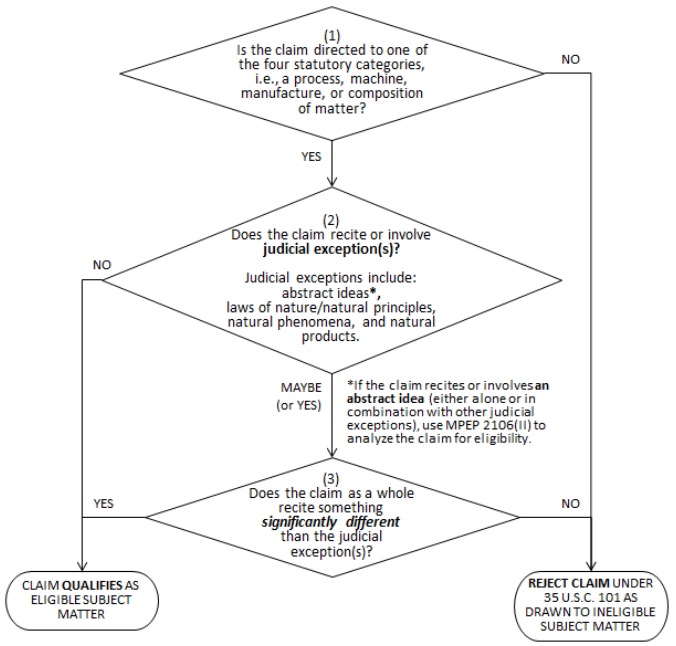
In a new set of training materials, the USPTO has attempted to provide some concrete guidance to its examiners on determining whether claims improperly encompass laws of nature, natural principles, natural phenomena, or products of nature. The updated guidance is necessary based upon the Supreme Court’s decisions in Association for Molecular Pathology v. Myriad Genetics, Inc., 569 U.S. _, 133 S. Ct. 2107, 2116, 106 USPQ2d 1972 (2013), and Mayo Collaborative Services v. Prometheus Laboratories, Inc., 566 U.S. _, 132 S. Ct. 1289, 101 USPQ2d 1961 (2012).  The USPTO is awaiting outcome of the CLS Bank decision before providing parallel insight on examining claims for abstract ideas.

Although these guidelines do not have force of law, they are important because of their de facto power for the several hundred thousand pending patent applications.

The basic test, according to the USPTO is “whether a claim reflects a significant difference from what exists in nature” (patent eligible) or instead “whether a claim is effectively drawn to something that is naturally occurring” (not patent eligible).  Of course, the rub is the dividing line between these mutually exclusive categories.

The PTO provides the following flowchart:

pic-113


More later.

Apple Loses on Claim Construction and Indefiniteness

by Dennis Crouch

Ancora Tech. v. Apple Inc. (Fed. Cir. 2014)

Ancora’s patent covers a verification system to ensure that the software running on a computer are properly licensed.  U.S. Patent No. 6,411,941.  Following claim construction, Ancora stipulated to a summary judgment of non-infringement — agreeing that the district court’s construction of the claim term “program” was so narrow that Apple’s verification system did not fit within its bounds.  In particular, the examples from the original 1998 patent application all focused on application programs — ones that rely upon an operating system in order to run and thus exclude the (Apple) operating system itself.

Asserted claim 1 is written as follows:

1. A method of restricting software operation within a license for use with a computer including an erasable, non-volatile memory area of a BIOS of the computer, and a volatile memory area; the method comprising the steps of:
selecting a program residing in the volatile memory,
using an agent to set up a verification structure in the erasable, non-volatile memory of the BIOS, the verification structure accommodating data that includes at least one license record,
verifying the program using at least the verification structure from the erasable non-volatile memory of the BIOS, and
acting on the program according to the verification.
On appeal, the Federal Circuit rejected a narrow construction of the term “program”  — finding that the patentee gave no reason to move the term from its ordinary meaning in context.

A claim term  should be given its ordinary meaning in the pertinent context, unless the patentee has made clear its adoption of a different definition or otherwise disclaimed that meaning. . . There is no reason in this case to depart from the term’s ordinary meaning.

Although not stated in the opinion, I suspect that this is one case that would have turned-out differently under a deferential standard of review. However, in Lighting Ballast, the Federal Circuit reconfirmed that a district court’s claim construction is given no deference and instead reviewed de novo on appeal.
= = =
You’ll note that the claim also includes references to “volatile memory” and “non-volatile memory.”   In a cross-appeal, Apple argued that those terms were invalid as ambiguous under 35 U.S.C. 112(b).  The panel here easily rejected that argument:

The Supreme Court currently is considering how to refine the formulations for applying the definiteness requirement. See Nautilus, Inc. v. Biosig Instruments, Inc., Sup. Ct. No. 13-369, cert. granted, 2014 WL 92363 (Jan. 10, 2014). In this case, we think that we can reject the indefiniteness challenge without awaiting the Court’s clarification. However other circumstances may be evaluated, it suffices to reject the challenge in this case that the claim language and the prosecution history leave no reasonable uncertainty about the boundaries of the terms at issue, even considering certain aspects of the specification that could engender confusion when read in isolation.

Most importantly, there is no dispute that the terms “volatile memory” and “non-volatile memory” have a meaning that is clear, settled, and objective in content. Both parties and the district court agreed that, as a general matter, “[t]o one of ordinary skill in the art, a volatile memory is memory whose data is not maintained when the power is removed and a non-volatile memory is memory whose data is maintained when the power is removed.” That meaning leaves the relevant public with a firm understanding of the scope of the claim terms, unless something exceptional sufficiently supplants that understanding.

Apple’s particular indefiniteness argument was based upon the fact that the specification refers to a “hard disk” as an example of volatile memory when, in reality, a hard disk is ordinarily thought of as quite the opposite.  According to Apple, those references so blur the meaning of volatile and non-volatile that the terms should be seen as indefinite.  The Federal Circuit rejected Apple’s argument for several reasons.

Under our claim-construction law, a clear ordinary meaning is not properly overcome (and a relevant reader would not reasonably think it overcome) by a few passing references that do not amount to a redefinition or disclaimer.

Under our claim-construction law, a clear ordinary meaning is not properly overcome (and a relevant reader would not reasonably think it overcome) by a few passing references that do not amount to a redefinition or disclaimer. . . . [Furthermore], it is well known that a computer’s hard disk is routinely used as “virtual” memory to provide temporary storage when there is insufficient RAM to complete an operation.

It will be interesting to see here if Apple asks petitions for certiorari on either de novo review or indefiniteness.

Federal Circuit Splits on Venue Transfer Issues

By Dennis Crouch

In re Apple Inc. (Fed. Cir. 2014); In re Barnes & Noble (Fed. Cir. 2014)

In a pair of decisions, the Federal Circuit has denied two different petitions for writ of mandamus that sought appellate oversight in the transfer motions. Both cases involved identical split panels with Judges Reyna and Prost in the majority (denying mandamus) and Judge Newman in dissent. Over the past several years, a number of § 1404 transfer petitions have been filed at the Federal Circuit following the court’s 2008 TS Tech decision. See, In re TS Tech USA Corp., 551 F.3d 1315, 1319 (Fed. Cir. 2008).

In both cases here, the majority found that the movant had failed to “meet its exacting burden to demonstrate that the district court was clearly and indisputably incorrect in concluding that the case should not have been transferred” by the District Court judge.

Judge Newman’s dissents are interesting she writes in Apple:

The plaintiff, Core Wireless Licensing, S.A.R.L., is a Luxembourg company having one employee. Core Wireless maintains a wholly-owned subsidiary, Core Wireless USA, a Texas corporation with 6 employees who live in or near Plano, Texas. Core Wireless USA’s employees manage Core Wireless’s patent portfolio, including any licensing agreements deriving therefrom. Neither Core Wireless nor Core Wireless USA makes, uses, or sells the patented subject matter in Texas or elsewhere.

The accused products are versions of Apple Incorporated’s iPhone and cellular iPad products. Apple has been headquartered in Cupertino, California since 1976. Apple’s management and primary research and development facilities are also located in Cupertino where Apple employs over 13,000 people. The record also states that the research, design, and development of the accused products took place in Cupertino and that virtually all Apple business documents and records relating to the research, design, development, marketing strategy, and product revenue for the accused products are located in or near Cupertino. Additionally, Apple has stated that its foreseeable witnesses with knowledge of the research, design, and development of the accused products reside or work in or near Cupertino. (more…)

Industry Responds to White House Calls for Prior Art, Examiner Training

Guest Post by Professor Jorge L. Contreras

As previously reported, on February 20 the White House highlighted its progress on five patent-related policy initiatives introduced in June 2013, announced three new patent-related initiatives, and renewed its call for legislation to combat “patent trolling”. In all, ten different initiatives were discussed. Below is a quick guide to making sense of the most significant ones, as well as a summary of private sector responses to date.

Patent Assertion Entities (PAEs) – In this year’s State of the Union address, President Obama came out publicly against unfair litigation tactics deployed by “patent trolls” and has called on Congress to enact legislation to “curtail abusive patent litigation.” Two of the Administration’s June 2013 initiatives relate to PAE litigation: a proposed PTO rule that would require reporting of real party in interest (re-branded as “attributable ownership”) information in patents and patent applications, and an online toolkit providing links and other information for the recipients of patent demand letters. Among the most useful features of the toolkit are links to advanced demand letter and patent litigation analytics provided by Lex Machina and Docket Navigator. Although the toolkit is available to anyone, its intended beneficiaries are small businesses that have been targeted by some of the more notorious PAEs for using off-the-shelf office equipment like scanners and wireless routers. The Administration seems to realize that both of these initiatives are relatively modest, and it has again urged Congress to enact measures that will have a meaningful impact on reducing abusive patent litigation.

PTO Fixes – The Patent and Trademark Office (PTO) has, fairly or unfairly, come under increasing fire for procedural lapses and staffing inadequacies that allow the issuance of too many “bad” patents. Last week’s announcements contain some meaningful proposals that could help to address this situation.

  • Claim Clarity – the PTO has implemented new training programs for examiners and judges relating to “functional claims“, which have been widely criticized as overly broad and unclear. The PTO also highlighted an upcoming pilot program involving the use of glossaries in patent specifications to clarify claim language. The details of this program remain to be seen, but anything that will bring greater consistency and rationality to claim interpretation can only help.
  • Examiner Technology Training – One perceived problem with the patent examination system is the inability of examiners to keep up with rapidly changing technologies. Gaps in technical knowledge can result in examiners’ failure to identify relevant prior art, to appreciate the interaction of different system elements, and to make cogent assumptions and conclusions about inventiveness, anticipation and nonobviousness. To address this issue, the Administration has called for private sector volunteers to provide state-of-the-art technical training to patent examiners through a program coordinated by the PTO. This is clearly an area in which the private sector can help to solve a known weakness in the patent system. Several private sector entities have already committed to participate in this project. For example, The Clearing House, a financial services industry association, has pledged to develop educational materials and offer seminars to examiners in the area of financial infrastructure technology, and Verizon, which has already begun to train PTO examiners in the areas of network architecture and communications, will continue these efforts.

    While commitments such as this are a welcome start, important details will likely need to be worked out as this program grows. Though examiners work in specific art units, they must still cover a wide range of products and technologies. In complex and fast-moving fields, one could easily see some examiners spending virtually all of their working hours being trained. Moreover, one can envision competition among businesses to “educate” examiners regarding their competitors’ product lines without providing a balanced or realistic survey of the field. Accordingly, the PTO will need to exercise some oversight regarding both the scope and content of this program, and to ensure that whatever training is provided is likely to enhance the patent examination system, rather than burden or bias it.

  • Crowdsourcing Non-Patent Prior Art – Perhaps the most interesting and ambitious announcement made last week was the Administration’s call for the private sector to disclose and share prior art. The problem of non-patent prior art is a real but difficult one. It goes without saying that patent examiners examining an application should seek prior art relevant to the claimed invention from whatever sources are available. Traditionally, examiners have focused primarily on prior art contained in other patents and patent applications. While patents and patent applications are admittedly easy to search, this technique is sure to miss relevant art that has not been included in patent applications. In fast-moving industries such as software, it is likely that most of the relevant art is contained in “non-patent literature” (NPL). Yet NPL is notoriously difficult to search, particularly outside of the biosciences in which scientific publications are regularly reviewed and cited by examiners. In the software arts, NPL could include old product brochures, documentation manuals, technical drawings, and obsolete code. Even finding, let alone analyzing, prior art from this diffuse and heterogeneous mass of information presents a daunting challenge.

    The problem of NPL has been understood for some time, and “crowdsourcing” of prior art searching has long been viewed as a potential solution. In 2007, the PTO announced its pilot “Peer to Patent” program, which was intended to recruit members of the public to submit prior art relevant to applications under review, initially in the areas of software and business methods. The program was funded by a number of large companies and received a reasonable amount of press coverage, both favorable and unfavorable. The initial pilot program ran from 2007-09, with a second pilot from 2010-11. Perhaps it was the enactment of the America Invents Act in 2011, with its battery of new pre-grant challenge mechanisms, or the difficulty in finding qualified volunteer peer reviewers in highly specific technology categories, but the Peer-to-Patent project has quietly faded into oblivion.

    The Administration’s current “crowdsourcing” approach is different, in that it calls directly on companies, the repositories of most NPL, to help. It is encouraging that a number of private firms have already answered the Administration’s call and pledged to make large quantities of previously non-public technical material available to the PTO. To date, pledges to this effect have been made by:

    • The Clearing House (to provide the PTO with access to documents describing the national financial infrastructure),
    • Microsoft (to provide PTO with access to more than 10 million archived Microsoft technical documents),
    • SAS (to provide 38 years of user documentation and technical papers to IP.com, working in conjunction with the PTO), and
    • Yahoo (to continue to share prior art relevant to its business).

    The amount of data contained within the private coffers of the world’s technology companies is mind-boggling; and collecting, formatting and presenting this data in a cost-effective manner that is useful to patent examiners could prove to be a monumental task. Nevertheless, the effort must be undertaken if patents will continue to be issued in fast-moving technology fields. Google, the world’s largest search engine, has started down this path with its Prior Art Finder, an outgrowth of the popular Google Patent Search launched in 2006. The Administration’s leadership in this area is to be commended, and one can only hope that many more companies will follow those who have already pledged to assist with this vital project.

  • Patent Pledges? – It is notable that both the Examiner Technology Training and the Crowdsourcing Prior Art programs announced last week rely heavily on voluntary engagement by the private sector. The Administration has called upon industry to take a leading role in addressing some of the problems that have emerged in the patent system. This approach is sensible, as the technological expertise necessary to evaluate patents in complex and rapidly evolving technical areas resides within the companies that create those technologies, not in the PTO. However, such calls to action are also risky. What if they are ignored, or too few companies heed the call? Governmental calls to action have been around since the Crusades and have recently sought to address social issues from healthy eating and blood diamonds to financial reform and climate change. Over the past few years, spurred by the increase in PAE litigation, among other things, companies have begun to make voluntary pledges relating to patents. These have included pledges not to assert patents, or not to seek injunctions, against standardized technologies and common technology platforms, to charge royalties that are fair, reasonable and non-discriminatory (FRAND), to refrain from transferring patents to PAEs, and a variety of other activities. As I have written elsewhere, these pledges are intended to assure the market that the pledgor’s patents will not be used to disrupt valuable social activity. The recent pledges made in response to the Administration’s call are of a slightly different variety. Rather than impose “negative” encumbrances on the pledgor’s patents or its ability to enforce them, they create “positive” obligations on the pledgors to contribute knowledge, technology and (presumably) trade secrets to the PTO and/or the public. These new positive patent pledges are an intriguing and potentially game-changing development, and it will be interesting to see how many additional companies elect to commit themselves in this manner. I oversee a project at American University that catalogs patent-related pledges made outside formal standards-setting organizations, and look forward to adding many new commitments from the private sector in response to the Administration’s latest call.

Patent Pro Bono/Pro Se Assistance – Another of the new initiatives announced last week relates to the allocation of “dedicated educational and practical” PTO resources to help pro se (unrepresented by counsel) patent applicants navigate their way through the patent application process. Presumably this means that better documentation, explanatory screens and improved help resources will be made available on the PTO web site, all of which would be useful additions. The Administration also called for private sector volunteers to offer increased pro bono (free) legal assistance to small inventors. While these initiatives are welcome, the vast majority of U.S. patents are filed by businesses that can comfortably afford patent counsel, and the Edisonian conception of the sole inventor has been show largely to be a myth. Thus, while politically appealing, it is not clear that these initiatives will have a meaningful impact on the market or the patent system overall.

One wonders, in fact, why the PTO’s pro bono program is limited to patent prosecution, a relatively inexpensive legal task in the grand scheme of things. Perhaps this program would be more useful, and more aligned with the Administration’s other initiatives, if the pro bono program made lawyers available to advise retailers, small businesses and non-profit organizations about how to respond to PAE patent demand letters. While the analytics and information provided through the new PTO patent litigation toolkit are a gold mine for academics and patent litigators, it is not clear that members of the lay public will be able to make effective use of them without professional legal assistance. The PTO’s pro bono program could nicely fill this gap and make the most of the electronic tools that have already been developed and deployed by the Administration.

Conclusion – There are problems with the U.S. patent system. Rather than avoiding them, the Administration has taken positive and productive steps toward addressing them. While the long-term benefits of some of these initiatives are uncertain, programs such as the PTO’s solicitation of non-patent prior art and enhanced technical training for patent examiners could yield meaningful benefits for the system. The companies that have already pledged their support of these initiatives deserve to be commended. Let’s hope that both the Administration and the private sector follow-through on these promising first steps.

Supreme Court on Fee Shifting – A review of Oral Arguments in Octane Fitness and Highmark

By Dennis Crouch

Octane Fitness v. Icon Health & Fitness (SCOTUS 2014); Highmark v. Allcare Health Mgmt. (SCOTUS 2014) (Transcripts: HighmarkTranscriptOctaneTranscript)

Today, the Supreme Court heard oral arguments in the paired fee-shifting cases of Octane Fitness and Highmark that focus on the proper standard for an exceptional case finding by a district court under 35 U.S.C. § 285 and the proper standard of review on appeal. In Octane Fitness, petitioner asks the Court to lower the standard for proving an exceptional case. In Highmark, petitioner asks for deference to lower court exceptional case findings. In both cases, the Federal Circuit sided with the patentees who lost their infringement actions. In Octane Fitness, the Federal Circuit confirmed that the case was not “exceptional” while in Highmark, a divided Federal Circuit reversed an exceptional case finding based upon a de novo appellate review that gave no deference to the district court’s finding that the lawsuit was objectively baseless.

In the U.S., each party to litigation ordinarily pays its own attorney fees regardless of the case outcome. In the patent litigation context, this changes as 35 U.S.C. § 285 provides an avenue for awarding “reasonable attorney fees to the prevailing party” in “exceptional cases” at the discretion of the lower court. However, discretion only goes so far, and the Federal Circuit’s standard for classifying an “exceptional case” has been critiqued as too rigid, tough, and pro-patentee.

The first case heard today was Octane Fitness. Arguing on behalf of Octane, Rudy Telscher’s main focus was on moving the away from the “objectively baseless” standard to something that is easier for a successful defendant to prove. However, the debate quickly descended into a theoretical discussion of the proper adjective – moving between whether the case was “meritless;” “objectively meritless;” “without substantial merit;” “low likelihood of success;” “unreasonable;” “unreasonably weak;” “a little bit lower than [the Rule 11] standard” and “something more than frivolous.”

Justice Scalia helped cut through the problem somewhat by noting that really what Octane is seeking is a totality of the circumstances test:

JUSTICE SCALIA: Mr. Telscher, it occurs to me that you really cannot answer the question of what adjectives should be attached to “meritless.” And the reason you can’t is, since it is a totality of the circumstances test, that is only one factor and it doesn’t have to be an absolute degree of meritlessness. Even in a I assume you would say that even in a very close case, if there has been outrageous litigation abuse by the other side, the court would be able to say: My goodness, I’ve never seen lawyers behave like this. You’re going to pay the attorneys’ fees for the other side. Couldn’t the court do that?

MR. TELSCHER: That’s absolutely correct, your Honor.

JUSTICE SCALIA: So then how can we possibly define “meritless”? We can’t, because it goes up and down, even in a case where it’s a close case. It could still be exceptional.

MR. TELSCHER: It’s the degree of the unreasonable nature of the case as one factor.

And, in this sense, Octane agrees with the US Government that fees should be awardable whenever the totality of the circumstances indicates that fees are “necessary to prevent gross injustice.”

In a colloquy with Justice Kagan, Octane identified what it sees as a non-exhaustive list of factors to be considered, including (1) whether the case is meritless; (2) bad faith; (3) litigation misconduct; (4) other equitable considerations; (5) anything else that “bears on the gross injustice and uncommon nature of the case.” In addition, Octane argued that the fact that the patentee “never made a product under [the] patent” should be considered as well. Arguing for the U.S. Government, Roman Martinez added that advancement of “objectively unreasonable legal arguments” should also be considered as a factor and, in its own, sufficient for a finding of exceptional case. In his summary, Mr. Telscher did a nice job of summing this up as saying that the exceptional case question is really about “how extreme” the conduct needs to be before it is considered exceptional.

One difficulty is that the Justices had difficulty squaring this laundry list of potentially sufficient factors with the legislative history that the statute is designed to prevent “gross injustice.” In the eyes of the justices (or at least in their questions), gross injustice seems to suggest something more serious than these more mundane factors.  Although both parties and the US Government agree that the “exceptional case” standard should follow a gross injustice standard, Justice Scalia offered a predictable negative outlook on that standard since its establishment is largely based upon legislative history.

Ordinarily, the Supreme Court gives no deference to appellate court decisions. However, here Chief Justice Roberts jumped into the debate to consider the role of deference to the appellate panel in this case based upon the congressionally mandated role of the Federal Circuit in unifying patent law.

CHIEF JUSTICE ROBERTS: [W]hy shouldn’t we give some deference to the decision of the Court that was set up to develop patent law in a uniform way? They have a much better idea than we do about the consequences of these fee awards in particular cases. And since we’re just as Justice Kennedy pointed out dealing with adjectives, you know meritless, frivolous, exceptional why don’t give some deference to their judgment?

MR. TELSCHER: Well, I think we need to look at the basis of the judgment.

On that point, the Government responded favorably to the idea that the Federal Circuit could be given deference on some issues, but the internal inconsistencies on this particular issue mean that deference doesn’t make sense here:

MR. MARTINEZ: I think if the Federal Circuit had had a consistent view over its history or if the Federal Circuit were not internally divided on this issue, that may be a consideration. Deference might be more appropriate. But here there is no consistent history and the Federal Circuit, as we’ve seen in Kilopass, is divided.

Here, Chief Justice Roberts may be considering whether the Federal Circuit should be thought of more like an expert agency who would receive some amount of deference for its rulemaking (i.e., precedential decisions).

In the oral arguments, Justice Alito attempted to focus in on exceptionality and noted that, for most district court judges, all patent cases are unusual and – as such – may have no basis for determining whether a particular case is exceptional as compared with the ordinary patent case.

An important issue in the Octane fitness case that was only subtly discussed is also whether clear-and-convincing evidence is required to prove an exceptional case or is a preponderance of the evidence sufficient.

Carter Phillips argued on behalf of the respondent here; arguing that – absent other misconduct – that the case must have been “objectively baseless” in order to be deemed exceptional under Section 285.

One interesting aspect of the decision focused on the applicability of the Supreme Court’s decision in Prof’l Real Estate Investors v. Columbia Pictures Indus.,508 U.S. 49 (1993) and Noerr immunity.

MR. PHILLIPS: Well, I think you could argue that there is at least a First Amendment concern that’s in here;

CHIEF JUSTICE ROBERTS: First Amendment concern, what, to bring a patent case?

MR. PHILLIPS: Well, access to the courts, access to the courts. Any time you talk about imposing multimillion dollar fee awards at the end of the litigation, particularly if you do it on a fairly arbitrary basis.

JUSTICE SCALIA: Do you think Congress could not require the loser to pay in all cases?

MR. PHILLIPS: Well, I have no doubt that Congress could well, I’m not sure about in all cases.

JUSTICE SCALIA: I mean, if it can do that, there’s certainly no First Amendment problem.

MR. PHILLIPS: Well, I’m not sure I concede that in all cases. I do think in the run of the mill cases, but when you’re talking about a situation where the assertion is that the conduct of the litigation, the bringing of the litigation itself is inappropriate

JUSTICE SCALIA: That’s an English rule. It used to be our rule. I don’t see how you can possibly say that it’s unconstitutional to make the loser pay.

JUSTICE KENNEDY: This is not your best argument. (Laughter.)

MR. PHILLIPS: It is not my best argument, I appreciate that.

On the other hand, if you if you go back and look at Christiansburg. In that case the Court also didn’t treat it as a First Amendment issue, but it still recognizes an important policy of trying not to have too much interference with access to

When Justice Breyer entered the argument, he implicitly pushed Mr. Phillips to recognize that the USPTO has issued many bad patents but that the associated presumption of validity of the patents is a setup that makes it very hard to show a case is objectively baseless even when it is pretty clear that a patent is invalid. Philips responded simply that the filing of a frivolous claim should be seen as objectively baseless and that the present case was not such a case.

Phillips also gave his talk on how the “patent troll” debate is really nonsense and that there is nothing to see here:

MR. PHILLIPS: First of all, as I say, the plaintiff this you know, there’s a reason why you don’t see advertisements on television when Saiontz & Kirk says, If you think your patent has been infringed, call us. Why? Because there’s not a long line of people who can bring plaintiffs’ patent cases. They are expensive to litigate, and the ultimate effect and you have to get an expert, and at the end, you put your patent into validity [risk].

Apart from that, however, the court did not appear to focus on the “troll” issue in any depth.

= = = =

The Highmark argument came immediately following that of Octane Fitness. The second cases focuses on the standard of appellate review for the objectively baseless question and so, obviously depends upon the outcome in Octane Fitness. Certainly, if the court moves toward a “totality of the circumstances test” then more deference would be given to district court judges in their determination. That makes Highmark the trailing decision here and likely less important.

Neal Katyal argued on behalf of petitioner Highmark who is asking the court to give deference. Katyal is a former Acting Solicitor General of the US and also brother to Fordham Law School IP Professor Sonya Katyal. The basic argument that whether or not the party’s position is reasonable is a question of fact that, once decided, should be given deference on appeal. The US Solicitor’s office also supported Highmark here arguing for deference. Don Dunner argued on behalf of the respondent here